

The Supreme Court has acquitted Ravi Kumar Singh Malhotra in a 1989 case concerning the deaths of his wife Sushma and their minor son, holding that the prosecution failed to establish a complete chain of evidence pointing only towards his guilt.
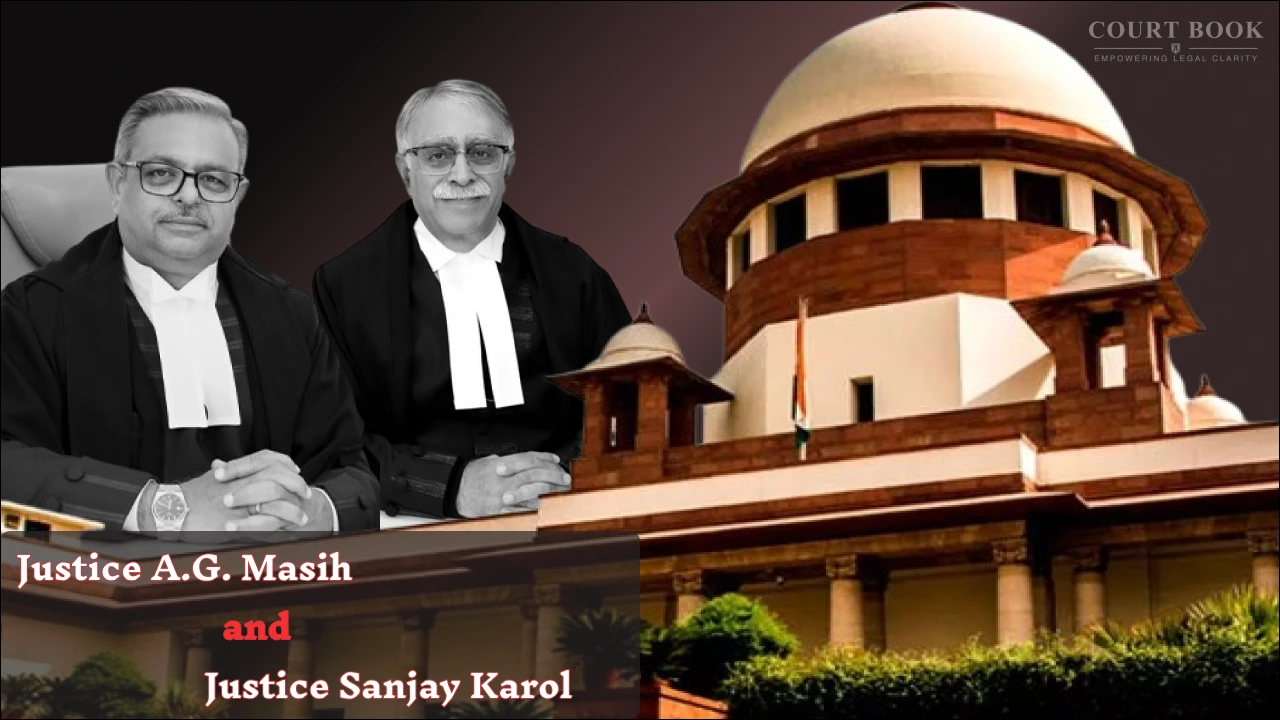
A Bench of Justice Sanjay Karol and Justice Augustine George Masih delivered the judgment on August 20, 2026, setting aside the Madhya Pradesh High Court's decision that had reversed his acquittal and convicted him under Sections 302 and 201 of the Indian Penal Code.
Background Of The Case
The prosecution case arose from an incident in September 1989. Sushma had left with her two sons and the appellant for a trip from Kanpur towards Khajuraho. She had been living separately from the appellant with her children.
On September 26, 1989, a four-and-a-half-year-old boy was found injured near Bhero Ghat. He was taken to the police and later received medical treatment. The bodies of a woman and a male child were subsequently recovered from the area.
The prosecution later relied substantially on the statement of the surviving child, who allegedly claimed to have witnessed his mother and brother being killed by the appellant. The appellant was arrested in March 1990, following which clothes and a bottle were allegedly recovered from the spot at his instance.
The trial court acquitted the appellant in December 1993, finding the child's evidence unreliable and noting the absence of sufficient corroboration. However, the Madhya Pradesh High Court reversed the acquittal in 2012 and sentenced him to life imprisonment under Section 302 IPC and two years' rigorous imprisonment under Section 201 IPC.
Supreme Court Examines Child Witness Evidence
The Supreme Court found that the High Court had not properly applied the heightened protection available to an accused whose acquittal is being challenged.
The Bench noted that an appellate court dealing with an acquittal must keep in mind the "double presumption of innocence" in favour of the accused. It said interference is justified only when the trial court's view is one that no reasonable court could have taken on the evidence.
The Court also examined the reliability of the child witness. The child was around four-and-a-half years old when the incident occurred, while his evidence was recorded four years later. The record also contained his statement that he had been tutored before appearing in court.
The Bench observed:“The Trial Court’s insistence on independent corroboration of the child witness’s account, given the specific and serious doubts as to tutoring... cannot be said to be an unreasonable or impermissible approach.”
Missing Links In Prosecution Evidence
The Court found several gaps in the prosecution case. There was no medical or scientific evidence connecting the appellant to the alleged crime. The bodies were considerably decomposed when examined, making it impossible for the doctors to give a definite opinion about the cause of death. The blood-stained soil examination was also inconclusive.
The alleged recovery of clothes and a bottle was also found doubtful. Independent witnesses associated with the confession and recovery had turned hostile. The Court further noted circumstances surrounding the recovery that raised doubts about whether the articles could have remained at the stated location for several months.
The prosecution also failed to establish reliable last-seen evidence or motive. Witnesses did not confirm that the appellant was the person who left with Sushma and the children, while one witness specifically stated that the person sitting in the car was not the appellant.
Delay In FIR Also Considered
The Supreme Court additionally took note of the unexplained delay in registering the FIR. The surviving child had reached the police station on September 26, and the prosecution claimed that the appellant's identity was disclosed by September 29. Yet, the FIR was registered only on October 1.
The Court said this delay, in the circumstances of the case, weakened the prosecution version and raised the possibility of embellishment during the investigation.
Decision
The Supreme Court held that the prosecution had failed to produce cogent evidence establishing guilt beyond reasonable doubt. It reiterated that suspicion, however strong, cannot replace proof and that a conviction based on circumstantial evidence requires a complete chain of circumstances.
The Court accordingly allowed the appeal, set aside the Madhya Pradesh High Court's October 9, 2012 judgment, and acquitted the appellant of the charges.
His bail bonds were also discharged.
Case Details
Case Title: Ravi Kumar Singh Malhotra v. The State of Madhya Pradesh
Case Number: Criminal Appeal No. 937 of 2014
Judges: Justice Sanjay Karol and Justice Augustine George Masih
Decision Date: August 20, 2026


