

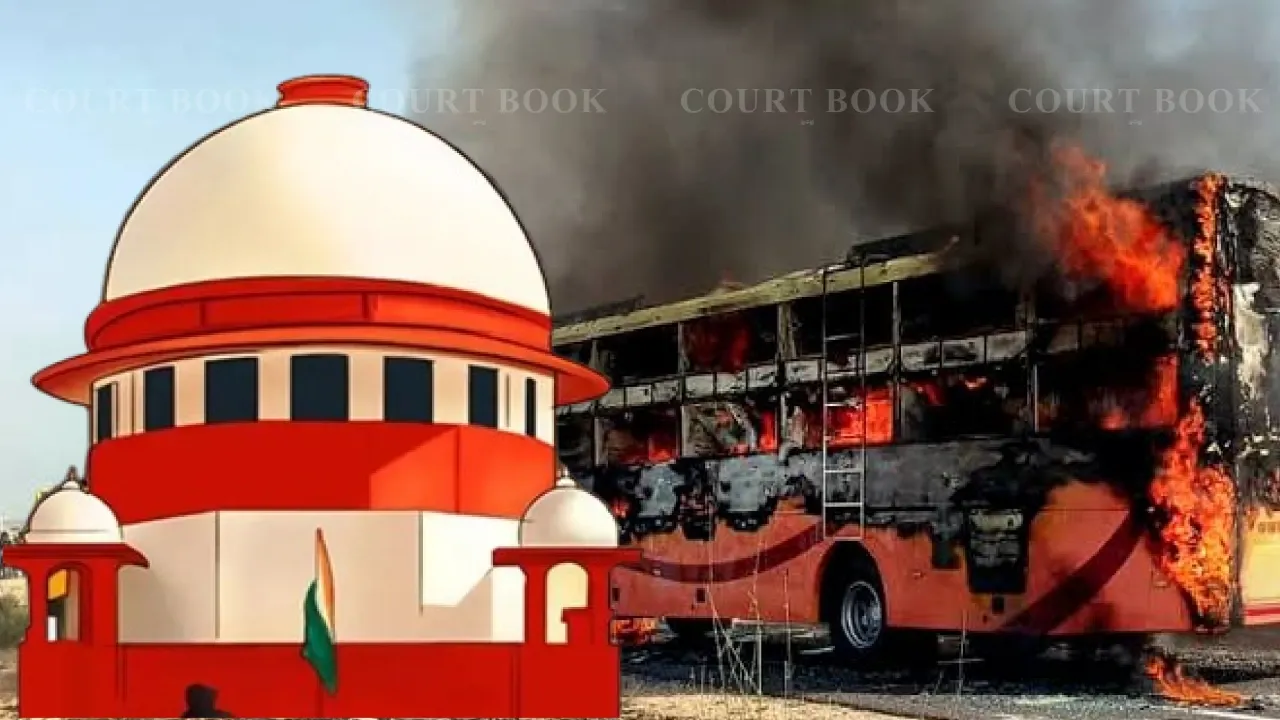
Nearly three decades after the 1996 Samleti bus blast in Rajasthan, the Supreme Court has delivered a significant judgment that reshapes the course of the long-running criminal case. While setting aside the conviction of Dr. Abdul Hameed and directing a fresh trial, the Court also acquitted co-accused Pappu @ Salim, holding that his conviction could not be sustained. At the same time, the Court refused to interfere with the acquittal of six other accused persons challenged by the State.
Background of the Case
The case arose from the bomb blast that occurred on 22 May 1996 inside a Rajasthan Roadways bus near Samleti village in Dausa district. The explosion claimed the lives of 14 passengers and injured several others. Following an extensive investigation spanning multiple years, several persons were prosecuted on allegations relating to the blast and the alleged conspiracy behind it.
The trial court convicted Dr. Abdul Hameed and others in 2014. His conviction and sentence, including the death penalty, were later affirmed by the Rajasthan High Court. Pappu @ Salim was separately convicted in connected proceedings.
Court's Observations
A three-judge Bench of Justice Vikram Nath, Justice Sanjay Karol and Justice Sandeep Mehta examined whether the trial against Dr. Abdul Hameed satisfied the constitutional requirement of a fair trial.
The Bench found that the proceedings suffered from a serious defect because the accused did not receive effective legal representation during crucial stages of the trial. The Court stressed that the right to meaningful legal assistance is an essential part of a fair criminal trial and cannot be treated as a mere procedural formality.
The judgment observed:
“The constitutional guarantee of a fair trial occupies a position of paramount importance in our legal system.”
The Court further noted that even in cases involving grave allegations, courts must ensure that criminal trials strictly follow constitutional safeguards and due process before determining guilt.
Because of this fundamental defect, the Supreme Court held that the conviction against Dr. Abdul Hameed could not be allowed to stand.
Fresh Trial Ordered
Instead of acquitting Dr. Abdul Hameed, the Supreme Court directed that he face a de novo (fresh) trial before a specially designated court in Jaipur.
The Bench directed the Rajasthan High Court to designate a Special Court presided over by an experienced judicial officer. The trial will begin afresh from the stage of prosecution evidence, with all prosecution witnesses to be summoned again. The Court also directed that Dr. Abdul Hameed must receive competent legal representation and adequate opportunity to cross-examine witnesses.
“The Special Court shall proceed with the case… uninfluenced by any observations contained in the judgments of the trial Court, the High Court or in the present judgment on the merits of the prosecution case,” the Bench directed.
The Court further clarified that Dr. Abdul Hameed will remain in judicial custody during the fresh trial, though he is free to apply for bail before the Special Court, which will decide the application independently in accordance with law.
Court's Decision
Allowing Pappu @ Salim's appeal, the Supreme Court set aside his conviction and acquitted him of all charges. It directed that he be released immediately if he was not required in any other case. As a result, the State's appeal against the High Court's order granting him permanent parole was declared infructuous and dismissed.
The Court also dismissed the State of Rajasthan's appeals challenging the acquittal of Javed Khan, Abdul Goni, Lateef Ahmad Baja, Mohammad Ali Bhatt, Mirza Nisar Hussain and Raees Baeg, leaving those acquittals undisturbed.
Finally, it clarified that its observations regarding Dr. Abdul Hameed relate only to the fairness of his earlier trial and should not influence the fresh proceedings before the Special Court.
Case Details
Case Title: Dr. Abdul Hameed v. State of Rajasthan (Connected Appeals)
Case Number: Criminal Appeal Nos. 1827–1829 of 2019 & Connected Matters
Judge: Justice Vikram Nath, Justice Sanjay Karol & Justice Sandeep Mehta
Decision Date: 21 July 2026


