

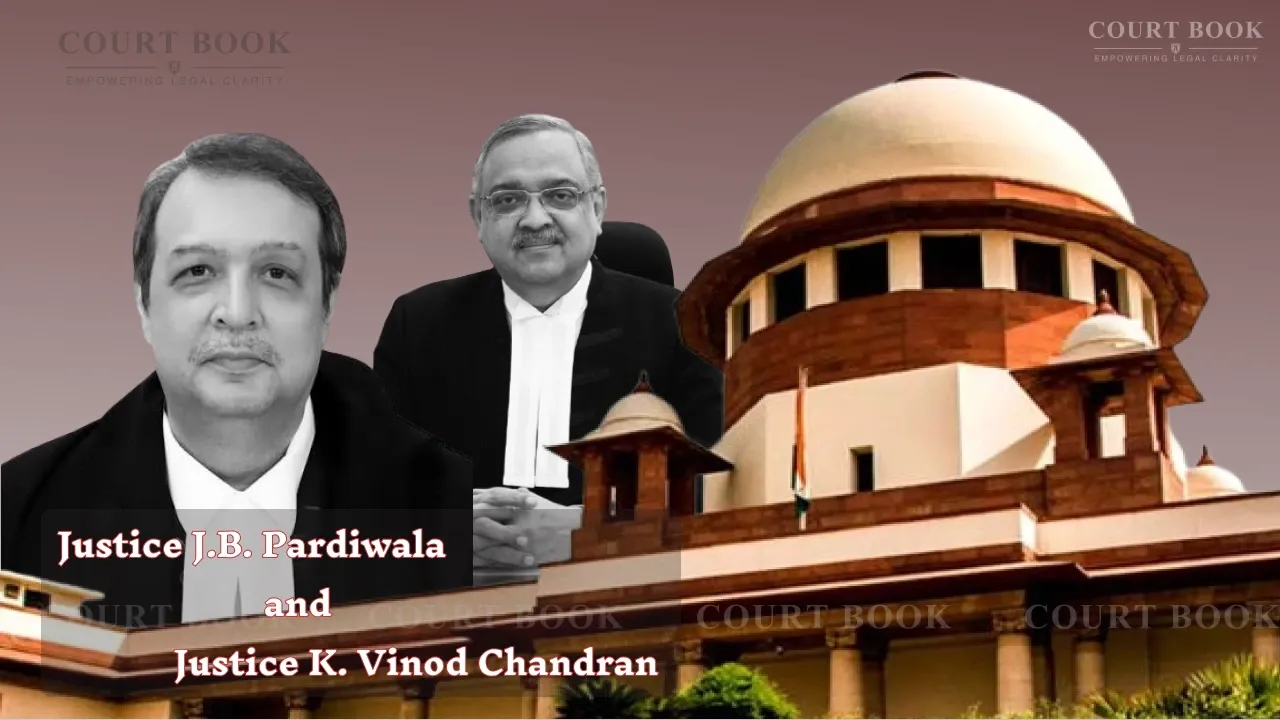
The Supreme Court has acquitted two men who were convicted of murdering their friend after finding that the prosecution evidence did not establish that the death was homicidal. The Bench of Justice J.B. Pardiwala and Justice K. Vinod Chandran held that the medical evidence and surrounding circumstances pointed more towards accidental drowning than a premeditated murder.
The judgment was delivered on August 13, 2026, in Criminal Appeal No. 76 of 2020, arising from the conviction of the accused under several provisions of the Indian Penal Code.
Background of the Case
The deceased had left his home with the two accused on July 17, 2006, reportedly to go to Ankleshwar to play volleyball. He did not return that evening. His clothes and belongings were later found near a river, and his body was recovered the following morning.
The post-mortem examination recorded the cause of death as cardio-respiratory arrest due to asphyxia caused by drowning. Three injuries were found on the body, but the doctor stated that they could have been caused by contact with hard objects while bathing or while the body was being carried by the river current.
The Trial Court convicted the accused for murder, conspiracy and causing disappearance of evidence. The High Court later upheld the conviction.
Supreme Court Examines Evidence
The Supreme Court closely examined the medical evidence and rejected the prosecution's suggestion that the deceased had been struck with a broken soda bottle before being drowned.
The Bench noted that no broken bottle or blood-stained glass fragments were seized from the scene or sent for forensic examination. It further observed that the post-mortem evidence did not establish that the deceased had been rendered unconscious and deliberately drowned.
The Court also found significance in the four-month delay before the FIR was registered. According to the judgment, no allegation of murder was initially made even after the body was recovered and the accused had spoken about the drowning.
Court's Observation on Circumstantial Evidence
The Bench found that the alleged motive was not convincing. The evidence showed that the deceased's family had allowed him to leave with the accused, which, according to the Court, indicated that the relationship between them was friendly at the relevant time.
The Court also rejected the reliance placed on the accused's conduct after the incident. It observed that their failure to immediately inform the family and their decision to go to a movie could not, by themselves, establish murder.
The Bench remarked that the subsequent conduct relied upon by the High Court could not displace the more plausible hypothesis of accidental drowning.
Decision
The Supreme Court concluded that the circumstances relied upon by the prosecution had not been established sufficiently to sustain the murder conviction. It held that the evidence supported the possibility that the deceased accidentally drowned and that the accused fled in panic rather than carrying out a premeditated killing.
The Court therefore reversed the Trial Court and High Court orders and acquitted both accused. It directed that they be released forthwith if not required in any other case, while bail bonds, if applicable, were ordered to stand cancelled.
The appeal was accordingly allowed.
Case Details:
- Case Title: Taher Vajiyuddin Rangwala & Anr. v. The State of Gujarat
- Case Number: Criminal Appeal No. 76 of 2020
- Judge: Justice J.B. Pardiwala and Justice K. Vinod Chandran
- Decision Date: August 13, 2026


