

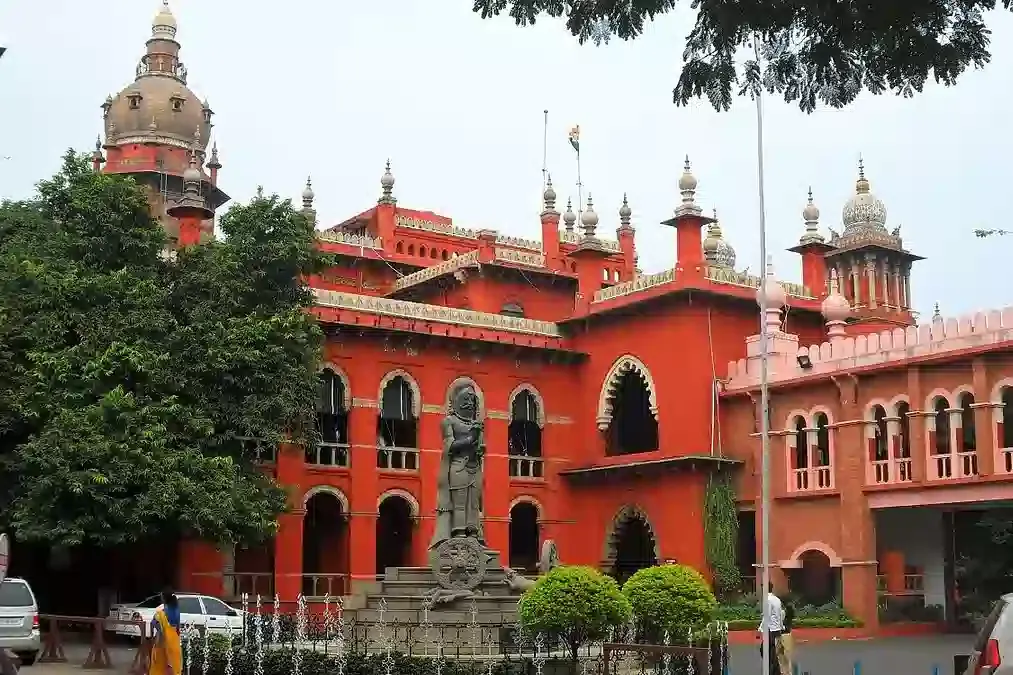
The Madras High Court has ruled that a writ petition under Article 226 of the Constitution cannot be used to recover disputed professional fees arising out of an advocate-client relationship. Dismissing an appeal filed by advocate Sunit Kumar Agarwal, the Division Bench held that where liability is disputed and factual issues require evidence, the appropriate remedy lies before a competent civil court, not in writ jurisdiction.
Background of the Case
The appeal challenged an order of a Single Judge dismissing a writ petition seeking payment of outstanding professional fees from Punjab National Bank. The appellant, a former empanelled advocate of the bank, claimed that his unpaid legal fees and expenses initially amounted to ₹6.80 lakh and later increased to over ₹10 lakh after additional bills were identified during the appeal proceedings.
Appearing in person, the advocate argued that the dues were genuine and that he had rendered legal services to the satisfaction of the bank. He also alleged that the delay in payment was linked to demands for illegal commission by certain bank officials. On the other hand, the bank maintained that while some undisputed bills had already been settled, the remaining claims were contested because of alleged deficiencies in the services rendered.
Court's Observation
After considering the rival submissions, the Division Bench observed that the central issue was whether a writ court should decide claims for professional fees arising from a contractual relationship when the underlying facts are disputed.
The Bench observed,
“A writ is an extraordinary public law remedy. It is designed to correct glaring constitutional overreaches, failures of public duty, and arbitrary abuses of State power. It is not intended to serve as an alternate recovery mechanism for commercial or professional contracts.”
The judges further noted that a writ court may interfere in contractual matters only where there is an unequivocal admission of liability along with clear arbitrariness by a public authority. In the present case, however, the bank had disputed the claims and questioned the quality of services rendered, while the appellant had made allegations of corruption against bank officials. Such disputed questions of fact, the court said, require evidence and cannot be resolved in writ proceedings.
Decision
Finding no error in the Single Judge's reasoning, the Division Bench dismissed the writ appeal and affirmed the earlier order. However, it granted liberty to the appellant to pursue his claim before a competent civil court or any other appropriate forum.
The court also directed that the time spent pursuing the writ proceedings would be excluded while computing limitation if a civil suit is filed.
No order was passed as to costs.
Case Details
Case Title: Sunit Kumar Agarwal v. Punjab National Bank & Others
Case Number: W.A. No. 1750 of 2024
Judges: Chief Justice Sushrut Arvind Dharmadhikari and Justice G. Arul Murugan
Decision Date: 14 July 2026


