

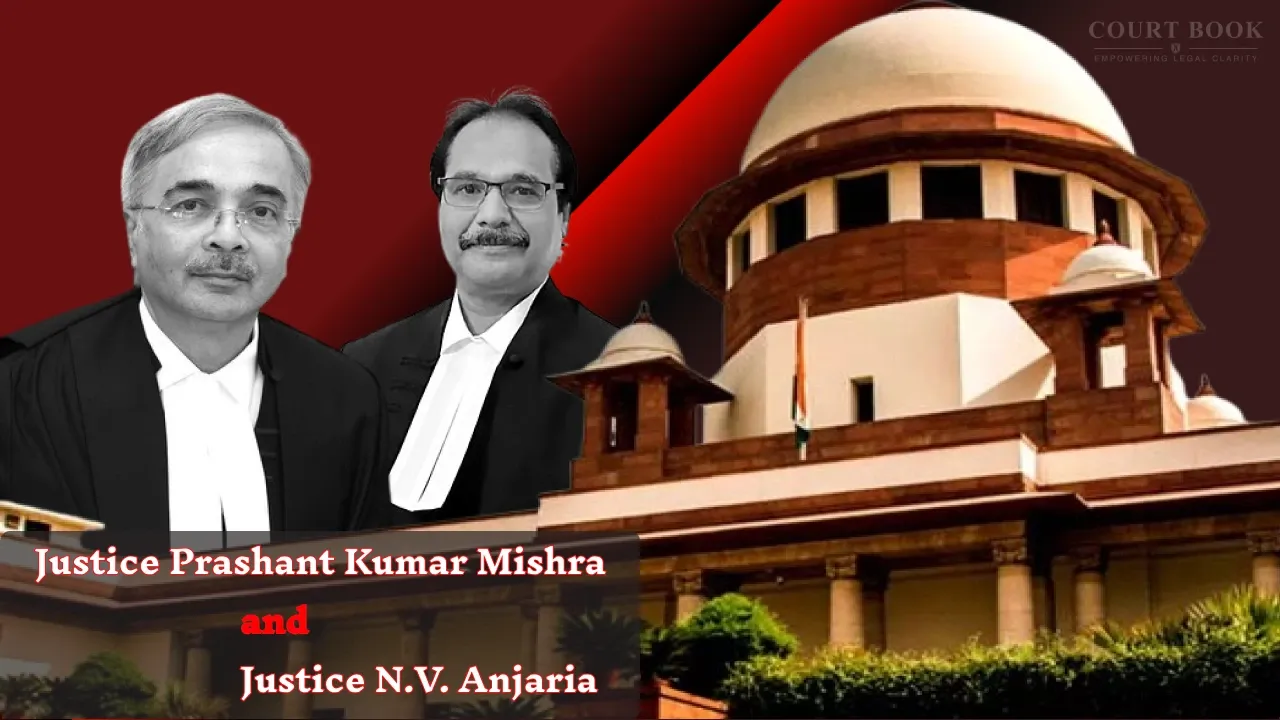
The Supreme Court has held that merely signing an agreement to sell between a landlord and tenant does not, by itself, bring the existing tenancy to an end. The Court said that the tenancy can cease only when the agreement or the conduct of the parties clearly establishes an express or implied surrender of the tenancy rights.
A Bench comprising Justice Prashant Kumar Mishra and Justice N.V. Anjaria delivered the judgment on August 13, 2026, while dismissing a challenge to concurrent orders directing the tenant to vacate the premises.
Background of the Case
The dispute concerned a 200 sq. ft. shop in Kondhwa Khurd, Pune. The premises had been let to the petitioner at a monthly rent of Rs.1,500. During the subsistence of the tenancy, the landlord agreed to sell the shop to him for Rs.1.90 lakh.
An agreement to sell was executed on September 21, 2004. The petitioner paid Rs.40,000, while the balance Rs.1.50 lakh was to be paid within three months. The proposed sale, however, did not materialise.
The landlord later instituted a suit for possession, citing rent default, change in use of the premises and bona fide requirement. The tenant argued that the landlord-tenant relationship had ended once the agreement to sell was executed.
The Small Causes Court rejected that contention and directed the tenant to hand over possession. The First Appellate Court upheld the decision in November 2023, followed by the Bombay High Court, which dismissed the tenant's revision petition on April 1, 2026.
Supreme Court's Observation
The Supreme Court examined whether the execution of the agreement to sell had resulted in the determination of the tenancy under Section 111 of the Transfer of Property Act, 1882.
The Court distinguished an earlier decision in R. Kanthimathi v. Beatrice Xavier, noting that the agreement in that case contained specific language showing that possession had been surrendered pursuant to the sale arrangement and a substantial portion of the consideration had already been paid.
In the present case, however, the agreement contained no such indication. The Court noted that it neither stated that possession would thereafter be held under the agreement to sell nor provided for cessation of rent or alteration of the landlord-tenant relationship.
The Bench observed that “the mere execution of the agreement to sell” coupled with payment of Rs.40,000 out of Rs.1.90 lakh could not be treated as determining the tenancy.
The Court also placed importance on Clause 4 of the agreement. It provided that if the proposed loan was not sanctioned, the agreement would stand cancelled and possession would have to be handed back in its previous condition. According to the Court, this provision was consistent with the continuation of the existing tenancy rather than its replacement by a purchaser-seller relationship.
Section 53A Protection Also Rejected
The tenant also relied on Section 53A of the Transfer of Property Act, which can provide limited protection to a person in possession under part performance of a contract for transfer.
The Supreme Court held that the tenant had originally entered the premises as a tenant and had neither established that this possession had ended nor shown that his subsequent possession began under the agreement to sell.
Further, the agreement was executed in 2004 but remained unregistered. Under Section 17(1A) of the Registration Act, documents executed after the relevant amendment for claiming protection under Section 53A must be registered. The Court therefore held that the unregistered agreement could not provide such protection.
Decision
The Supreme Court found no reason to interfere with the concurrent findings of the courts below. It held that the agreement to sell had not ended the tenancy and that the petitioner could not claim protection under Section 53A.
Accordingly, the Bench dismissed the Special Leave Petition.
Case Details
Case Title: Nazim Shaikh Hasan v. Nasir Mushtaq Shaikh & Others
Case Number: SLP (C) No. 17699 of 2026
Judges: Justice Prashant Kumar Mishra and Justice N.V. Anjaria
Decision Date: August 13, 2026


