

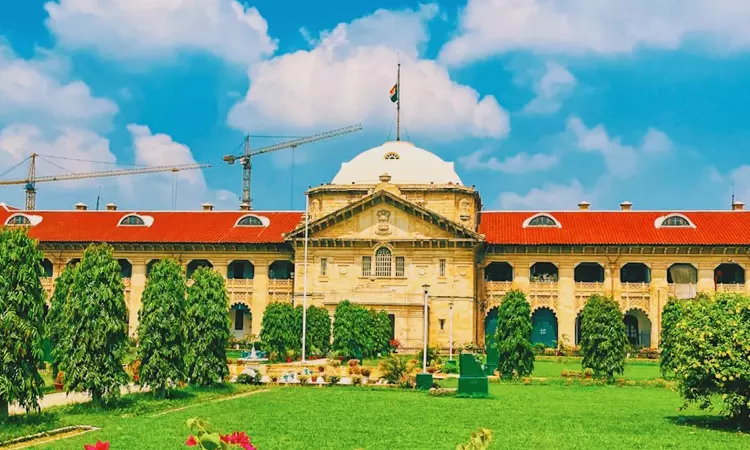
The Allahabad High Court has urged the Uttar Pradesh Government to institutionalize the scientific study of crowd behaviour, observing that religious gatherings cannot be managed solely through policing and traffic control. While deciding a petition filed by Swami Shiv Swarupanand Ji Maharaj, the Court also granted liberty to the petitioner to pursue his grievance afresh before the Mathura Vrindavan Development Authority (MVDA) and kept the earlier appellate order in abeyance pending reconsideration.
Background of the Case
The writ petition challenged an order dated September 4, 2025, passed by the Commissioner, Agra Division, rejecting the petitioner's appeal against demolition proceedings initiated by the Mathura Vrindavan Development Authority.
According to the record, the petitioner claimed ownership of a parcel of land in Vrindavan where permission had been sought for constructing an ashram. The development authority refused approval, stating that the land fell within a flood-affected area where permanent construction was not permissible. Despite this, construction was carried out, following which demolition proceedings were initiated under the Uttar Pradesh Urban Planning and Development Act, 1973. The petitioner's statutory appeal was later dismissed after authorities found that the construction had not been raised according to an approved building plan.
The petitioner further alleged discriminatory enforcement, arguing that demolition orders had been passed against 23 properties but action had been selectively taken against only a few, including the petitioner.
Court Expanded the Scope Beyond the Individual Dispute
Justice Vinod Diwakar observed that the matter raised issues extending beyond unauthorized construction. The Court therefore expanded the proceedings to examine whether authorities in Mathura possessed a scientifically designed crowd and crisis management framework, particularly in view of previous crowd crush incidents in the city and the growing number of pilgrims visiting religious sites.
The Court directed affidavits from the District Magistrate, Superintendent of Police, Municipal Commissioner, MVDA and other authorities detailing crowd management strategies, research, institutional preparedness and action against unauthorized constructions.
Court Observations
After examining the affidavits, the Court noted that authorities had implemented several administrative measures, including traffic diversion plans, CCTV surveillance, separate entry and exit routes, online darshan registration, road widening projects and parking facilities.
However, the Court found that these measures largely focused on traffic regulation rather than understanding how crowds actually behave.
Observing the need for a different approach, the bench said:
“The prevention of crowd crush disasters... cannot be achieved through the deployment of additional police personnel, the installation of more barricades, or the issuance of more standard operating procedures drafted in ignorance of the science of crowd behaviour.”
The Court further remarked that religious gatherings differ significantly from political rallies or sporting events and therefore require specialized planning based on behavioural science rather than conventional policing.
Justice Diwakar also expressed concern that despite India's experience in managing some of the world's largest religious congregations, structured academic study of crowd behaviour remains absent in higher education institutions across Uttar Pradesh.
Recommendations to the State Government
The judgment contains a series of recommendations aimed at improving public safety during large religious gatherings.
The Court recommended introducing crowd behaviour and crowd management as dedicated academic disciplines in universities, establishing a Centre of Excellence for Crowd Science, encouraging collaboration with institutions such as IIT Kanpur and IIT Roorkee, and integrating crowd safety principles into urban planning and development regulations. It also suggested examining the feasibility of creating a statutory urban design commission for Uttar Pradesh.
The Court emphasized that these recommendations arise from the State's constitutional obligation to protect life under Article 21 of the Constitution.
Decision
Disposing of the writ petition, the Allahabad High Court permitted the petitioner to approach the Mathura Vrindavan Development Authority afresh. The Court directed the authority to reconsider the petitioner's grievance in accordance with State Government circulars issued following directions of the Supreme Court concerning demolition proceedings.
Pending such reconsideration, the Court ordered that the Commissioner's order dated September 4, 2025, shall remain in abeyance. It also directed the Registrar (Compliance) to forward a copy of the judgment to the Chief Secretary, the University Grants Commission and the concerned education authorities for future reference.
Case Details
Case Title: Swami Shiv Swarupanand Ji Maharaj v. State of U.P. & 3 Others
Case Number: Writ – C No. 41777 of 2025
Judge: Justice Vinod Diwakar
Decision Date: July 22, 2026


