

The Supreme Court has quashed a criminal case arising from a commercial dispute over the supply of camphor, holding that a contractual disagreement cannot be converted into a criminal prosecution unless the allegations disclose the essential ingredients of the alleged offences.
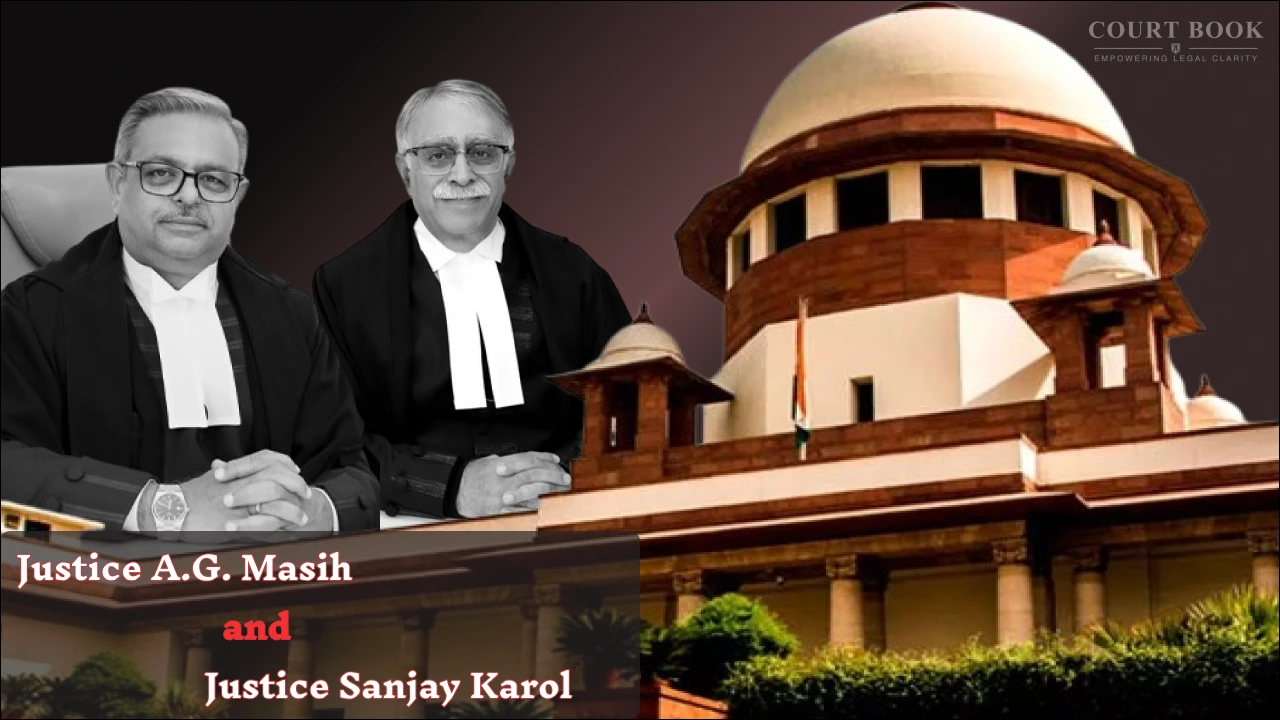
A Bench of Justice Sanjay Karol and Justice Augustine George Masih delivered the judgment on August 12, 2026, setting aside the Jharkhand High Court's order that had refused to interfere with the FIR registered at Ranchi Kotwali Police Station.
Background of the Case
The case arose from an FIR registered as Kotwali P.S. Case No. 323 of 2024 under Sections 316(2), 318(4) and 3(5) of the Bharatiya Nyaya Sanhita, 2023.
The dispute concerned a distributorship arrangement for 'Saraswati' camphor in Jharkhand. According to the FIR, the informant was offered the distributorship for three years and paid substantial amounts as advance. Six payments totalling Rs. 73 lakh were allegedly made between April and June 2024.
Goods worth Rs. 31,49,167 were supplied under four bills. The informant alleged that supplies were subsequently stopped and that Rs. 41,50,833 remained unpaid.
The appellants argued before the Supreme Court that the allegations, even if accepted as stated, essentially disclosed a dispute concerning price, supply and accounts under a written commercial agreement.
Supreme Court Examines Ingredients of Cheating
The Supreme Court focused on whether the FIR actually contained facts necessary to constitute cheating under Section 318(4) of the BNS.
The Court noted that cheating requires dishonest or fraudulent intention at the beginning of the transaction. Referring to its earlier decisions, the Bench observed that “mere breach of contract cannot give rise to a criminal prosecution for cheating” unless dishonest intention existed from the outset.
The Bench found that the FIR did not allege that the distributorship was offered without any intention to provide it. Nor did it state that the appellants knew at the time of entering the agreement or receiving payments that they would not supply the goods.
“The word ‘cheated’ and the expression ‘I got deceived’,” the Court noted, were conclusions without the supporting facts needed to establish deception.
Contractual Dispute Could Not Be Given Criminal Colour
The Court also considered the fact that the agreement had actually been executed, the distributorship was conferred and goods worth more than Rs. 31 lakh were supplied.
According to the Bench, these circumstances did not conclusively rule out cheating, but the FIR contained no factual allegation showing dishonest intention at the beginning. The Court therefore held that treating an initial fraudulent intention as existing in such circumstances would amount to speculation rather than an allegation supported by facts.
The termination of the distributorship also did not, by itself, establish cheating. The Court observed that if termination of a contract was wrongful, the affected party could seek damages, but criminal liability would require allegations showing that the termination resulted from a plan formed from the outset.
Criminal Breach of Trust Allegation Also Failed
The Supreme Court separately examined Section 316(2) of the BNS, concerning criminal breach of trust.
The Bench explained that this offence requires “entrustment”, meaning property must be handed over to another to be held or dealt with for the benefit of the person who entrusted it.
The Court held that money paid to a supplier as the price of goods or as an advance under a contract ordinarily becomes the supplier's money. If the supplier later fails to deliver the goods, that may amount to a contractual breach, but it does not by itself establish criminal breach of trust.
Supreme Court's Decision
The Court found that the FIR did not disclose the essential ingredients of either cheating under Section 318(4) or criminal breach of trust under Section 316(2) of the BNS.
The Bench held that allowing the criminal proceedings to continue would amount to using the criminal process for a dispute arising from a written commercial contract.
It accordingly allowed both appeals, set aside the Jharkhand High Court's February 19, 2025 order and quashed Kotwali P.S. Case No. 323 of 2024, along with all proceedings arising from it.
The Court clarified that its judgment would not affect the merits of any civil, arbitral or other proceedings between the parties.
Case Details
Case Title: Parag Kishore Satoskar & Ors. v. State of Jharkhand & Anr.
Case Number: Criminal Appeal No. of 2026, arising out of SLP (Crl.) Nos. 3933 of 2025 and 3996 of 2025.
Judge: Justice Sanjay Karol and Justice Augustine George Masih.
Decision Date: August 12, 2026.


