

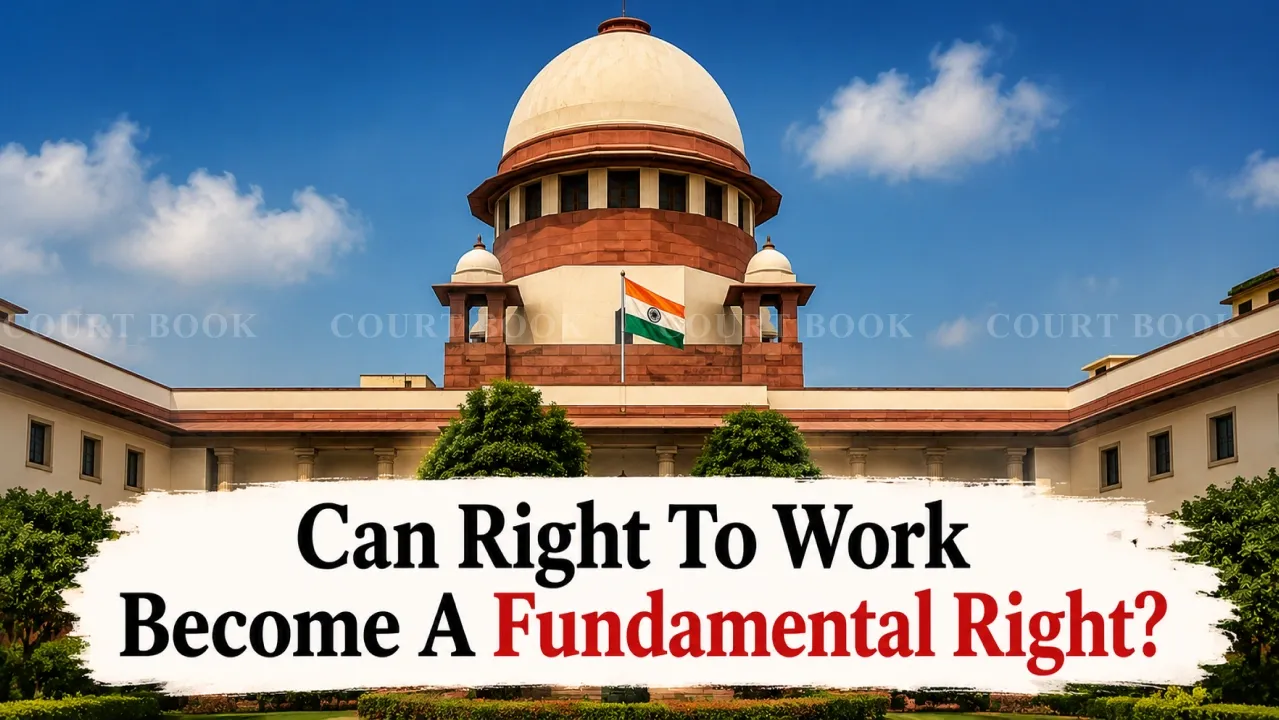
The Supreme Court on Friday, August, 21, 2026, examined an important constitutional question concerning the status of employment guarantees for rural workers, asking whether a statutory employment scheme can be placed on the same footing as the fundamental right to life and dignity under Article 21.
A Bench comprising Chief Justice of India Surya Kant and Justices Joymalya Bagchi and V. Mohana was hearing a plea concerning minimum wages and compensation for delayed payment of wages under the rural employment guarantee framework.
Court Examines Constitutional Status Of Right To Work
Justice Joymalya Bagchi observed that the Constitution does not expressly recognise the right to work as a fundamental right. Instead, the right to work finds place among the Directive Principles of State Policy, which guide the State in framing welfare measures but are generally not directly enforceable in court.
“The Constitution does not make the right to work a fundamental right. In fact, it is only a democratic aspiration under Part IV. To achieve that aspiration, the State formulates a policy where work is provided at a graded compensatory level. Should we create it on a par with Article 21?”
Justice Bagchi also questioned the consequences if the right to work under a statutory scheme were treated as equivalent to a fundamental right and welfare measures were subsequently reduced.
Minimum Wages Issue Also Before Court
Advocate Prashant Bhushan argued that workers under the new Viksit Bharat–Guarantee for Rozgar and Ajeevika Mission (Gramin) framework should continue to receive applicable State-notified minimum wages. He also relied on earlier Supreme Court decisions concerning payment below minimum wages.
Chief Justice Surya Kant, however, pointed to the practical impact of imposing a higher wage threshold on a fixed employment budget.
“Put minimum wages as a threshold and employment shrinks. You realise the difficulty. When a wage threshold is put, the net of employment shrinks because the size of the pie remains the same.”
The Bench also noted that the applicability of minimum-wage legislation would depend upon the nature of work undertaken under the employment scheme.
Court Directs Fresh Petition Under New Law
The Court observed that the earlier proceedings had been overtaken by the new statutory framework replacing MGNREGA. It said fresh material and implementation details would be necessary to examine the issues under the new law.
Bhushan ultimately agreed to file a fresh petition covering minimum wages as well as compensation for delayed payment under the new framework.
The Supreme Court accordingly directed that the issues be raised through a fresh petition.


