

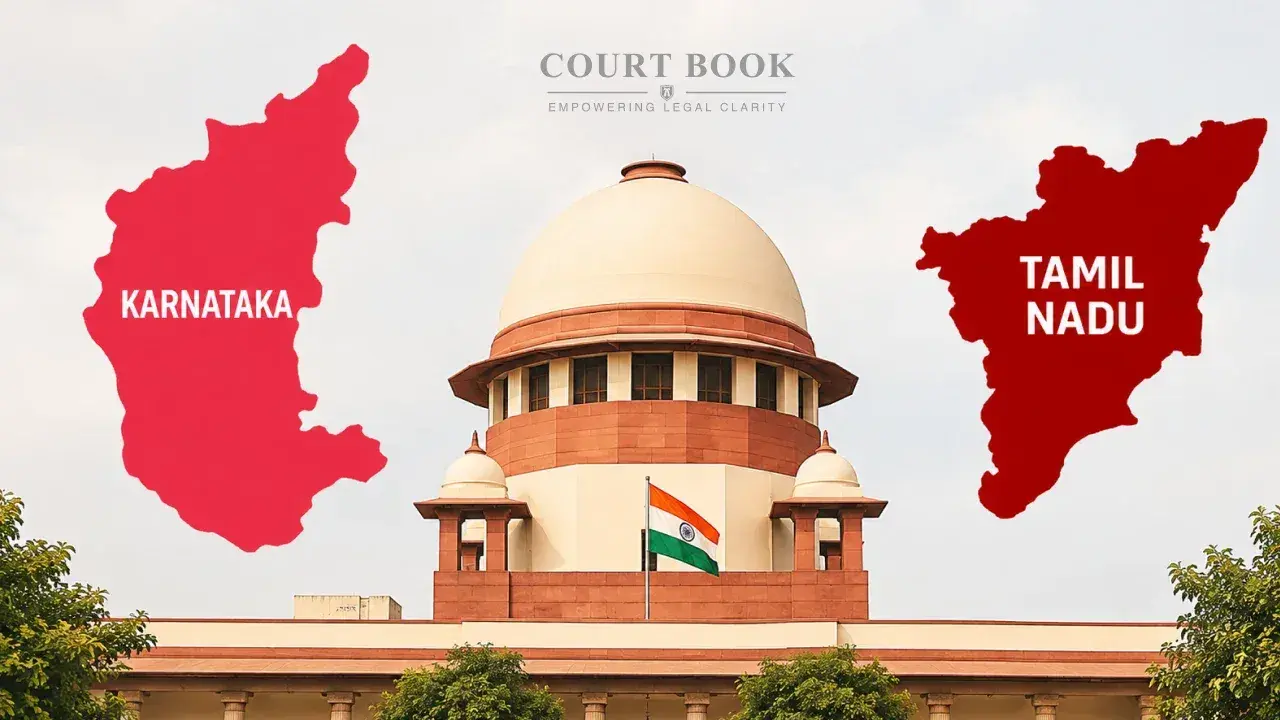
The Supreme Court has dismissed applications filed by Tamil Nadu seeking directions to Karnataka for the release of additional Cauvery river water, holding that the ongoing dispute over water releases and alleged shortfalls should be examined by the authorities specifically constituted to monitor the river-sharing arrangement.
The Court observed that the Cauvery Water Management Authority (CWMA) and the Cauvery Water Regulation Committee (CWRC) were already dealing with the issue and were responsible for monitoring compliance with the water-sharing framework.
Background
Tamil Nadu approached the Supreme Court through multiple applications in the long-running Cauvery water dispute, seeking directions to Karnataka to release additional water and make good the alleged shortfall during the 2026–27 irrigation year.
The State relied on decisions taken by the CWMA, including directions issued in July and September 2026 requiring Karnataka to ensure specified water flows at Billigundulu, the inter-State measuring point.


Tamil Nadu alleged that the releases were insufficient to meet its share and sought directions for additional water, including the adjustment of alleged deficits on a proportionate basis.
Karnataka, however, maintained that it had complied with the directions issued by the CWMA and that the water released from its reservoirs had exceeded the quantities stipulated by the Authority.
The Court noted that the water-release schedule operates on an annual cycle from June to May and that the concerns raised by Tamil Nadu regarding its allocation were premature, particularly because the expert authorities were continuing to monitor the situation.
The Bench observed:
"The present application is misconceived, particularly when the expert body entrusted with monitoring and regulating the release of Cauvery waters is already seized of the matter."
The Court further noted that the CWRC was regularly convening meetings to review the prevailing situation, hear the concerned States and issue directions based on the circumstances at the relevant time.
While considering Tamil Nadu’s claim regarding the alleged shortfall, the Court observed that determining the deficit required an assessment of distress conditions and water flows across the entire Cauvery basin.
"The said authorities have been constituted precisely for this purpose and are entrusted with examining such issues, taking into account the prevailing hydrological conditions and the framework governing the sharing of Cauvery waters."
The Court also noted that the minutes of meetings held by the CWMA and CWRC showed that the grievances raised by Tamil Nadu had been considered by the authorities.
The Supreme Court declined to issue separate directions to Karnataka for additional water releases or for making good the alleged shortfall. It held that the matter should be left to the CWMA and CWRC to consider in accordance with law.
The applications filed by Tamil Nadu were accordingly dismissed. The Court also dismissed the miscellaneous application filed by the Dravida Munnetra Kazhagam, observing that the concerns raised by the applicant were adequately represented by Tamil Nadu and that the scope of the original Cauvery Tribunal proceedings could not be enlarged through an application filed by a party that was not part of the original proceedings.



