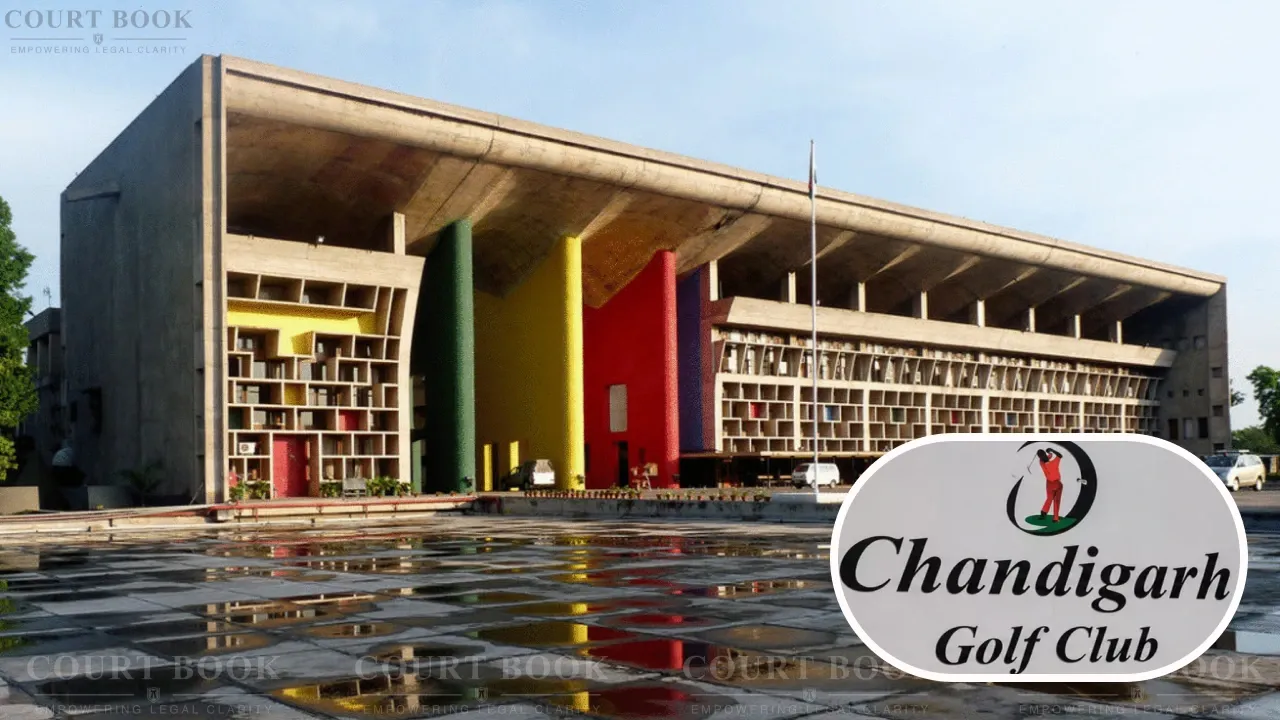
In a significant ruling on transparency and public accountability, the Punjab and Haryana High Court has held that Chandigarh Golf Club falls within the definition of a “public authority” under the Right to Information (RTI) Act and must comply with its provisions.
The court dismissed a petition filed by the Golf Club challenging a 2012 order of the Central Information Commission (CIC), which had directed the club to establish a mechanism for providing information under the RTI Act.
Background of the Case
The dispute began when the CIC concluded that Chandigarh Golf Club was substantially financed and controlled by the Chandigarh Administration. Based on this finding, the Commission declared the club a public authority under Section 2(h) of the RTI Act.
The Golf Club challenged that decision before the High Court. It argued that it is a private society run by its own managing committee and receives no direct financial assistance from the government. The club also maintained that the presence of government officers on its management committee did not amount to governmental control.
Court Examines Government Support
During the hearing, the court closely examined the nature of the club’s occupation of government land and the financial arrangements between the club and the Chandigarh Administration.
The judgment noted that the club occupies about 132 acres of prime land in Chandigarh along with buildings and facilities originally created using public funds. Despite the assessed rent running into lakhs of rupees, the club was paying only a nominal monthly amount under the lease arrangement.
The court observed that such concessional access to valuable public property amounted to substantial indirect financing.
Referring to Supreme Court precedents on the meaning of “substantially financed,” the court held that government support need not always be in the form of direct cash grants. Subsidised land and public assets can also constitute substantial financial assistance where an institution’s existence depends on them.
Findings on Government Control
The High Court also considered provisions of the lease deeds executed between the Golf Club and the Chandigarh Administration.
The court found that the Administration retained significant powers regarding the club’s functioning. These included nomination of members to the governing body with voting rights, inspection powers, conditions relating to maintenance of facilities, and the authority to intervene in matters affecting public property.
“The control of U.T. Chandigarh Administration is not merely supervisory in nature,”
the court observed while noting that the Administration exercised effective control over important aspects of the club’s affairs.
Court’s Decision
Rejecting the Golf Club’s challenge, the High Court concluded that the Chandigarh Administration both substantially finances and substantially controls the Golf Club.
The bench held that the club therefore qualifies as a “public authority” under Section 2(h)(ii) of the RTI Act. Upholding the CIC’s order, the court directed the Golf Club to put in place a mechanism for RTI compliance within one month.
With these findings, the writ petition was dismissed and the CIC’s decision was affirmed.
Case Details:
Case Title: Chandigarh Golf Club v. Central Information Commission and Another
Case Number: CWP-21967-2012
Judge: Justice Kuldeep Tiwari
Decision Date: 29 May 2026









-300x169.webp)



-300x169.webp)