

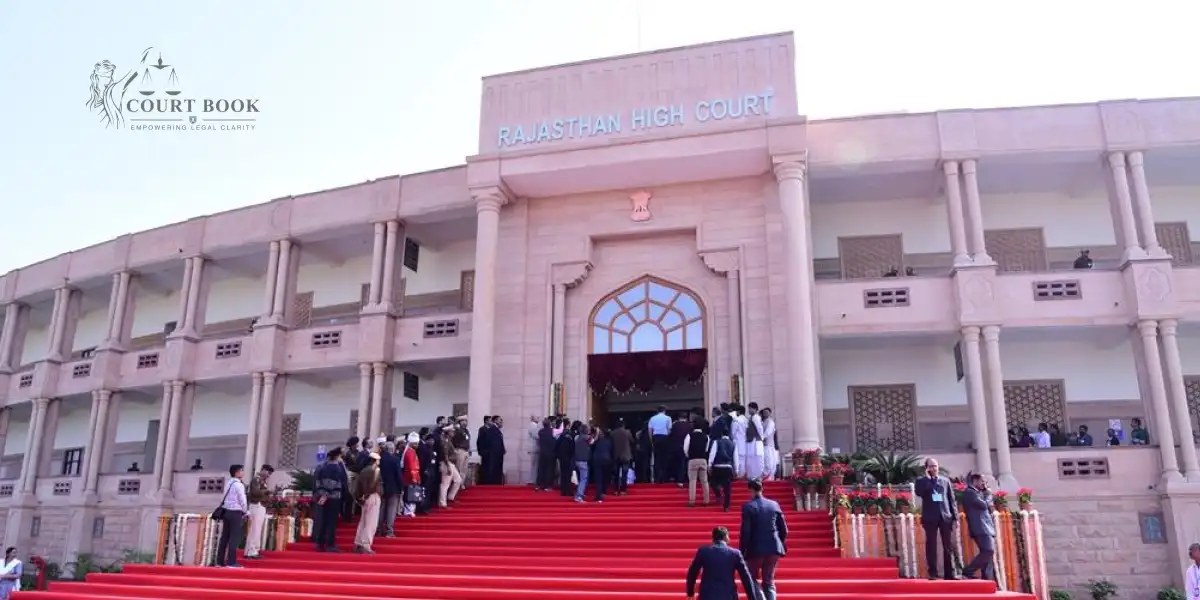
The Rajasthan High Court at Jodhpur has dismissed a criminal miscellaneous petition under Section 528 of the Bharatiya Nagarik Suraksha Sanhita, 2023, challenging the trial court’s decision to mark a subsequently produced bank return memo as an exhibit in proceedings under Section 138 of the Negotiable Instruments Act, 1881.
Justice Sunil Beniwal held that the later production of the memo, carrying the bank’s seal and authorised signature, could be treated as correction of an inadvertent error rather than an attempt to fill a lacuna in the complainant’s case.
Gulam Mohd. had approached the High Court against orders passed by the Special Judicial Magistrate, Pali, and the Sessions Court, Pali. The underlying complaint alleged that the petitioner had borrowed Rs. 3,90,000 and issued a cheque towards repayment of the amount. The cheque was returned unpaid on April 6, 2018, with the reason recorded as “Insufficient Funds”.
During the trial, the complainant initially produced an online-generated bank return memo, which was marked as Exhibit-2. The document did not contain the bank’s seal or the signature of an authorised officer.
During cross-examination, the validity of the online-generated memo was questioned on the ground that it did not bear the bank’s seal or the signature of an authorised officer. Thereafter, the complainant produced another return memo bearing the bank’s seal and authorised signature. The trial court permitted the same to be marked as Exhibit-9. The petitioner challenged that decision, arguing that the second document was introduced to cure a defect that had already emerged in the evidence.
Justice Sunil Beniwal examined whether the subsequent document amounted to an impermissible attempt to fill a lacuna. Referring to Supreme Court decisions, the High Court noted that an inadvertent mistake in presenting evidence is not necessarily the same as an inherent weakness in a party’s case. The Court found that the return memo had already been produced earlier and that the later document was produced after the validity of the first memo was questioned for want of the bank’s seal and authorised signature.
The Court observed:
“There is yet another reason for not accepting the arguments made by learned counsel for the petitioner. It is to be noted that there is difference between document being exhibited and it being admitted. The purpose of exhibiting document is only for the purpose of marking it for identification, however, whether such document would be admissible as a piece of evidence is to be decided separately after the same is put to test as per the procedure provided in the Bhartiya Sakshya Adhiniyam.”
The Court also noted that the subsequent document was not a new piece of evidence introduced to establish a previously missing fact, but related to the same cheque return transaction for which the earlier memo had already been produced. The Court therefore found that permitting the subsequent memo to be exhibited did not amount to allowing the complainant to fill a lacuna in the case.
The High Court further clarified that merely marking Exhibit-9 did not, by itself, establish the document’s authenticity or execution, or prove the truth of its contents. The petitioner would still have an opportunity to cross-examine the complainant and raise objections regarding its admissibility.
The High Court held that no substantial prejudice or failure of justice had been shown. It therefore dismissed the criminal miscellaneous petition. The Court also directed that the petitioner be permitted to cross-examine the complainant regarding the genuineness of Exhibit-9 and raise all permissible objections concerning its admissibility in accordance with law.
Case Title: Gulam Mohd. v. Gopal Traders & Anr.
Case Number: S.B. Criminal Miscellaneous (Petition) No. 4345/2026


