

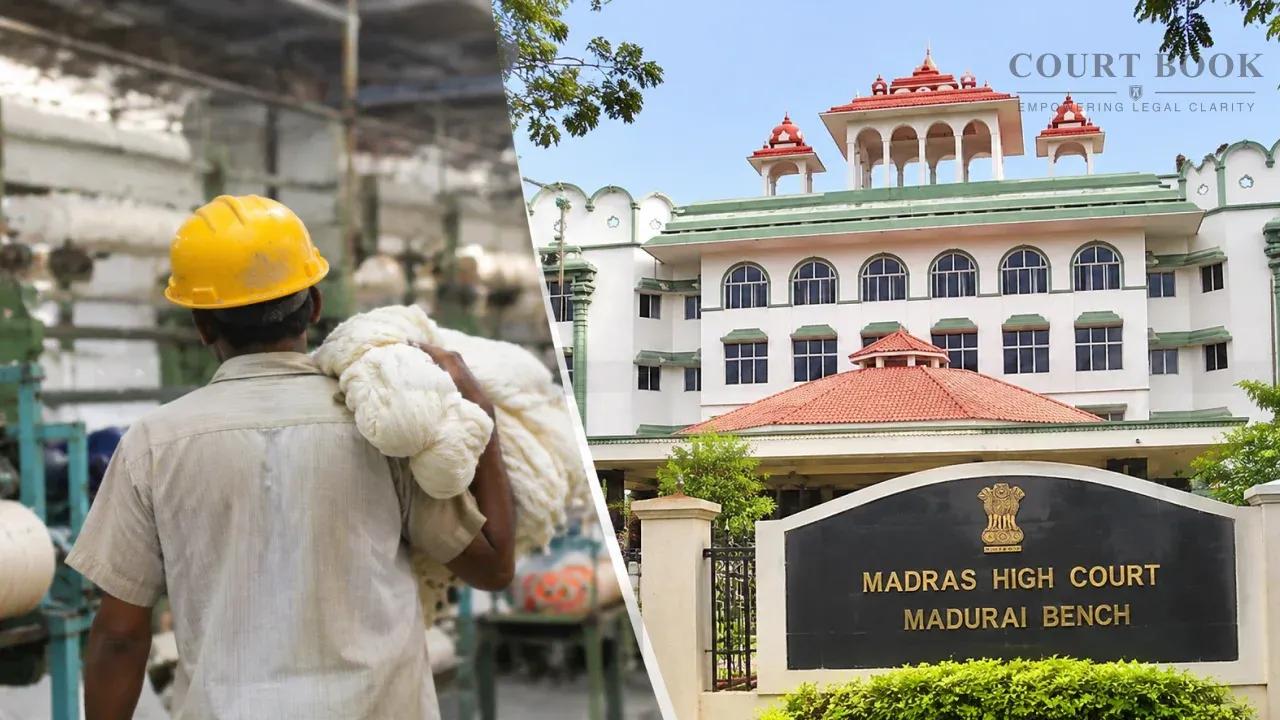
The Madurai Bench of the Madras High Court has upheld compensation payable to the family of a textile mill worker who died after reportedly suffering health complications while performing heavy work at the workplace. The Court held that death caused by work pressure or strenuous duties can fall within the meaning of an accident under Section 3(1) of the Employees’ Compensation Act, 1923, even when there is no external physical injury.
Justice Dr. P. Murugan dismissed an appeal filed by Star Health and Allied Insurance Company Limited, which had challenged the direction to pay ₹3 lakh as compensation with 12% annual interest.
Background
The case arose from the death of Kumuthavalli, who was working as a helper responsible for loading cotton at Gurukrishna Textiles Mills in Theni.
According to the claim, on November 16, 2016, at around 11 PM, she experienced health complications while carrying out her duties. She reportedly suffered from high blood pressure and fainted due to heavy work and stress. She was initially taken to a private hospital and subsequently referred to Government Medical College Hospital, Theni, where doctors declared her brought dead.


Her son, N. Pitchaimani, approached the Employee's Compensation Commissioner, seeking ₹10 lakh in compensation.
The Commissioner determined the total compensation at ₹5,32,800, directing the insurance company to pay ₹3 lakh under the group personal accident policy and the mill owner to pay the remaining ₹2,32,800, with 12% annual interest.
The insurance company challenged the award before the High Court.
The insurance company argued that the policy covered only accidents involving sudden, unforeseen events caused by external, visible and violent means. Since Kumuthavalli had fainted without suffering any external injury, the insurer contended that her death could not be treated as an accident under the policy.
The High Court rejected this argument after examining the Supreme Court's decision in Param Pal Singh v. National Insurance Company Ltd.
The Court noted that an unexpected death resulting from stress and strain connected with the nature of employment could qualify as an employment-related accident.
Observing the circumstances surrounding Kumuthavalli's death, the Court stated:
"Therefore, the workman died during the employment, out of work pressure or heavy work and it comes under section 3(1) of the Employee’s Compensation Act, thereby, the contention of the insurance company that the accident was not happened that there is an external injury cannot be a ground to reject."
The Court also examined the insurer's objection to the 12% annual interest awarded by the Commissioner. Referring to Section 4A(3) of the Act, it observed:
"In the present case, the simple interest prescribed under the enactment is 12% per annum. Therefore, the Commissioner has no power to reduce the same. Therefore, the interest remains intact."
Finding no merit in the insurance company's arguments, the High Court answered both substantial questions of law against the insurer.
Accordingly, the Court dismissed the appeal and confirmed the compensation award passed by the Commissioner of Labour for Employee's Compensation, Dindigul.
No order as to costs was passed.