

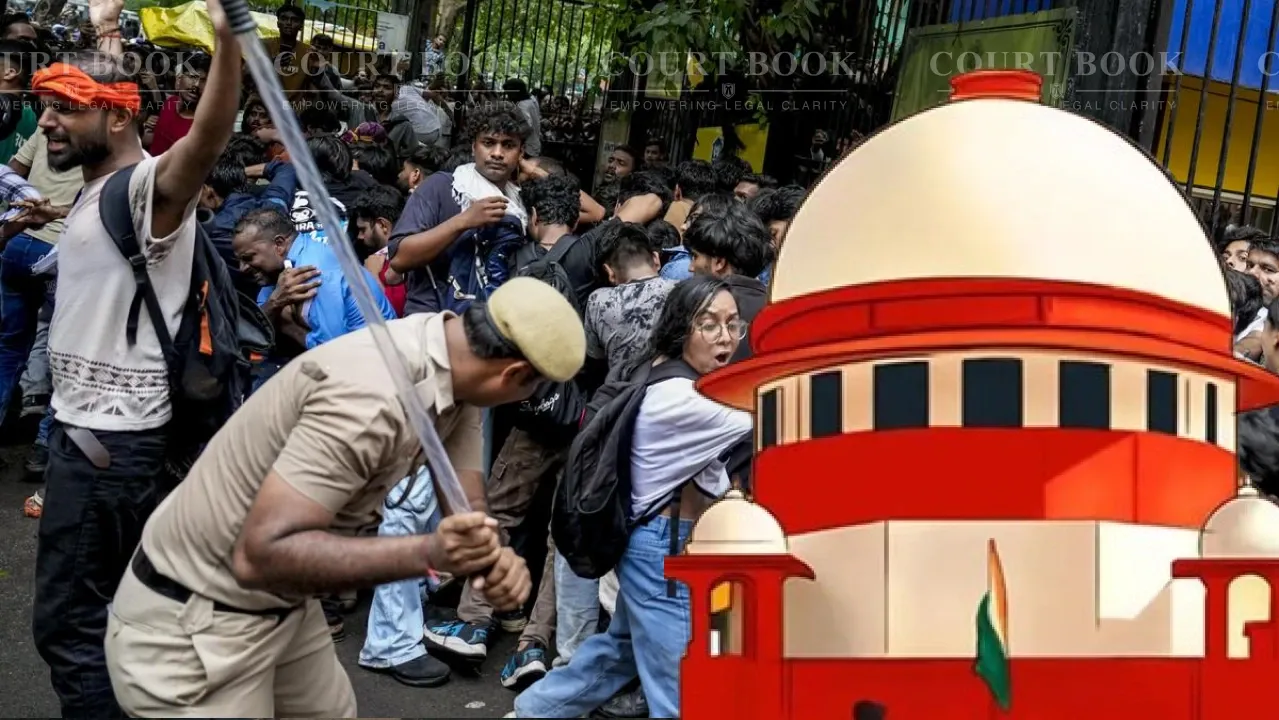
The Delhi Police has denied allegations of excessive force during the July 20 student protest at Jantar Mantar, telling the Supreme Court that its personnel exercised “maximum restraint” and used only the force it considered necessary to control the situation.
The response was filed by Deputy Commissioner of Police (New Delhi District) Sachin Sharma in the proceedings concerning allegations of police excesses during protests linked to alleged examination irregularities. The police maintained that its version would be placed before the independent mechanism proposed by the Supreme Court.
Background of the Protest
The protests were organised following concerns over alleged irregularities in examinations, with demonstrators demanding action from the Union Government and the resignation of the then Union Education Minister Dharmendra Pradhan.
According to the Delhi Police, permission had been granted only for a limited protest at Jantar Mantar. It said no permission was granted for a subsequent march towards Parliament and that prohibitory orders were already in force in the New Delhi district.
The police alleged that the situation escalated when sections of the crowd crossed several barricades and attempted to proceed towards Parliament.
Delhi Police Defends Use of Force
The affidavit said more than 30,000 people were present across the protest area, while around 5,000 police personnel were deployed for crowd management. It claimed that more than 240 police and other uniformed personnel suffered injuries, while around 200 protesters underwent medical examination.
The police maintained that the force used was “graded” and became necessary only after the situation allegedly turned violent.
It also disputed allegations concerning sticks fitted with nails. According to the affidavit, the video relied upon showed a solitary incident involving an object which the police said was a stick carrying the national flag, rather than a police lathi fitted with nails.
Plainclothes Officers and Facial Recognition
The Delhi Police also defended the presence of plainclothes personnel carrying lathis, describing them as “spotters” deployed for crowd-control purposes. It said officers from various branches had moved within the crowd to assess the situation and respond to developments.
On facial-recognition technology, the police said the system was not being used for indiscriminate surveillance of peaceful protesters. It claimed that matches were followed by field verification and that the system was used to identify persons with previous serious criminal records.
The affidavit stated that 2,873 persons with matching criminal records were identified during the protest period. The police said investigations would be confined to those persons.
Supreme Court Proceedings
The Supreme Court has been examining allegations of police excesses in the protests. A Bench comprising Chief Justice of India Surya Kant, Justice Joymalya Bagchi and Justice V. Mohana has stressed that peaceful protest is constitutionally protected and that allegations of excessive force require independent examination.
The Court had also directed preservation of CCTV, drone footage, body-camera recordings and other relevant records connected with the protests.
The Delhi Police, in its affidavit, said it would cooperate with the committee or investigative mechanism constituted by the Court to examine the allegations.
Decision
The Supreme Court has not recorded a final finding on whether the Delhi Police used excessive force during the July 20 protest. The police affidavit places its defence on record, while the allegations raised by the petitioners remain subject to independent examination by the Court-directed process.


