

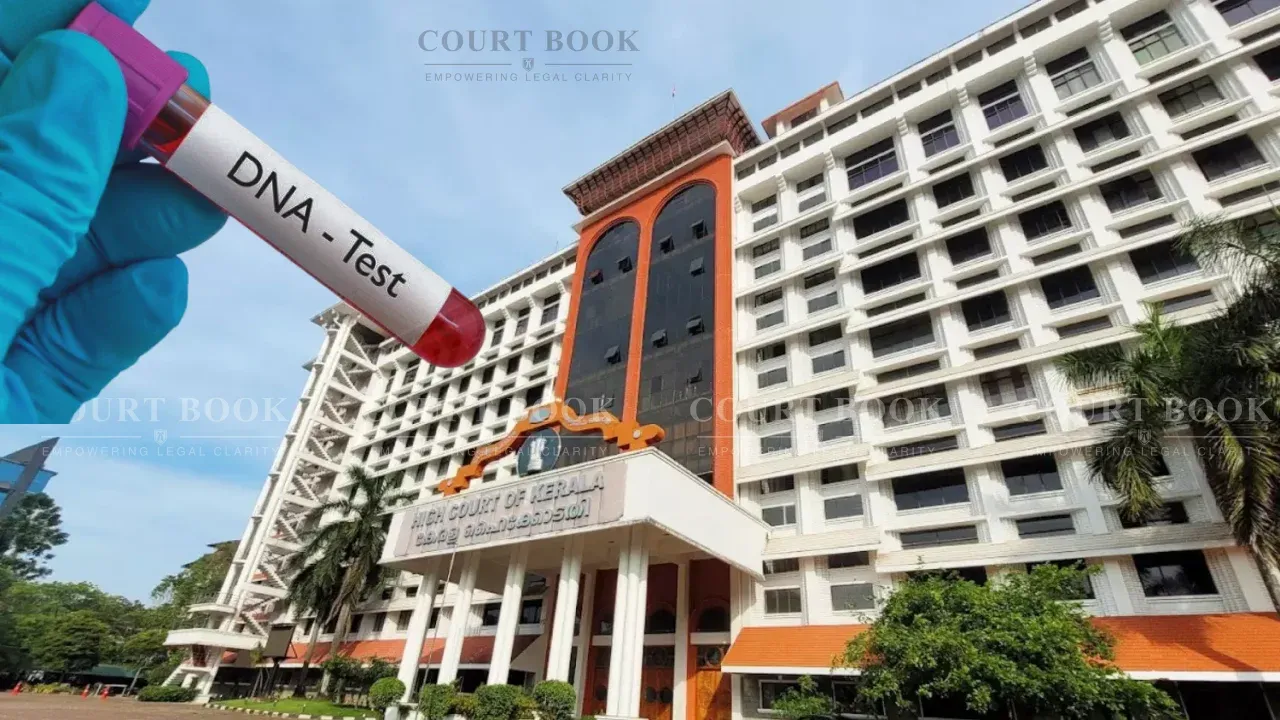
The Kerala High Court has held that a DNA test cannot be directed routinely merely because paternity of a child born during a valid marriage is disputed. Justice Jobin Sebastian observed that before seeking such an examination, there must be specific pleadings and prima facie material showing that the spouses had no access to each other during the relevant period.
The Court made the observation while dismissing Crl.M.C. No. 2332 of 2026, which challenged an order of the Judicial First Class Magistrate Court, Wadakkanchery, refusing to direct DNA examination of a minor child.
Background
The underlying proceedings were initiated under Section 12 of the Protection of Women from Domestic Violence Act, 2005, seeking maintenance for the woman and her minor child, besides return of gold ornaments. During the proceedings, the respondent sought DNA testing of the child, claiming that he was not the biological father. The Magistrate rejected that application on 23 August 2025, leading to the High Court challenge.
The petitioner also relied on an alleged understanding reached during mediation, claiming that the parties had agreed to undergo DNA examination. The High Court, however, noted that proceedings under the Domestic Violence Act are concerned with allegations of domestic violence and statutory reliefs, rather than determining biological parentage.
The Court noted that the marital relationship between the parties was not disputed. In the absence of material showing that the respondent had no access to the woman during the relevant period, the presumption under Section 112 of the Indian Evidence Act, 1872 continued to operate in favour of the child’s legitimacy.
The Court explained that Section 112 protects the legitimacy of a child born during a valid marriage. The presumption can be displaced where it is shown that the spouses had no access to each other when the child could have been conceived.
The Court observed,
“Therefore, in the absence of specific pleadings and prima facie material demonstrating non-access between the spouses during the relevant period, a direction for DNA profiling cannot be sought as a matter of course merely on the basis of an allegation disputing paternity.”
The High Court further held that an understanding during mediation could not, by itself, compel a court to order DNA testing. Although such an understanding may be considered, parties cannot consent to an order that is contrary to law or public policy.
Finding no prima facie material establishing non-access between the spouses during the relevant period, Justice Jobin Sebastian held that the Section 112 presumption remained operative. The Magistrate was therefore justified in refusing the DNA examination.
The High Court declined to interfere with the order dated 23 August 2025 and dismissed the criminal miscellaneous case.






-300x169.webp)