

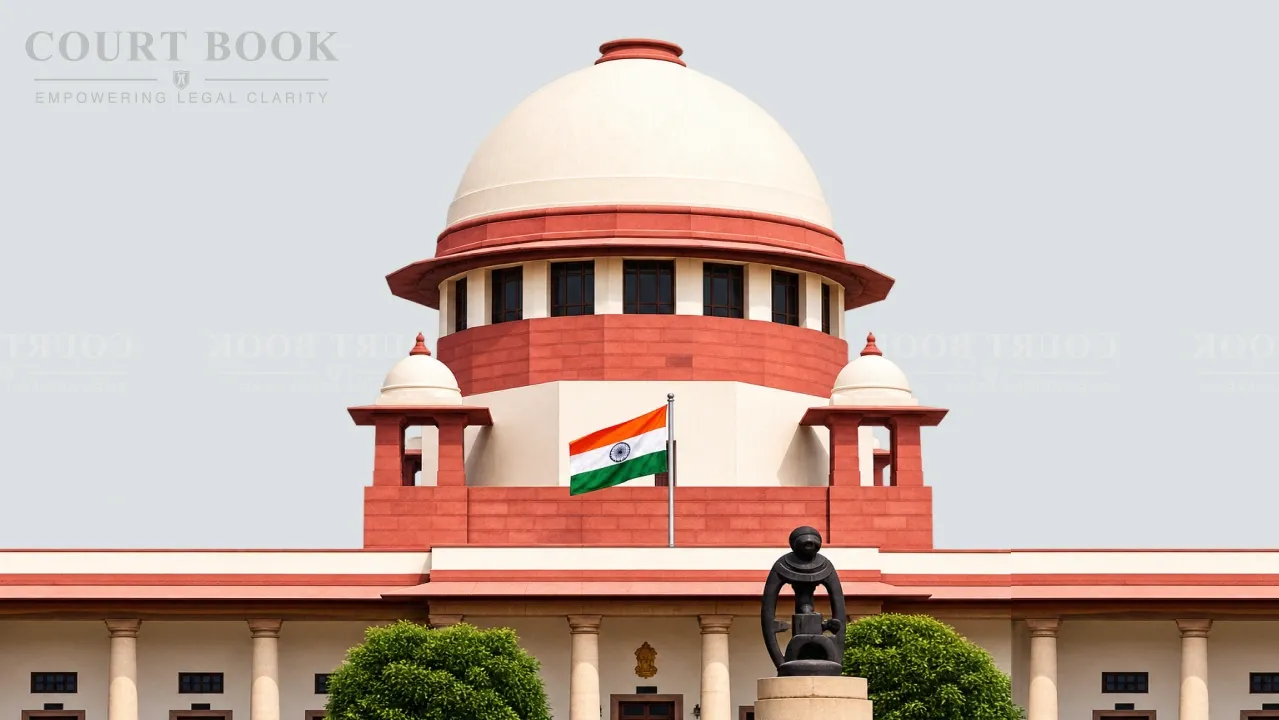
The Supreme Court on October 7 dismissed a special leave petition by V. Pon. Paneerselvam. The petition challenged a Madras High Court order that had rejected his election petition against S. Regupathy, the returned candidate from the 181-Thirumayam Assembly Constituency in Tamil Nadu. A Bench of Justice Prashant Kumar Mishra and Justice Shree Chandrashekhar held that the election law expects the petitioner to present the petition himself.
Background
Mr Paneerselvam had challenged Mr Regupathy's election, declared on 4 May 2026, under the Representation of the People Act, 1951. He sought to have the election declared void. He also alleged the corrupt practice of undue influence, claiming that details of his spouse's assets and income were suppressed or wrongly stated in the Form 26 affidavit.
In its order of 22 July 2026 in ELP No. 36/2026, the High Court held the petition not maintainable because it had been presented by the petitioner's counsel. It relied on Rule 7 of the Madras High Court Election Petitions Rules, 1967. That rule says every election petition must be presented by the petitioner in person before the II Assistant Registrar, Original Side, or before another officer the Registrar directs.
The Bench began with Section 81(1) of the Act, which governs how an election petition is presented. Relying on G.V. Sreerama Reddy v. Returning Officer, it noted that the provision has five components, one of which is that the petition must be presented "by" the petitioner. Section 86(1) directs the High Court to dismiss any petition that does not comply with Section 81.
On the consequence of non-compliance, the Court said:
"The significance attached to these requisites is further borne out by Section 86(1) of the RP Act, 1951, which mandates that the High Court shall dismiss an election petition which does not comply with the provisions of Section 81 of the Act. Thus, the requirement of presentation under Section 81 cannot be viewed as a mere procedural formality divorced from the statutory scheme, as its compliance bears direct nexus with the maintainability of the election petition and a defect, if any, shall not be curable."
The Court also traced the history of the provision. Before the 1966 amendment, Section 81(2) allowed presentation through a person authorised in writing, or by registered post. That sub-section was omitted, and the present provision recognises no such modes.
The Bench then considered whether a High Court may frame rules on presentation. Relying on Jamal Uddin Ahmad v. Abu Saleh Najmuddin, it said a High Court can regulate the administrative and ministerial steps involved in receiving documents. It concluded:
"Approaching the present controversy through the lens of Jamal Uddin Ahmad (supra), Rule 7 of the Madras High Court Election Petitions Rules, 1967 cannot be said to travel beyond the statutory scheme of Section 81 of the RP Act. The rule regulates the manner in which an election petition is to be presented and received before the High Court and, in doing so, operates as an incident of the jurisdiction conferred upon the High Court by the RP Act. The rule does not, by its terms, trench upon or run contrary to any requirement expressly prescribed by Section 81 of the Act."
Mr Paneerselvam said he had personally presented the petition on 16 June 2026. The Court found no contemporaneous record of the act of presentation. The CISF entry pass showed only that he entered the High Court premises that day. The receipt for the security deposit under Section 117 was issued in his counsel's name. The CCTV footage, the Court said, could at most show his presence on the premises.
His reliance on Dr. Vijay Laxmi Sadho v. Jagdish was held misplaced. That case dealt with a defect under Section 83 and a rule requiring the petition to be in English, neither of which falls within Section 86(1). The Court also noted that the petitioner did not claim to have been present with his counsel, which was the situation in Sheo Sadan Singh v. Mohan Lal Gautam.
Agreeing with the High Court, the Supreme Court held the special leave petition to be without merit and dismissed it.
Case Details:
Case Title: V. Pon. Paneerselvam v. S. Regupathy and Others
Case Number: Special Leave Petition (Civil) No. 30538 of 2026
Judge: Justice Prashant Kumar Mishra and Justice Shree Chandrashekhar
Decision Date: 7 October 2026


