

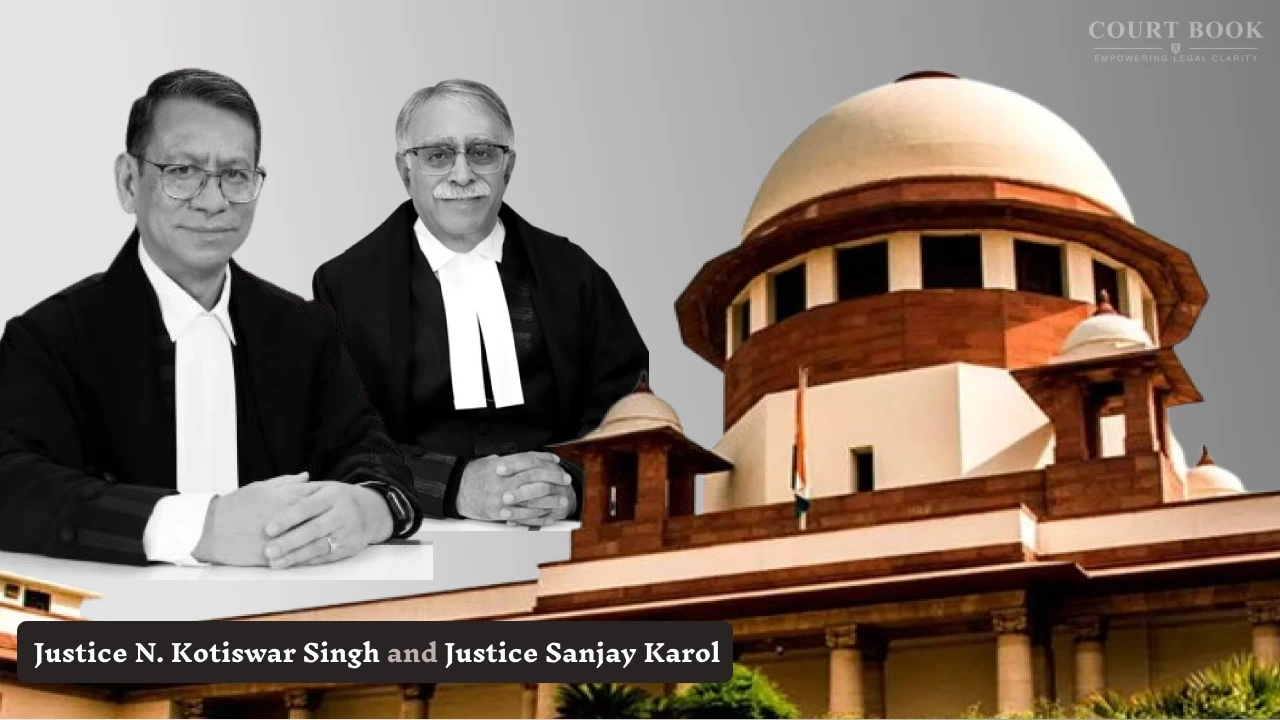
The Supreme Court has clarified that compensation claims arising from electrocution cannot ordinarily be decided through writ proceedings under Article 226 of the Constitution when the case involves disputed questions of fact.
A Bench of Justice Sanjay Karol and Justice Nongmeikapam Kotiswar Singh delivered the judgment on August 12, 2026, while deciding appeals concerning compensation awarded by the Karnataka High Court in two electrocution cases.
Background of the Case
The first matter concerned Rekha, whose husband N. Subramanya died after an electrocution incident on February 22, 2018. The Karnataka High Court had held Karnataka Power Transmission Corporation Limited (KPTC) liable and awarded compensation of Rs. 25,52,500 with 6% interest after three months from the judgment.
In the connected case, Muizz Ahmad Shariff suffered serious injuries after coming into contact with a 66KV electricity line while attempting to retrieve a cricket ball from the roof of a neighbouring building. The High Court had awarded Rs. 44,32,050, which was later upheld by the Division Bench.
KPTC challenged the orders before the Supreme Court, arguing, among other things, that the writ petitions were not maintainable and that disputed factual issues required proper examination.
Supreme Court’s Observations
The Bench examined the distinction between strict liability and absolute liability. It held that electricity transmission is an inherently dangerous activity, and bodies engaged in it can be held strictly liable for harm caused by electricity, even without proof of negligence, subject to recognised exceptions.
“The transmission of electricity is undoubtedly inherently dangerous,” the Bench observed. It added that those carrying out such activities should ordinarily bear the burden of the resulting risk.
However, the Court rejected the High Court’s approach of treating the liability as absolute. It explained that strict liability can have exceptions, including an unforeseeable act of a stranger, an act of God, statutory authority and circumstances where the damage is solely caused by the claimant’s own act.
The Court also found several factual disputes requiring determination. These included questions concerning the use of an aluminium ladder near an 11KV line, the responsibility of the plantation owner, the condition of protective relays, the statutory distance between an electricity line and a building, and the possible responsibility of the building owner.
The Bench therefore held that such disputed issues could not appropriately be resolved in writ proceedings.
Compensation Cannot Be Calculated Using Motor Vehicles Act Multiplier
The Supreme Court further held that the compensation formula under the Motor Vehicles Act, 1988 could not simply be applied to electrocution cases.
Relying on its earlier decision in Raman v. Uttar Haryana Bijli Vitran Nigam Ltd., the Court said the multiplier method used under the Motor Vehicles Act was not applicable to electrocution compensation. Instead, the guiding principle would remain the award of “just and reasonable, fair compensation”, taking into account the person's income and other relevant claims.
Decision
The Supreme Court held that the writ petition seeking compensation in the first case was not maintainable because disputed questions of fact were involved. It quashed and set aside the judgments of both the Single Judge and Division Bench of the Karnataka High Court.
The Court clarified that the respondents could pursue available alternative remedies before the appropriate forum. It also directed that the Rs. 5 lakh interim compensation already paid would not be recovered and would not affect any compensation that may ultimately be awarded in appropriate proceedings.
Following the same conclusion, the respondents in the connected appeal were also given liberty to take appropriate action. Both appeals were allowed, pending applications were disposed of, and the parties were directed to bear their own costs.


