The Supreme Court has set aside the termination of a technician employed by Fertilizers and Chemicals Travancore Ltd. (FACT), holding that a person cannot be treated as having suppressed a criminal case if there is no material showing that he knew about it when he filled the verification form.
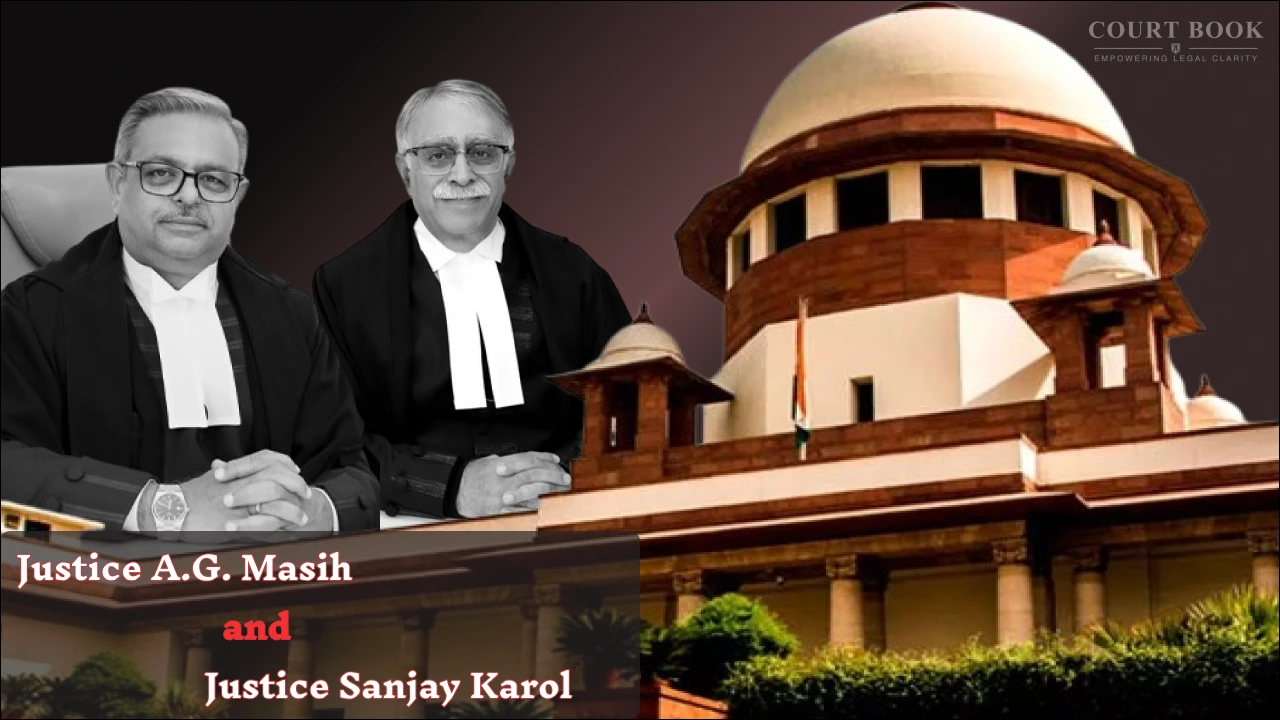
A Bench of Justices Sanjay Karol and Augustine George Masih delivered the judgment on August 11, 2026, stressing that termination for non-disclosure of criminal antecedents requires a careful, two-stage examination rather than an automatic approach.
Background of the Case
The appellant, Shatrughn Yadav, was appointed as a Technician (Process) by FACT on May 5, 2021, initially on consolidated pay for two years. In his attestation form, he stated that no criminal case was pending against him.
During subsequent verification, authorities found that a Non-Cognizable Report (NCR) registered in 2019 under Sections 323 and 504 of the IPC existed against him. FACT issued a show-cause notice alleging that he had furnished false information.
Yadav maintained that he was unaware of the NCR. He pointed out that he had never been arrested, summoned or called to the police station. He also produced a police certificate issued in 2020 stating that there was no adverse entry against him. Later, another police certificate recorded that his name had been removed after investigation as no evidence was found against him.
Despite his explanation, FACT terminated his appointment on August 5, 2023. The Kerala High Court upheld the termination, following which he approached the Supreme Court.
Supreme Court's Observation
The Supreme Court relied on the principles laid down in Avtar Singh v. Union of India and held that every case of alleged suppression must be examined on its own facts.
The Bench observed that
“knowledge of a fact is a necessary pre-requisite for its non-disclosure.”
It further held that a person cannot be said to have concealed information that was never within his knowledge.
The Court identified a two-pronged enquiry. First, the employer must determine whether there was actually any suppression or false declaration, considering what the employee knew at the relevant time. Second, the employer must assess the nature of the alleged suppression, the allegations, the post held, the duties involved and the outcome of the criminal proceedings before deciding whether termination is justified.
In this case, the Bench found that Yadav's claim of ignorance was supported by documentary evidence. There was also no material showing that he had been informed about the NCR.
Decision
The Supreme Court held that the termination was not legally permissible and suffered from non-application of mind. It set aside the termination order and directed FACT to reinstate Yadav with consequential benefits.
The Court restricted back wages to 50%, directing that the amount be paid within eight weeks. It further ordered that interest at 6% per annum would become payable in case of delay.
The appeal was accordingly allowed.