

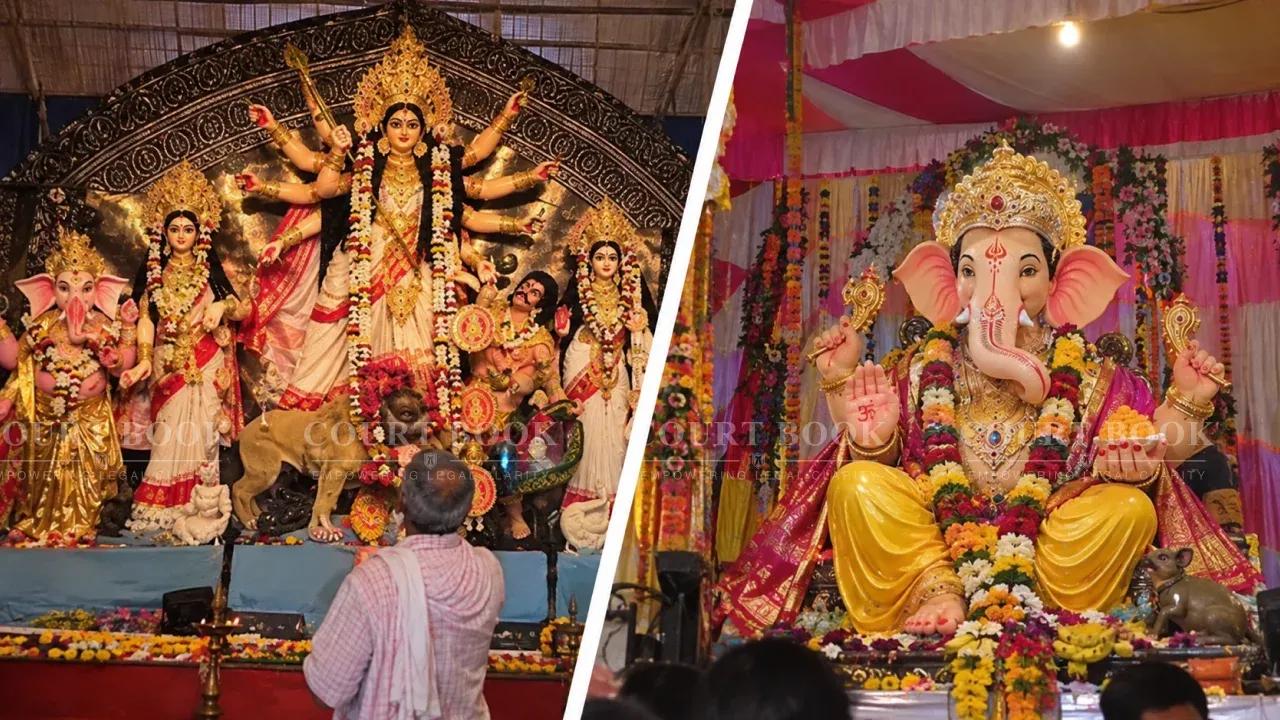
The Orissa High Court has disposed of a public interest litigation concerning temporary religious pandals erected on public roads for Ganesh and Durga Puja, emphasising that religious celebrations must coexist with public convenience and emergency access.
A Division Bench comprising Chief Justice Harish Tandon and Justice Mruganka Sekhar Sahoo clarified that religious activities cannot be completely prohibited merely because they occupy public spaces, provided reasonable access and movement are maintained.
Background
The petition was filed by Sarat Kumar Gajendra, whose house is approximately 50 metres from the location where temporary religious pandals were erected. He alleged that the structures completely blocked the road, preventing him from accessing his residence.
The State disputed this allegation, informing the Court that a 22-foot passage remained available for vehicular movement. Several local residents also approached the Court to support the continuation of community religious celebrations.


The Bench examined the relationship between religious freedom under Article 25 of the Constitution and the rights of residents to move freely and access their homes. It observed that individual inconvenience must be considered alongside broader public interests, without disregarding essential safeguards.
The Court clarified:
“Even if the pandals are constructed on a public place, there should be adequate space left for the movement of the vehicles or at least the movement of an ambulance and/or a fire engine in case of any emergency to avoid any public disorder or a disharmony into a large section of the society.”
It further emphasised the responsibilities of authorities while granting permission for religious events:
“Adequate distance should be strictly adhered to, which makes the movement of the emergency vehicles, so that in case of any emergency, such facilities and/or amenities are available at their doorstep.”
The Bench also directed authorities to maintain permissible sound limits, enforce prescribed deadlines and ensure that temporary structures do not obstruct vehicular movement.
The High Court declined to issue a writ of mandamus, finding no basis to order a complete stoppage of the religious ceremonies.
It disposed of the writ petition with observations and directions requiring authorities to preserve residential access and adequate passage for emergency vehicles.
Case Details
Case Title: Sarat Kumar Gajendra v. Collector & District Magistrate, Khordha and Others
Case Number: W.P.(C) No. 26356 of 2025
Bench: Chief Justice Harish Tandon and Justice Mruganka Sekhar Sahoo
Decision Date: 16 October 2026




