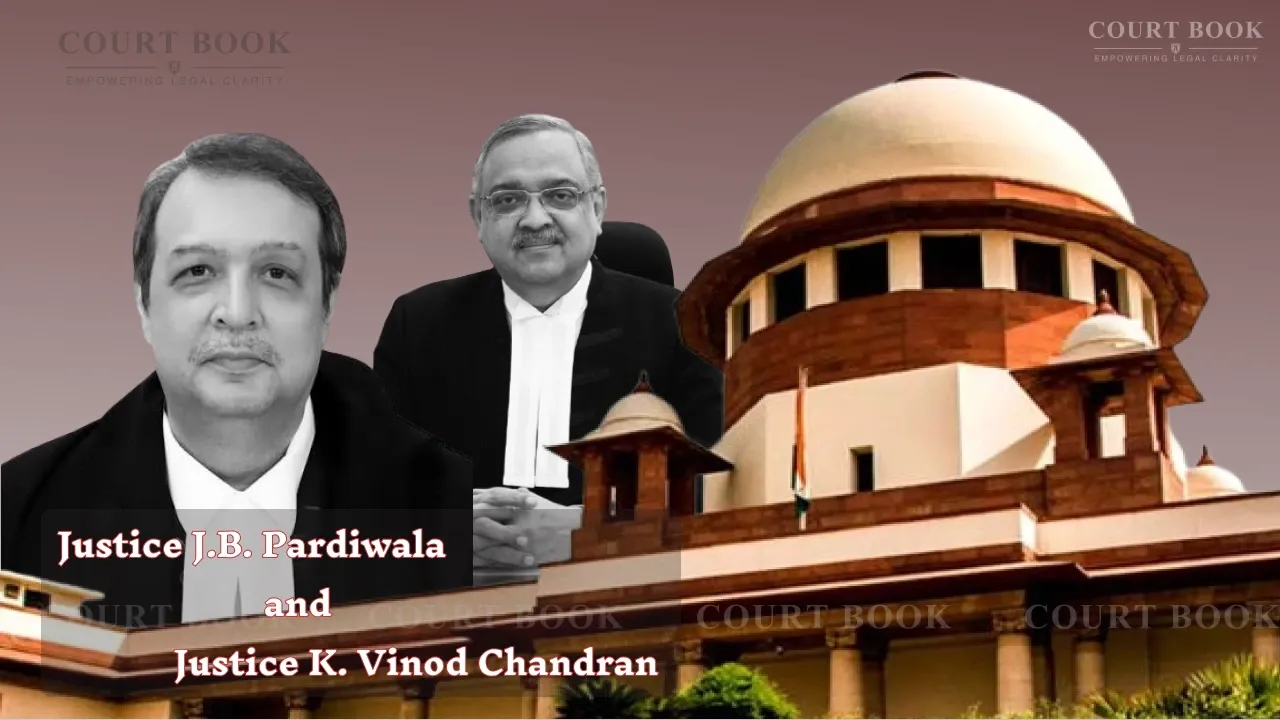
The Supreme Court has allowed a batch of civil appeals concerning 40.65 acres of land in Nellore, Andhra Pradesh, holding that the State could not seek to take over the disputed property through summary proceedings when its claim that the land was “assigned land” had not been clearly established.
A Bench of Justice J. B. Pardiwala and Justice K. Vinod Chandran set aside the appellate order that had disturbed the auction of land belonging to Circar Paper Mills Limited, a company that had gone into liquidation. The Court also revived the related proceedings concerning adjoining properties.
Background Of The Case
The dispute involved 65.94 acres spread across several survey numbers in Kodurupadu village, Nellore district. The State claimed 40.65 acres were government-assigned lands which could not have been transferred contrary to the Andhra Pradesh Assigned Lands (Prohibition of Transfers) Act, 1977.
Circar Paper Mills had purchased part of the property in 1980. Its name was entered in the revenue records, and the company subsequently used the land for industrial purposes. After the company entered liquidation, the Official Liquidator took possession of the properties on the orders of the Company Court in March 2001.
The land was later auctioned under orders of the Company Court. Jeevaka Kandasari Sugar Mills (J.K. Sugar Mills) emerged as the successful bidder with an offer of Rs. 7.80 crore.The State objected to the auction, claiming that 40.65 acres were assigned lands. The Company Court nevertheless confirmed the sale and directed payment to the Government based on the valuation of the disputed land. The State challenged that decision before the High Court and succeeded.
Supreme Court's Observation
The Supreme Court found that the State had not produced sufficient material to establish that the disputed property was assigned land.
The Bench particularly noted that the State's own tabular statement claimed that 20.94 acres had been assigned to B.J. Rao. The Court questioned this assertion because the material before it indicated that B.J. Rao was not a landless person, while assignment under the 1977 law was meant for landless poor persons.
The Court observed:
“The assignment of lands also has not been established unequivocally, nor can it be done in a writ proceeding.”
The Bench further held that a genuine dispute concerning title could not simply be resolved through a summary eviction process. Relying on its earlier decision in Government of Andhra Pradesh v. Thummala Krishna Rao, the Court stressed that where the State's title itself is disputed, the matter requires proper adjudication rather than unilateral action.
Court On Long Possession And Auction Proceedings
The Court also took note of the long possession of the properties, registered sale deeds, mutation entries and the industrial activity carried out on the land.
It held that the properties had been taken into custody by the Official Liquidator pursuant to Company Court orders and that the auction was also conducted under those orders. The Government, according to the Court, did not approach the Company Court to properly establish its objection before the auction was confirmed.
The Court stated:
“The long possession itself restrains this Court from accepting any summary proceedings for eviction.”
Decision
The Supreme Court set aside the High Court's appellate order and revived the order of the learned Single Judge confirming the auction.
It directed that possession, if not already handed over, be given to J.K. Sugar Mills and that possession already with the purchaser should not be disturbed.
The proceedings involving Sundaramma and others were also restored to the High Court for fresh consideration on merits. The Court further directed that the amount deposited with the Government by the Official Liquidator be immediately restored for use in the liquidation of Circar Paper Mills Limited.
The civil appeals were accordingly allowed.




-300x169.webp)





-300x169.webp)
-300x169.webp)