

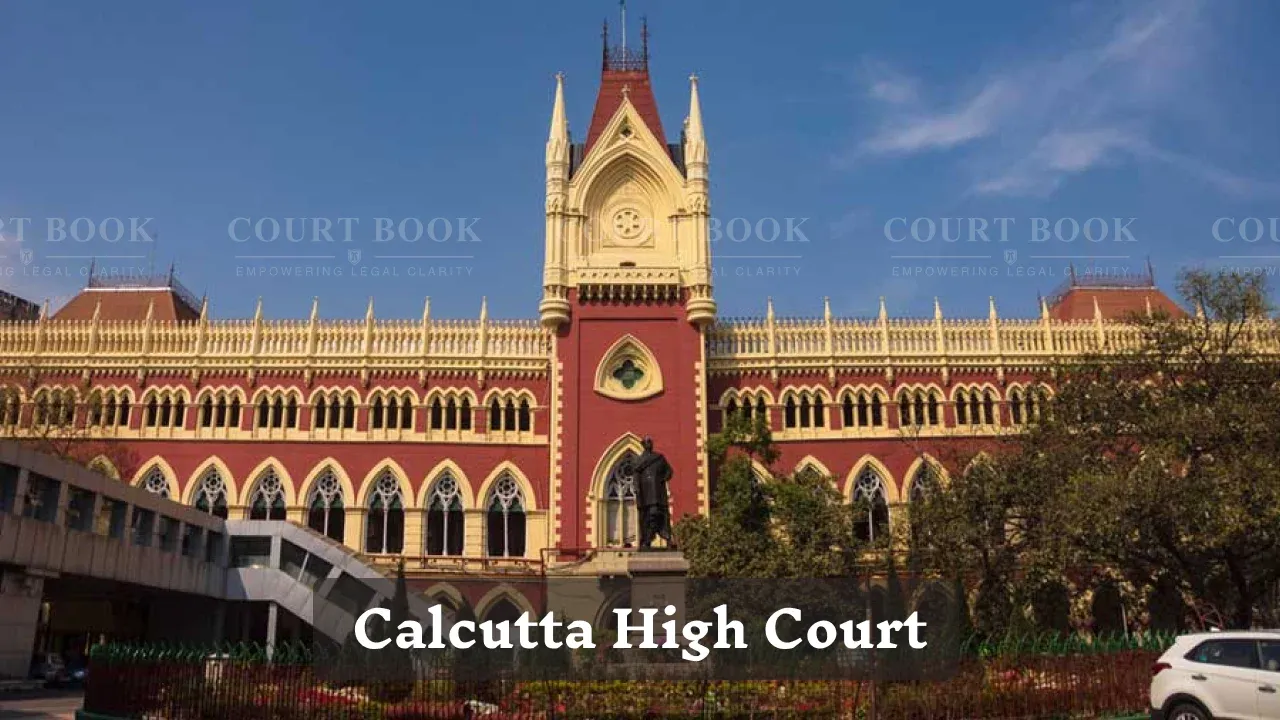
Nearly two decades after a woman's death was initially treated as a case that ended in acquittal, the Calcutta High Court has overturned the trial court's verdict and convicted her husband along with four of his relatives for murder. The Division Bench held that the trial court had wrongly discarded crucial evidence, particularly the testimony of the couple's minor son, whose account was found to be reliable and supported by medical evidence.
The judgment was delivered on July 16, 2026, by Justice Rajasekhar Mantha and Justice Rai Chattopadhyay in Swapan Kumar Pramanick v. Samir Das and Others (CRA 669 of 2017).
Background of the Case
The appeal arose from a 2017 judgment of a Sessions Court in South 24 Parganas that had acquitted all the accused of charges under Sections 498A, 306 and 302 read with Section 34 of the Indian Penal Code.
According to the prosecution, the woman was repeatedly subjected to cruelty over monetary demands. On the night of the incident in July 2006, it was alleged that she was assaulted inside her matrimonial home and poison was forcibly administered to her. The prosecution relied heavily on the testimony of the victim's young son, who claimed he witnessed the events while hiding under a bed.
The trial court had rejected his testimony and acquitted the accused, prompting the victim's brother to challenge the verdict before the High Court.
Court's Observations
The High Court found that the trial court had committed serious errors while evaluating the evidence.
The Bench noted that the post-mortem report recorded multiple bruises, nail scratch marks and injuries consistent with assault, contradicting the trial court's finding that there were no injuries on the victim's body.
Rejecting the reasoning adopted by the trial court, the Bench observed:
“The aforesaid finding of the Trial Judge is contrary to the post mortem report. The said finding is therefore perverse.”
The Court also gave significant weight to the evidence of the child witness. It held that a child who witnesses an extraordinary and traumatic incident is capable of recalling it with clarity, provided the testimony inspires confidence.
The Bench observed:
“Witnessing the death of one's mother... is indeed an abnormal event in the life of an individual... The evidence of PW 3, therefore, cannot be brushed aside.”
The judges further held that minor improvements in the child's testimony did not affect its core credibility because the substance of his version remained consistent throughout the proceedings.
Findings on the Accused
The High Court concluded that the prosecution had established the presence and participation of all the accused persons inside the matrimonial home.
The Bench found that the evidence showed the husband assaulted the victim, while other family members assisted in the incident and later attempted to conceal evidence. The Court also noted that some accused resisted attempts by the victim's relatives to take her to a hospital despite signs that she was still alive.
Referring to offences committed within the privacy of a home, the Court observed that direct eyewitnesses are often unavailable and courts must assess the surrounding circumstances carefully rather than insist upon impossible standards of proof.
Court's Decision
Allowing the appeal, the High Court set aside the acquittal and convicted Samir Das, Samar Das, Sabita Das, Sanjay Pramanik and Jharna Pramanik for the offence of murder under Section 302 read with Section 34 of the IPC.
The Court also convicted Samir Das under Section 498A IPC for cruelty towards his wife.
Each of the five convicted persons was sentenced to rigorous life imprisonment with a mandatory minimum of 24 years, along with a fine. The husband received an additional one-year rigorous imprisonment under Section 498A. The Court directed all convicts to surrender before the trial court within three weeks, failing which steps would be taken to secure their custody.
The criminal appeal was accordingly allowed.
Case Details
Case Title: Swapan Kumar Pramanick v. Samir Das and Others
Case Number: CRA 669 of 2017
Judge: Justice Rajasekhar Mantha and Justice Rai Chattopadhyay
Decision Date: July 16, 2026


