

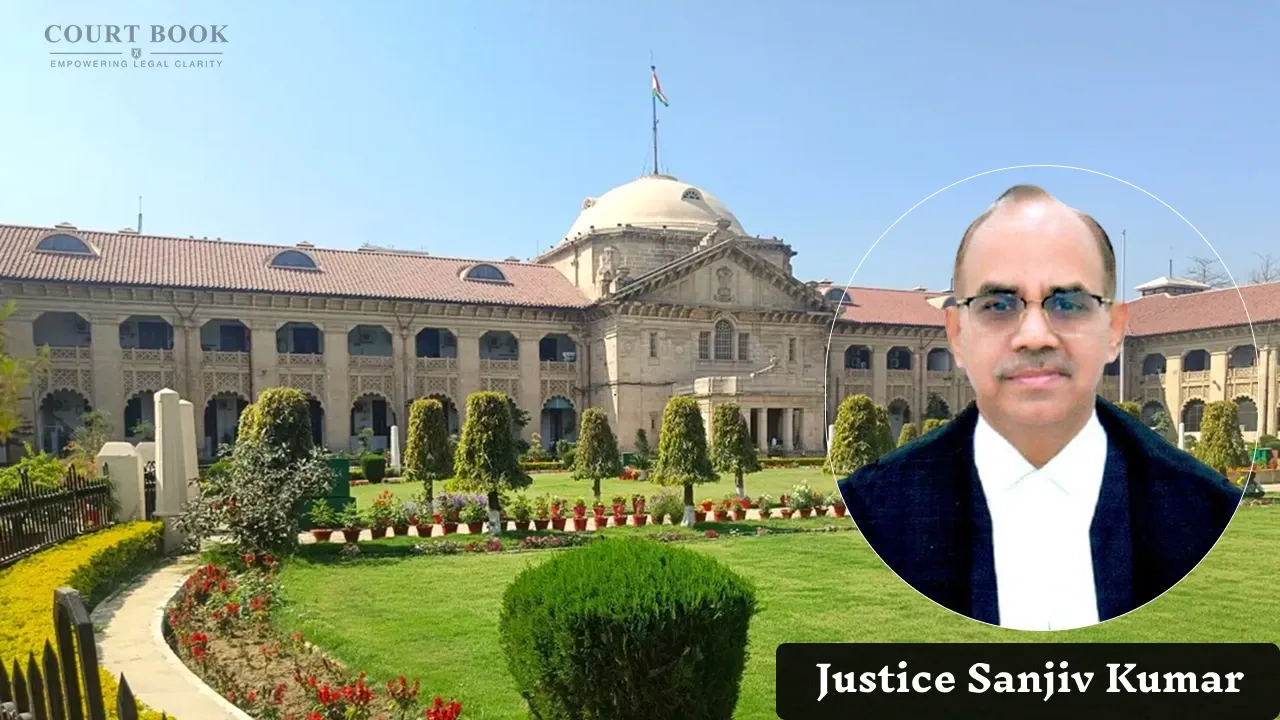
Nearly four decades after a violent clash over disputed agricultural land in Lalitpur district, the Allahabad High Court has partly allowed a criminal appeal, acquitting four women accused after finding no reliable evidence of their active participation in the assault. At the same time, the Court upheld the conviction of two surviving male appellants, concluding that the prosecution had proved their involvement beyond reasonable doubt.
Background of the Case
The appeal arose from a 1988 trial court judgment in which several members of one family were convicted under Sections 147, 323/149 and 324/149 of the Indian Penal Code in connection with a clash that took place on September 20, 1984. The dispute centred on the harvesting of a maize crop growing on land over which both sides claimed possession. During the pendency of the appeal, six appellants died, leaving the High Court to decide the case of the surviving accused.
Court's Observations
Justice Sanjiv Kumar examined the evidence in detail and noted that the incident was a cross-case in which both sides had suffered injuries. The Court found that the evidence did not clearly establish which party had sown the crop or who initiated the violence.
The bench observed,
“When it is not clear from evidence which party was the aggressor, then it would be deemed that it was a free fight. In case of free fight each person/party is responsible for its act.”
While assessing the role of the women appellants, the Court found significant inconsistencies in the testimony of prosecution witnesses. Witnesses admitted that although the women were present at the spot, they did not see them assaulting anyone.
The Court observed that there was no clear evidence showing that the women had participated in the assault or shared any common object with the other accused. It therefore held that they were entitled to the benefit of doubt.
However, the Court reached a different conclusion regarding Bhajan Lal and Ramanand. It held that there was specific and consistent evidence establishing their participation in the incident, making their conviction legally sustainable.
Decision
The High Court set aside the convictions of Smt. Badi Bahu alias Kanchan Devi, Smt. Sanjhli Bahu (wife of Bhajan Lal), Smt. Manjhli Bahu (wife of Baijnath) and Smt. Manjhli Bahu (wife of Zalim), acquitting them of all charges and cancelling their bail bonds.
The appeal of Bhajan Lal and Ramanand, however, was dismissed. Their convictions were affirmed, and the Court directed them to appear before the trial court within one month.
Instead of undergoing imprisonment, they were directed to execute probation bonds and maintain good behaviour for one year under the Probation of Offenders Act, 1968.
Case Details
- Case Title: Babu and Others v. State of Uttar Pradesh
- Case Number: Criminal Appeal No. 1524 of 1988
- Judge: Justice Sanjiv Kumar
- Decision Date: 21 July 2026


