

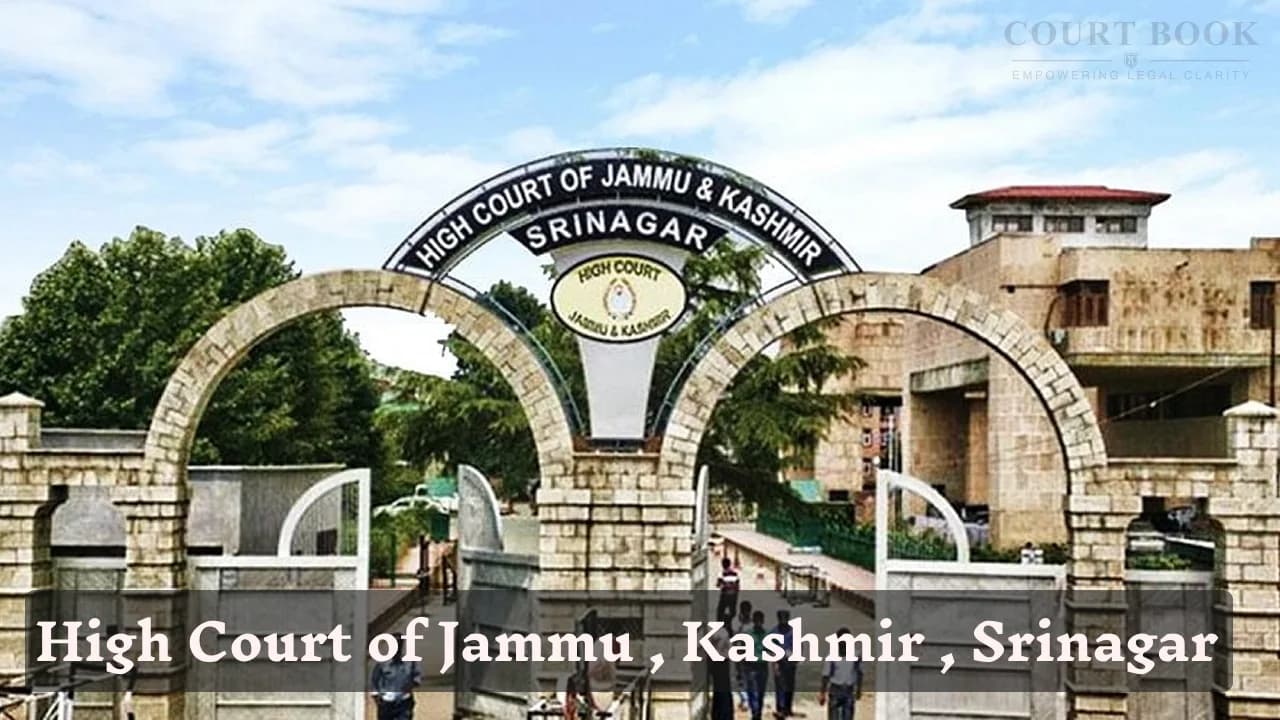
The Jammu and Kashmir and Ladakh High Court has struck down provisions of the Jammu and Kashmir Water Resources (Regulation and Management) Act, 2010, to the extent that they impose water usage charges on hydropower projects. A Division Bench of Justice Sanjay Dhar and Justice Rajnesh Oswal held that the levy effectively amounted to a tax on electricity generation, which the erstwhile State Legislature lacked the constitutional competence to impose. The Court allowed three writ petitions, quashed the impugned demand notices and restrained the respondents from imposing such a tax under the guise of water usage charges.
Background
The petitions were filed by M/s Mass N Energy and other companies, Magpie Hydel Construction Operation Industries Pvt. Ltd., and Choudhary Power Projects Pvt. Ltd. The companies challenged demands raised against their hydropower projects under the 2010 Act and the rules framed under it.
The petitioners argued that river water passes through turbines to generate electricity and is not consumed in the ordinary sense. They contended that the charges, linked to the height from which water operates the turbines, were in substance a tax on electricity generation rather than a regulatory fee for water use.
Examining the constitutional distribution of legislative powers, the Bench considered whether Entry 17 of List II, which deals with water, empowered the State Legislature to impose the disputed levy. The Court distinguished the power to regulate water from the constitutional authority to tax it, explaining:


“Once the water has been categorized separately from the land and the mineral, merely because water can also come within the definition of land or minerals would not make any difference. Intention of the Constitution framers has to be gathered from the manner in which various fields have been categorized in these lists. If the constitution framers intended to categorize water with land or mineral, there was no need to provide a separate entry for water. If we include the water with land or mineral then Entry 17 of List-II becomes redundant, which could never have been the intention of the Constitution framers. It is to be noted that Entry 17 of List-II, which relates to water is a regulatory entry and it does not vest power with the State to impose tax on water. There is no corresponding taxing entry in List-II of Schedule VII for the field of water.”
The Bench also considered the effect of the subsequent adoption of the 2010 Act under the Jammu and Kashmir Reorganisation Act, 2019. It rejected the argument that the later adoption could validate a law that was beyond the Legislature's competence when originally enacted. The judgment explained:
“A piece of legislation, which is ultra vires the Constitution at the time of its enactment cannot be legitimized by its adoption by the Parliament subsequently. In this context, it would be apt to refer to the ratio laid down by the Supreme Court in the case of Deep Chand v. State of U.P., 1959 SCC OnLine SC 12. In the said judgment, it has been held that if, at the time when an Act is passed, the State has no power to pass the said enactment, it becomes unconstitutional and, therefore, void from its inception. It is a stillborn legislation, which cannot be validated.”
Applying these principles, the High Court concluded that the water usage charges imposed on the petitioners' hydropower projects amounted, in substance, to a tax on electricity generation. The Court held that the erstwhile State Legislature lacked the competence to impose the levy.
The Bench accordingly ruled:
“The impugned Jammu and Kashmir Water Resources (Regulation and Management) Act, 2010, to the extent it provides for levying water usage charges upon the hydro power projects, amounts to imposing a tax on the generation of electricity and, therefore, the State Legislature did not have the competence to impose such tax upon the writ petitioners.”
Allowing all three writ petitions, the Court struck down the challenged provisions to the extent that they imposed water usage charges on the petitioners' hydropower projects, quashed the demand notices and restrained the respondents from imposing a tax on electricity generation under the guise of water usage charges or any other tax.



