

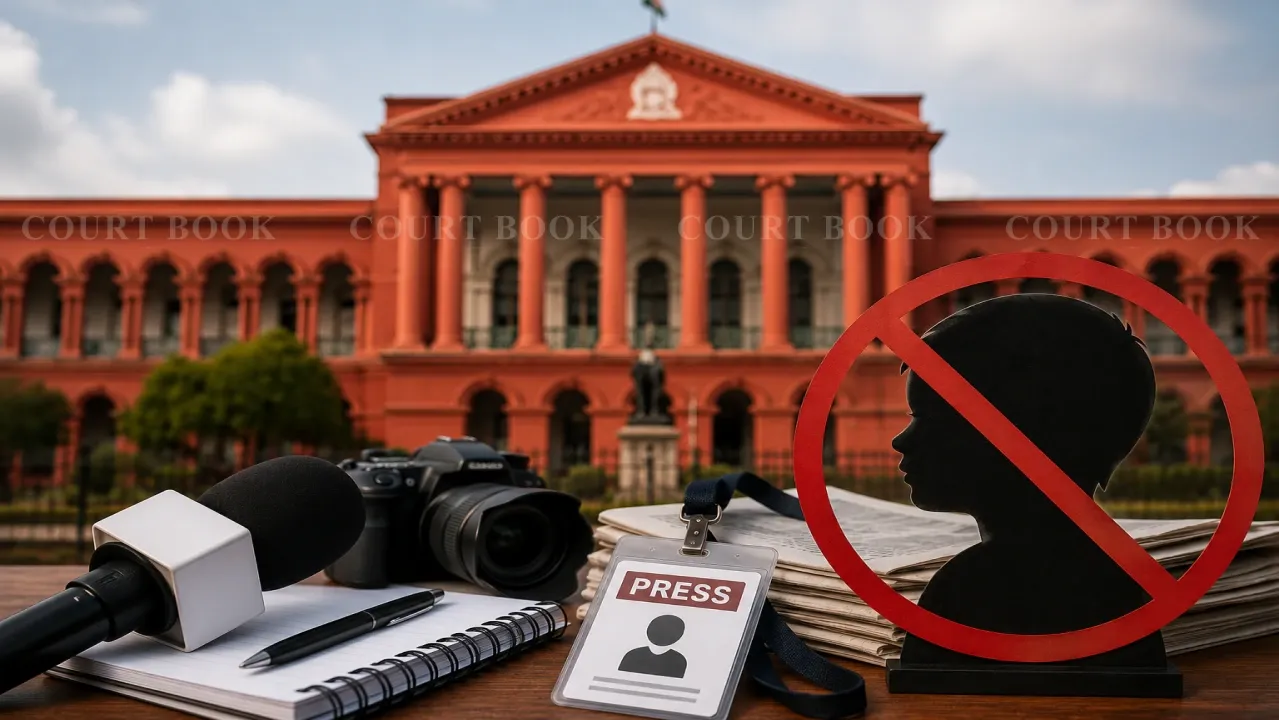
The Karnataka High Court has refused to quash criminal proceedings against a reporter and the editor of a Kannada daily newspaper accused of publishing details that allegedly disclosed the identity of a child victim. The Court held that the protection granted under Section 74 of the Juvenile Justice (Care and Protection of Children) Act, 2015 is mandatory and cannot be bypassed on the ground that the publication was intended to secure justice for the child.
Justice Anant Ramanath Hegde on June 30, 2026, dismissing the criminal petition filed by Girish Patil and Ashok Mahabaleshwar Hasyagara.
Background of the Case
The petitioners approached the High Court under Section 482 of the Code of Criminal Procedure seeking to quash the criminal case pending before the JMFC Court, Dandeli. The proceedings arose from Crime No. 06/2021, in which they were charged under Section 74(1) of the Juvenile Justice Act for allegedly publishing information capable of revealing the identity of a child victim.
According to the case records, a newspaper report published on January 20, 2020 covered an incident in which a school teacher had allegedly assaulted a child. On the same day, the child's father lodged a police complaint, following which an FIR was registered. After completing its investigation, the police filed a charge sheet alleging violation of Section 74(1) of the Juvenile Justice Act.
Before the High Court, the petitioners argued that the news report had been published only to highlight the incident and help the child obtain justice. They contended that the publication was never intended to damage the child's reputation and therefore did not attract the penal provision under Section 74 of the Act. The State opposed the plea.
Court's Observation
After examining the statutory provision, the High Court noted that Section 74 expressly prohibits newspapers, magazines, audio-visual media, and other forms of communication from disclosing the name, address, school or any other detail that could lead to the identification of a child involved in an inquiry, investigation or judicial proceeding, whether the child is in conflict with law, in need of care and protection, or a victim or witness of a crime.
The bench observed,
"Section 74 of the Act of 2015 is very specific. In case the child is a witness or child is in need of care and protection, the name of the child should not be disclosed and even if the child is a victim, the name of the child should not be disclosed."
Rejecting the petitioners' argument, the Court held that the statute does not create an exception merely because a publication was intended to support the victim or expose wrongdoing. The legislative purpose, the Court said, is to ensure that children receive protection, privacy and rehabilitation through a child-friendly legal framework.
The Court further observed,
"The petitioner cannot raise a defence that the publication is made in the interest of the child, keeping in mind the object of the enactment and also the legislative intent of Section 74 of the Act of 2015."
Justice Hegde also noted that widespread publicity may not always serve a child's welfare. According to the Court, every child reacts differently to public exposure, and publication of a child's identity even where the child is the victim may adversely affect the child's best interests.
Court's Decision
Finding no legal merit in the challenge, the Karnataka High Court dismissed the criminal petition and declined to interfere with the proceedings pending before the trial court.
The prosecution against the petitioners under Section 74(1) of the Juvenile Justice Act will therefore continue in accordance with law.
Case Details
Case Title: Girish Patil & Anr. v. State of Karnataka & Anr.
Case Number: Criminal Petition No. 101182 of 2022
Judge: Justice Anant Ramanath Hegde
Decision Date: June 30, 2026


