

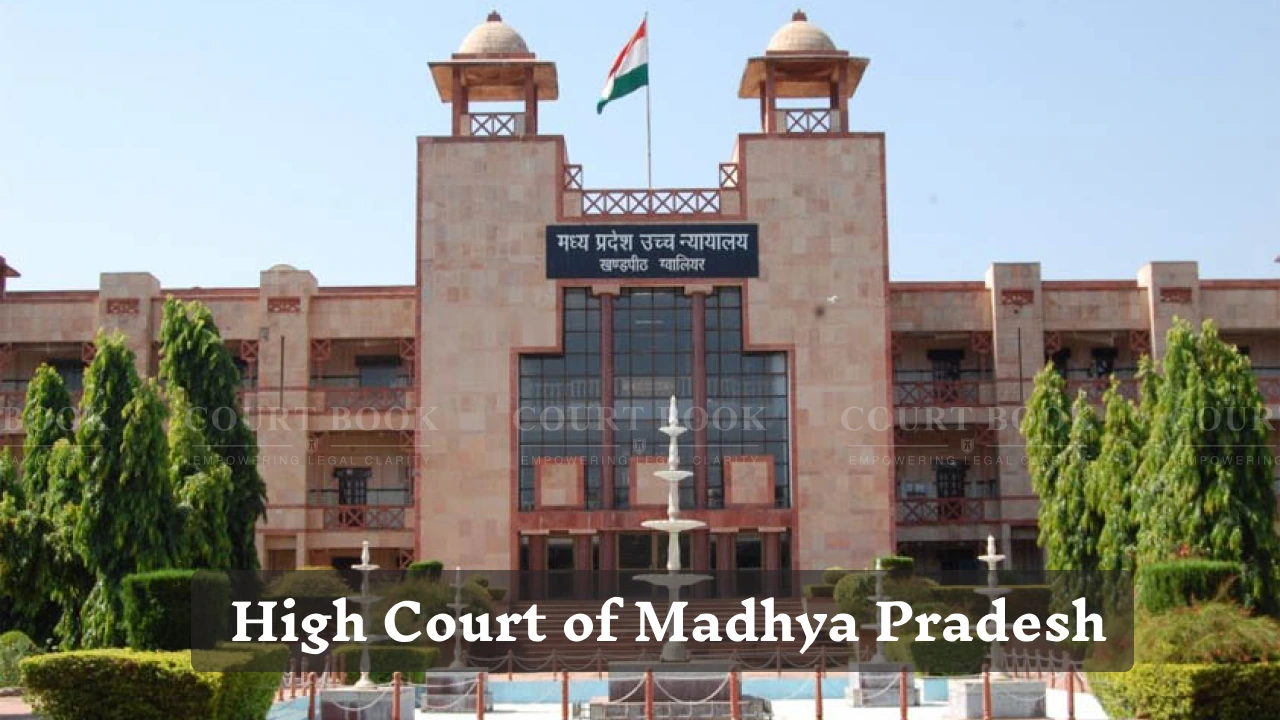
Gwalior: The Madhya Pradesh High Court has set aside a recovery order passed against a retired Estate Officer of the M.P. Housing Board, ruling that both the disciplinary authority and the appellate authority failed to record proper reasons before penalising him.
Background of the Case
The petitioner, Jandel Singh Veer, had approached the court under Article 226, challenging two orders - one dated 19.03.2005 (referred to as Annexure P/2, dated 11.03.2005 in the order) and another dated 07.03.2007. He also sought a refund of Rs 49,812 deposited under protest, along with 15% interest.
According to the petition, Veer was posted as Estate Officer at Morena in 1999 when a complaint surfaced regarding a plot allotted to one Prabhu Dayal Goyal, whose file had gone missing despite full payment being made in 1998. Veer's counsel argued that the file transaction had occurred before his client took charge, and that as soon as he learned of the issue in August 1999, he directed the Estate Manager to trace the file. He was transferred out in January 2000, before the matter was resolved.
Despite this, a recovery of Rs 74,718 was imposed on Veer and a co-employee in 2005, and his appeal was rejected in 2007 - both, his lawyer argued, through orders that gave no reasoning at all.
Court's Observations
Justice Anand Singh Bahrawat examined the impugned orders and found them wanting. The Court noted that the disciplinary authority, while imposing punishment, was exercising quasi-judicial power and was therefore bound to pass a reasoned order.
The bench observed:
"The affected party must know how his/her case or defence was considered before passing the prejudicial order."
Referring to the Supreme Court's rulings in Kranti Associates v. Masood Ahmed Khan and Oryx Fisheries v. Union of India, the Court reiterated that reasons are the "lifeblood" of decision-making and cannot be substituted by an appellate order containing reasons where the original order has none.
The Court also relied on O.K. Bhardwaj v. Union of India, holding that even a minor penalty requires the employee to be heard, and that a factual charge denied by the employee calls for a proper enquiry - which was absent here.
The Decision
Finding both the punishment order and the appellate order non-speaking and unreasoned, the High Court quashed them. It directed the Housing Board to extend all consequential benefits to the petitioner within three months and refund the Rs 49,812 deposited, failing which the amount would carry 6% annual interest.
Since the petitioner had already retired, the Court did not permit any fresh disciplinary action.
Case Details
Case Title: Jandel Singh Veer v. M.P. Housing Board & Others
Case Number: Writ Petition No. 2646 of 2008
Judge: Justice Anand Singh Bahrawat
Decision Date: August 17, 2026


