

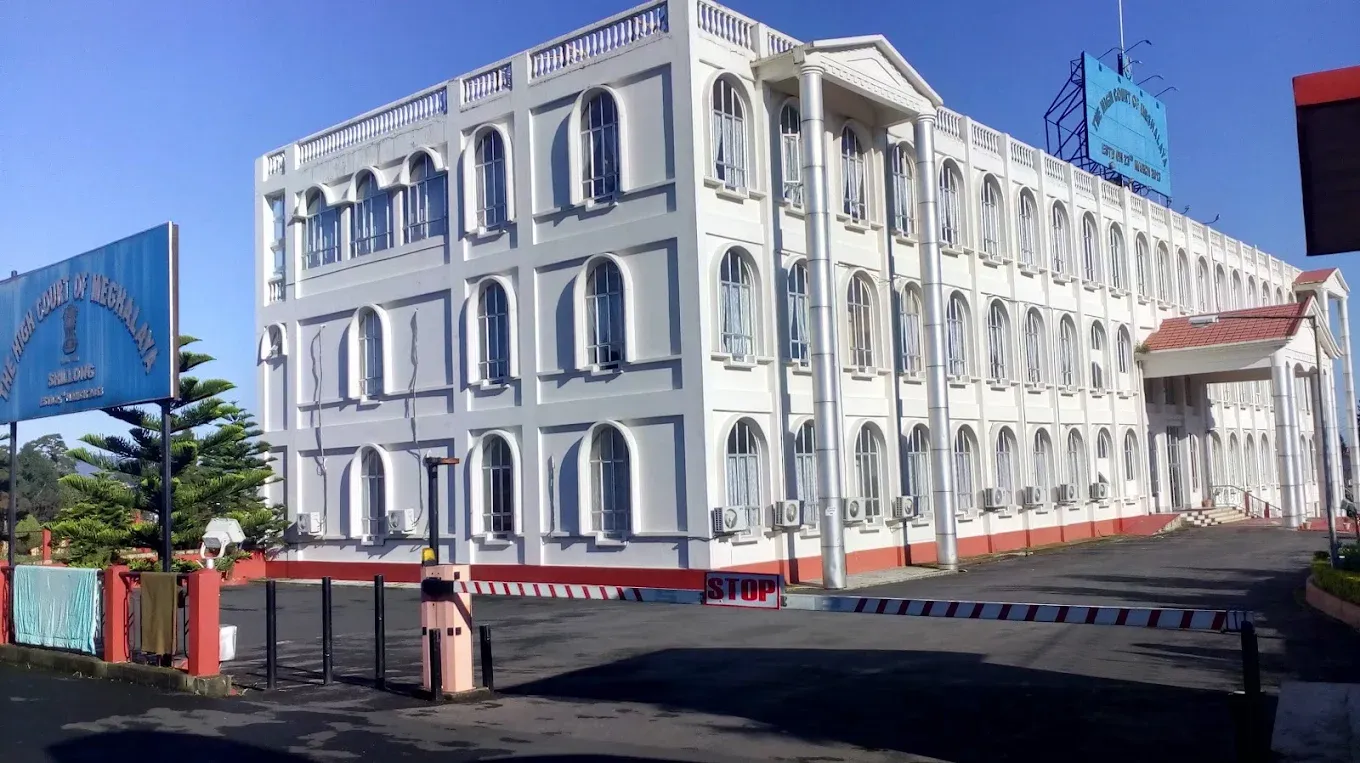
The Meghalaya High Court has issued show-cause notices to office-bearers and executive members of the Meghalaya High Court Bar Association and Shillong Bar Association over their call for lawyers to abstain from judicial work until the State Government removes the Advocate General. The Court observed that the abstention had obstructed the administration of justice and could attract criminal contempt proceedings.
A division bench comprising Chief Justice Revati Mohite Dere and Justice H.S. Thangkhiew passed the order on October 8, 2026, in a suo motu proceeding registered as PIL No. 21 of 2026.
The proceedings followed a resolution dated September 30, 2026, calling upon Bar Associations across Meghalaya to abstain from judicial work from October 1 until the Advocate General was removed from office.
The Registry's data showed that the abstention had affected court proceedings across the State, leaving litigants unrepresented, except in Baghmara district. The Court appreciated the Baghmara Bar Association for refusing to support the call, noting that participation would have been contrary to the Supreme Court's ruling in Ex-Capt. Harish Uppal v. Union of India.
The bench reiterated that lawyers have no right to go on strike or call for a boycott of court proceedings, including a token strike. Referring to Supreme Court precedents, it observed that advocates have professional obligations towards both the court and their clients.
The Court relied on Krishnakant Tamrakar v. State of Madhya Pradesh, in which the Supreme Court highlighted the connection between lawyers' strikes and delays in the administration of justice. It also referred to Common Cause v. Union of India, which held that abstention from work amounts to a strike in effect, regardless of whether it is described as a boycott or protest.
Rejecting the reason cited for the abstention, the bench observed:
A reason completely unacceptable. Courts cannot be used by lawyers to achieve their objective i.e., removal of the Advocate General. Courts are not concerned with the same and as such, abstention from work for the said reason, is uncalled for and cannot be countenanced. Strikes/abstention from work on any count much less the present reason given, is, completely illegal.
The Court observed that the abstention obstructed the administration of justice and stated that it would constitute criminal contempt under Section 2(c) of the Contempt of Courts Act, 1971. Accordingly, the bench issued show-cause notices under Section 15 of the Act, read with Article 215 of the Constitution, asking the concerned office-bearers and executive members why criminal contempt proceedings should not be initiated against them.
The matter was made returnable on October 13, 2026, with the concerned persons directed to appear personally. The Court also warned that it could issue notices to office-bearers of other District Bar Associations, excluding Baghmara, if judicial work did not resume. The Meghalaya State Bar Council and Bar Council of India were also issued notices, and the Chairman of the State Bar Council was directed to appear and inform the Court about the action taken against the protesting lawyers.
Case Title: Registrar General, High Court of Meghalaya v. State of Meghalaya & Ors.
Case Number: PIL No. 21 of 2026


