The Supreme Court has set aside the conviction and life sentences of four accused persons in a 2001 murder case from Odisha, holding that the prosecution failed to establish a complete and reliable chain of circumstantial evidence connecting them with the death.
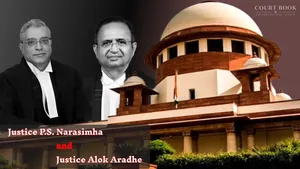
A Bench comprising Justice M.M. Sundresh and Justice Prasanna B. Varale delivered the judgment on September 18, 2026. The Court found material inconsistencies in the prosecution witnesses and held that the alleged identification of the assailants on a pitch-dark night could not safely be relied upon.
Background of the Case
The case arose from the death of Dhruba Pradhan in Odisha on May 14, 2001. According to the prosecution, one of the accused had allegedly threatened the deceased earlier in the day. Later that evening, a group of armed persons allegedly searched for him and intercepted him near Agi Chhak.
The prosecution alleged that the deceased was forcibly taken into a nearby paddy field and assaulted, resulting in his death. His motorcycle was subsequently thrown into a pond. An FIR was lodged at around 2:00 AM on May 15, 2001.
The trial court convicted six accused persons in January 2004, while acquitting eight others. The convicted persons were sentenced to life imprisonment. The Orissa High Court later upheld the convictions, relying on circumstantial evidence after rejecting the alleged eyewitness account. During the Supreme Court proceedings, two of the six appellants died, leaving four appellants in the appeals.
The Supreme Court closely examined the testimony of the prosecution witnesses, most of whom were relatives of the deceased. The Court found a significant inconsistency regarding who was actually present and witnessed the assault.
The Court also considered the lighting conditions. The incident allegedly occurred in a pitch-dark night, while the witnesses were positioned at a considerable distance. The prosecution case suggested that the accused themselves used torchlight to identify the deceased.
The Bench observed,
"the testimony of the alleged eye-witnesses cannot be relied upon."
The Court noted that if the eyewitness account was discarded, the case had to stand entirely on circumstantial evidence.
The Supreme Court reiterated that every circumstance relied upon by the prosecution must first be independently established. Those circumstances must then form an unbroken chain pointing towards the accused and excluding reasonable alternative explanations.
The Bench further emphasized that suspicion, even when strong, cannot substitute proof beyond reasonable doubt.
Examining the circumstances relied upon by the High Court, the Supreme Court found material weaknesses. The alleged identification through voice and the claim that witnesses heard the assault could not be safely accepted after the Court found the eyewitness evidence unreliable.
The Court also noted that the alleged 53-kg laterite stone said to have caused the fatal injury was not recovered, and there was no clear evidence showing how it had been brought to the spot.
The Court ultimately held that the prosecution had failed to establish a complete and consistent chain of circumstances excluding every reasonable hypothesis other than the guilt of the appellants.
Holding that the appellants were entitled to the benefit of doubt, the Supreme Court allowed the appeals and quashed the Orissa High Court judgment dated May 6, 2009, as well as the trial court's conviction and sentence dated January 28, 2004.





-300x169.webp)
-300x169.webp)