

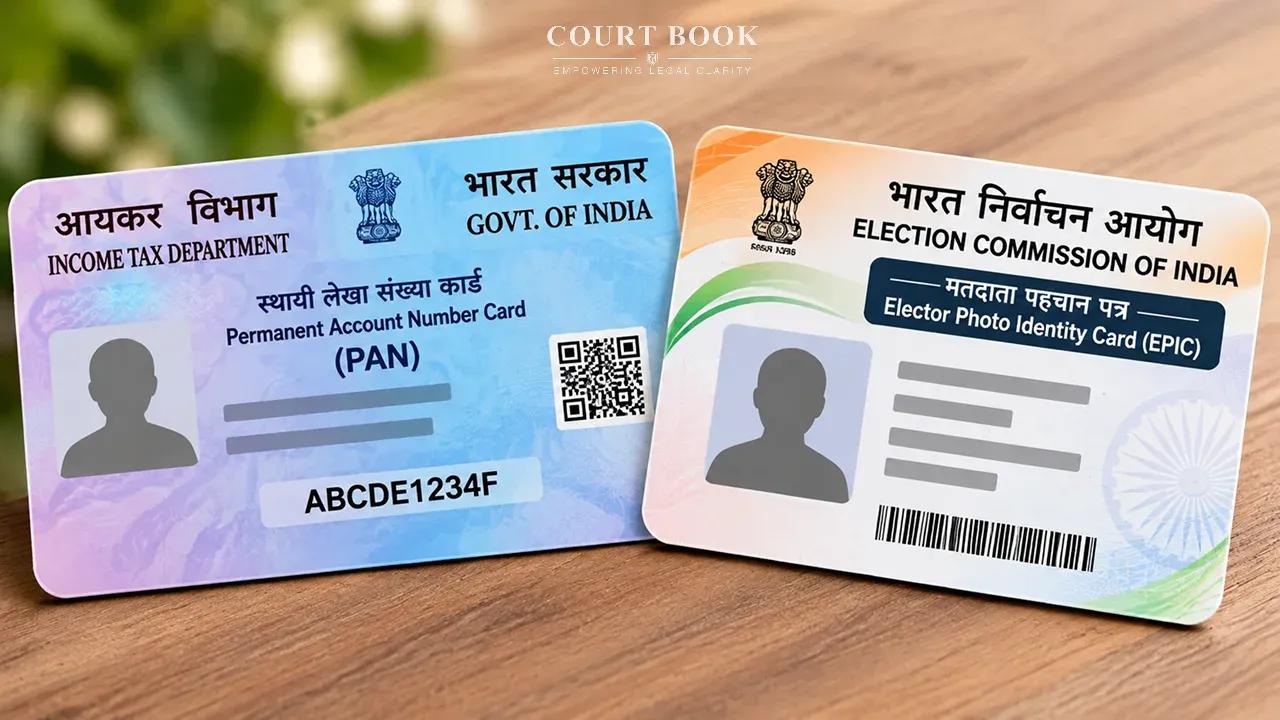
The Gauhati High Court has held that PAN cards and Electoral Photo Identity Cards (EPICs) cannot, by themselves, establish Indian citizenship when the supporting records behind their issuance have not been proved. The Court observed that such documents are generally issued on the basis of self-applications and require supporting evidence to establish a citizenship claim.
A Division Bench of Justice Kalyan Rai Surana and Justice Susmita Phukan Khaund dismissed a petition filed by Kulchan Begum, who had challenged a Foreigners Tribunal's opinion declaring her a foreigner of the post-March 25, 1971 category.
Background
Kulchan Begum claimed that she was born in Assam on April 25, 1977, and was an Indian citizen by birth. To establish her citizenship, she relied on voter lists from 1966 and 1970 containing the names of her projected grandparents. She also produced documents relating to her projected father, including his PAN card, voter ID and election-related records.
Additionally, she submitted her own PAN card, EPIC, ration card, a municipal certificate and an NRC application acknowledgement receipt. Her case was that her father was an Indian citizen who had contested parliamentary and Assembly elections and served as an elected councillor of the Guwahati Municipal Corporation.


However, the Foreigners Tribunal rejected her claim in August 2018, holding that she had failed to establish the necessary relationship with her projected father and grandparents.
Before the High Court, Begum argued that the Tribunal had failed to properly appreciate the documentary evidence. She also claimed that her previous lawyer had wrongly advised her that the documents already submitted were sufficient to establish her citizenship.
She requested that the matter be remanded to the Tribunal so that she could produce additional witnesses, including her parents and other family members, to establish her family connections.
The State opposed the request, arguing that she could not introduce evidence beyond the case presented in her original written statement.
After examining the Tribunal's records, the High Court found that the petitioner had been given several opportunities to produce additional evidence. However, she had not taken steps to examine her parents, other family members or the person who issued the municipal certificate.
The Bench also rejected her allegation that the Tribunal had decided the matter without providing an opportunity of hearing. The order sheets showed that both sides had been heard before the case was fixed for the final opinion.
On the evidentiary value of PAN cards and voter IDs, the Court made the following observation:
"The PAN Card and EPIC exhibited by the petitioner as Ext.1, Ext.5, Ext.6 and Ext.9 respectively, is not a proof of citizenship. These are documents that are issued on self-application without any formal enquiry by the Income Tax Department and Election Commission of India. Therefore, unless, the records supplementing the PAN Card and EPIC are proved, the said exhibited documents cannot be accepted as a proof of citizenship of India."
The Bench further examined the documents submitted to establish the petitioner's relationship with her projected father. It found that the municipal certificate had not been proved through its author, the NRC acknowledgement was unsupported by the original document, and the ration card and 2018 voter list did not establish her relationship with her projected parents.
The Court also noted that the petitioner had failed to establish the continuous residence of her projected grandparents and father in Assam between 1970 and 1997, as required under Section 6A(2) of the Citizenship Act, 1955.
Regarding her projected father's participation in elections and his position as a municipal councillor, the Court observed:
"Thus, a mere fact that the projected father of the petitioner had offered his candidature in Lok Sabha Election and State Assembly Election and that he was an elected Ward Member of Guwahati Municipal Corporation, is not sufficient to prove that the petitioner has been able to establish her linkage with the said person."
The Bench ultimately found that the documents produced by the petitioner were insufficient to establish her citizenship and family linkage. It observed:
"Thus, none of the exhibited documents helps the petitioner to discharge her burden under Section 9 of the Foreigners Act, 1946 to prove that she is a citizen of India and daughter of parents who are Indian."
Finding no grounds to interfere with the Foreigners Tribunal's opinion dated August 21, 2018, the Gauhati High Court dismissed Kulchan Begum's writ petition.
The Court also recalled and revoked the interim bail granted to her on April 18, 2022, and directed that the consequences of the Foreigners Tribunal's opinion would follow.



