

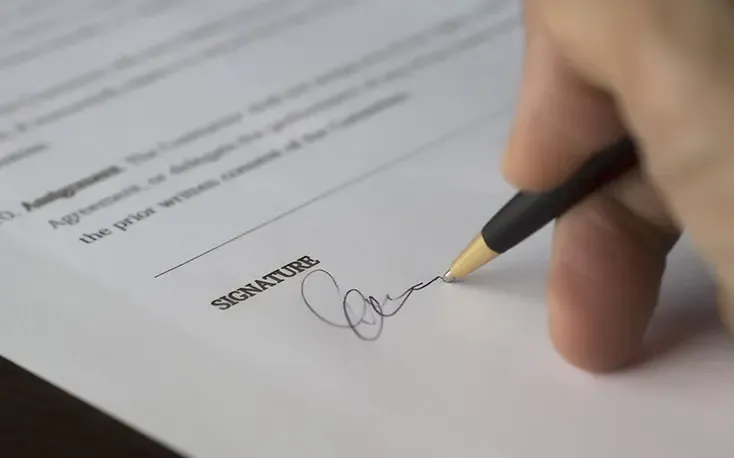
The Allahabad High Court has held that a disputed signature appearing only on a photocopy of a document cannot ordinarily be sent for forensic handwriting examination when the original document is unavailable. The Court dismissed a petition filed by Udayveer Singh, ruling that scientific comparison of signatures requires the original document because a photocopy does not preserve the features necessary for a reliable forensic analysis.
The judgment was delivered by Justice Dr. Yogendra Kumar Srivastava on July 29, 2026, while deciding a petition under Article 227 of the Constitution challenging orders passed by the Rent Authority and the Rent Tribunal, Etah.
Background of the Case
The dispute arose from eviction proceedings initiated under the Uttar Pradesh Regulation of Urban Premises Tenancy Act, 2021. Udayveer Singh claimed that he had been occupying a shop as a tenant since 2005 on the basis of a rent agreement allegedly executed with the previous owner, late Ansar Hussain.
According to the petitioner, the original rent agreement remained with the deceased landlord, leaving him with only a photocopy. During the eviction proceedings, he sought a direction for a handwriting expert to compare the disputed signatures on the photocopy with admitted signatures of the deceased available on rent receipts and other documents.
The Rent Authority rejected the application, observing that expert examination based only on a photocopy would not serve any useful purpose. The Rent Tribunal later upheld that decision, leading the petitioner to approach the High Court.
Petitioner's Stand
The petitioner argued that the authorities had wrongly denied him an opportunity to establish the authenticity of the rent agreement. He relied on the respondent's alleged statements during evidence that he could identify his late father's signatures and had acknowledged certain aspects relating to the tenancy.
According to the petitioner, these admissions provided sufficient foundation for obtaining expert opinion on the disputed signatures and rejecting the request caused serious prejudice to his defence.
Court's Observation
The High Court noted that although expert opinion is recognised under the law of evidence, such opinion is only an aid to the Court and not conclusive proof. More importantly, the material sent for examination must itself be suitable for scientific analysis.
Explaining why a photocopy is inadequate, the Court observed that forensic examination of handwriting involves studying characteristics such as line quality, pen pressure, ink flow, stroke formation, rhythm and natural variations. These features are ordinarily visible only in the original document and are lost when a document is reproduced through photocopying.
The bench observed,
"A photocopy merely reproduces the visual image of a document and inevitably obliterates these intrinsic forensic features."
The Court further held that admissions allegedly made by the respondent regarding identification of signatures or rent terms could not compensate for the absence of the original document.
As the Court put it,
"Admissions undoubtedly constitute relevant evidence, but they do not confer upon a party an indefeasible right to seek expert examination of a document which is unavailable in its original form."
Limits of High Court's Supervisory Jurisdiction
Justice Srivastava also emphasised that the High Court's jurisdiction under Article 227 is supervisory rather than appellate. It cannot substitute its own opinion merely because another view may also be possible. Interference is justified only where subordinate courts have acted without jurisdiction or where their orders suffer from patent illegality, perversity or grave miscarriage of justice.
The Court found that both the Rent Authority and the Rent Tribunal had considered relevant factors before refusing the request for expert examination. Their exercise of discretion, the Court said, was based on settled legal principles and did not warrant interference.
The High Court also clarified that dismissal of the application for handwriting examination does not prevent the petitioner from proving the alleged tenancy through other legally admissible evidence such as rent receipts, oral testimony or other documentary material.
Court's Decision
Finding no jurisdictional error or legal infirmity in the orders passed by the Rent Authority and the Rent Tribunal, the Allahabad High Court dismissed the petition. The Court held that expert examination based solely on a photocopy would not provide dependable forensic assistance and therefore declined to interfere with the decisions of the authorities below.
No order as to costs was passed.
Case Details
Case Title: Udayveer Singh v. Rent Tribunal and 2 Others
Case Number: Matters Under Article 227 No. 3845 of 2026
Judge: Hon'ble Dr. Justice Yogendra Kumar Srivastava
Decision Date: July 29, 2026


