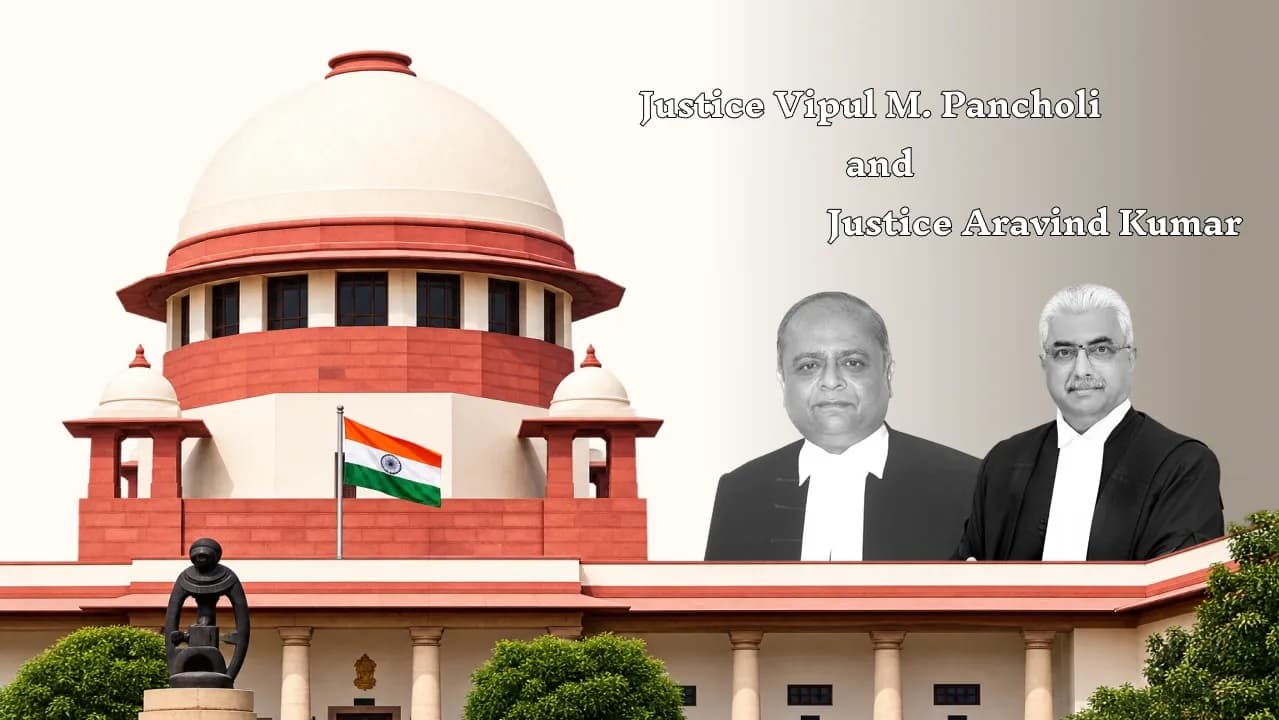
The Supreme Court has set aside the cancellation of sand mining auctions for Shahdol and Katni districts in Madhya Pradesh, ruling that a bidder’s previous high offer cannot automatically become the minimum benchmark for a future auction. A Bench of Justice Aravind Kumar and Justice Vipul M. Pancholi held that rejecting fresh bids requires relevant material showing why the amounts offered are inadequate.
The Court allowed appeals filed by Sahakar Global Limited and M/s Dhanlaxmi Merchandise Private Limited, restoring the October 2025 tender process and setting aside the Madhya Pradesh High Court’s judgment that had upheld the cancellations.
Background
The dispute arose after both companies surrendered their earlier sand mining contracts and participated in fresh auctions conducted by the Madhya Pradesh State Mining Corporation Limited in October 2025.
Sahakar emerged as the highest bidder for Shahdol with an annual offer of ₹48.20 crore, while Dhanlaxmi secured the highest bid for Katni at ₹54.07 crore. Both offers exceeded their respective reserve prices.
However, the Corporation cancelled the auctions in November 2025, citing substantial reductions compared with the companies’ earlier annual bids. The difference was approximately 29.98% for Shahdol and 16.52% for Katni. The Madhya Pradesh High Court upheld the decision in March 2026, prompting the companies to approach the Supreme Court.
The Court acknowledged that the highest bidder does not automatically acquire an enforceable right to a contract and that public authorities can reject bids to protect public revenue. However, such decisions must comply with Article 14 of the Constitution, which requires fairness and non-arbitrary State action.
The Bench observed:
“A previous bid is not, by itself, a continuing adjudication of market value.”
It explained that an earlier offer reflects a bidder’s commitment under a particular contractual arrangement. It does not establish the amount that a fresh auction must necessarily generate, particularly when the new tender provides for a separate contractual tenure.
The Court also noted that seven bidders had qualified for Shahdol and five for Katni. The auctions generated successive bids, and the Corporation had not identified collusion, manipulation or any procedural defect. Yet, it rejected the results primarily by comparing them with the companies’ previous offers.
The judgment further noted that the January 2026 amendment to the Sand Rules introduced restrictions on surrendering operators participating in subsequent auctions for the same group. Those restrictions could not retrospectively disqualify bidders who were eligible under the rules governing the October 2025 auction.
Holding that the earlier bids alone did not establish that the fresh offers were inadequate, the Supreme Court ruled that the cancellation could not be sustained.
The Court set aside the Madhya Pradesh High Court’s judgment dated March 18, 2026, and quashed the cancellation of the Shahdol and Katni auctions.
It directed the companies to confirm their willingness to honour their final bids within two weeks, after which the Corporation must communicate the outstanding formalities and complete the consequential approval and allotment process, subject to compliance with the tender conditions.