

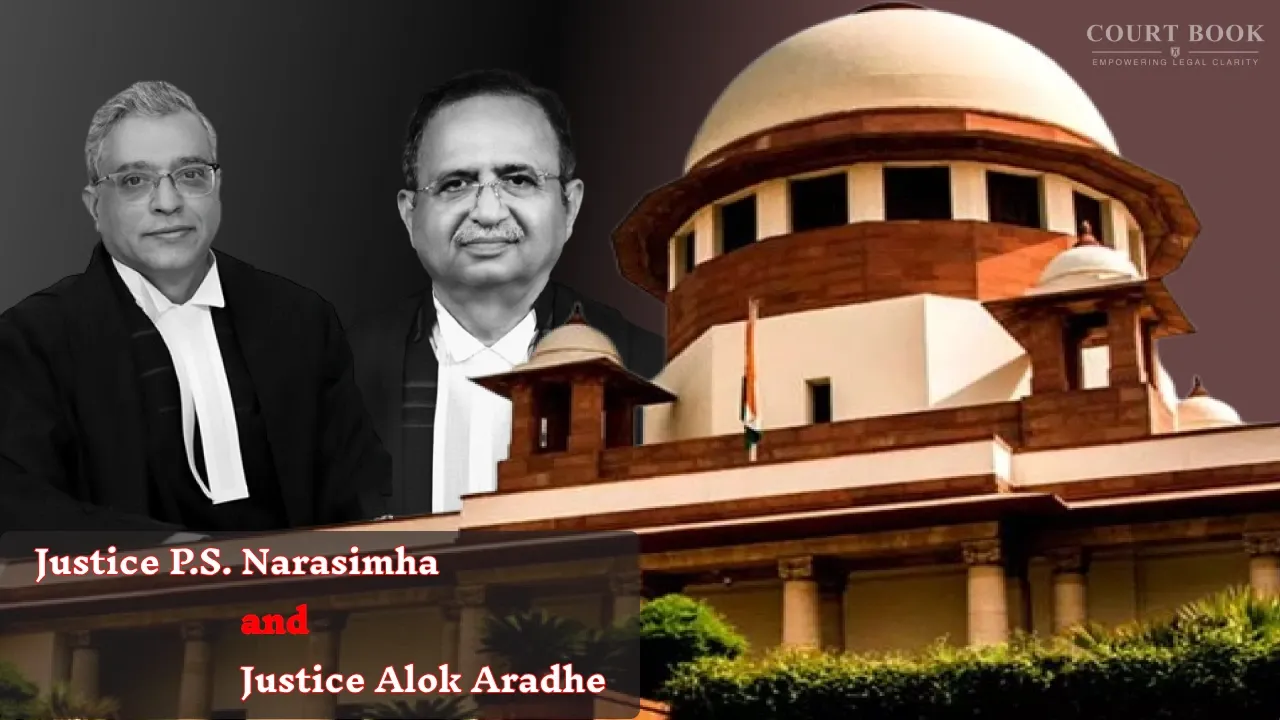
The Supreme Court on August 14, 2026, ruled that the protection available under Section 60(1)(ccc) of the Code of Civil Procedure (CPC), which exempts a judgment-debtor’s main residential house from attachment and sale in certain cases, is personal to the judgment-debtor. The benefit does not extend to the deceased judgment-debtor’s legal representatives.
A Bench of Justice Pamidighantam Sri Narasimha and Justice Alok Aradhe also held that the absence of a notice under Order XXI Rule 22 of the CPC did not invalidate the auction sale in the circumstances of the case.
Background of the Case
The dispute arose from recovery proceedings initiated by Punjab & Sind Bank against a company and its guarantors after the company defaulted on its loan obligations. A compromise decree was passed by the Morena Court in 1991. After the judgment-debtor died, his widow and children were impleaded in the execution proceedings.
The proceedings were later transferred to the Debts Recovery Tribunal (DRT). In 2006, the Recovery Officer ordered the auction of a residential property at Panchsheel Park, New Delhi. The auction was eventually confirmed in favour of the auction purchaser.
The Madhya Pradesh High Court had subsequently set aside the DRAT order and remitted the matter to the DRT for examining whether the widow had suffered substantial prejudice due to non-service of notice and whether the property was protected under Section 60(1)(ccc) CPC.Supreme Court’s Observations
The Supreme Court noted that the execution proceedings had been transferred to the DRT under the Recovery of Debts and Bankruptcy Act, 1993. Once before the Recovery Officer, the applicable procedure was governed by Section 29 of the 1993 Act read with the Second Schedule to the Income-tax Act, 1961.
The Bench observed that Order XXI Rule 22 CPC therefore had no impact on the validity of the auction sale.
On the absence of notice under Rule 2 of the Second Schedule, the Court acknowledged that no such notice had been served on the widow or her children. However, it found that they were already parties to the execution proceedings and that the widow had knowledge of the auction proceedings. She had also filed objections seeking recall of the auction order.
“The question of substantial injury” therefore did not arise in the circumstances, the Court held, noting that the remedy under Rule 61 to challenge the sale had also not been pursued.
Residential Property Exemption
The Court then examined Section 60(1)(ccc) CPC. It held that the provision protects one main residential house belonging to and occupied by the judgment-debtor.
The Bench remarked that the statutory protection is “personal to the judgment debtor” and does not pass to legal representatives merely because they inherit or occupy the property.
The Court also noted that the exemption had not been raised before the Recovery Officer or in the earlier proceedings and was introduced only at a later stage. It held that the High Court was therefore wrong in remitting the matter for a fresh factual inquiry on that issue.
Decision
The Supreme Court quashed and set aside the Madhya Pradesh High Court judgment dated May 15, 2009. Civil Appeal No. 182 of 2016 filed by the auction purchaser and Civil Appeal No. 190 of 2016 filed by Punjab & Sind Bank were allowed, while Civil Appeal No. 191 of 2016 filed by Jagminder Singh was dismissed.
The Court made no order as to costs.


