

The Supreme Court has restored the co-ownership and partition rights of the legal heirs of late Ramprasad in an agricultural property dispute from Indore, holding that a revenue mutation entry by itself cannot extinguish a person’s title to immovable property.
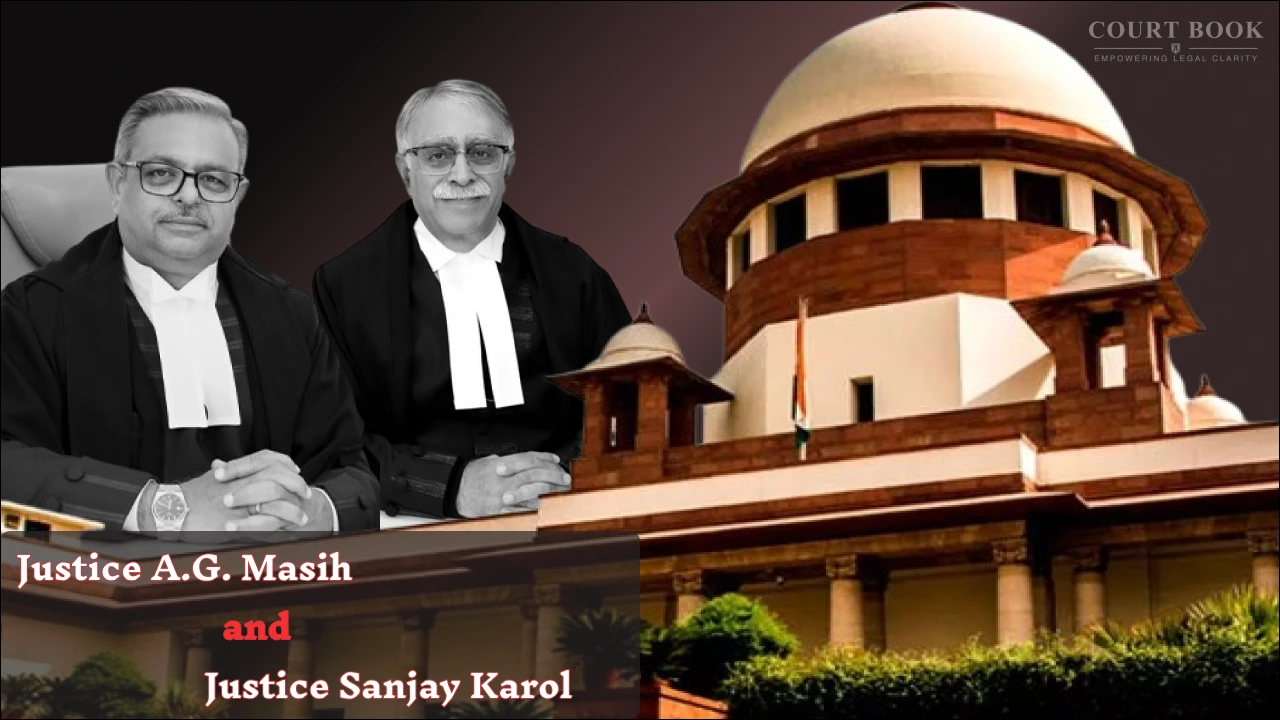
A Bench of Justice Sanjay Karol and Justice Augustine George Masih set aside the Madhya Pradesh High Court’s judgment, finding that the High Court had exceeded the limited scope of its jurisdiction in a second appeal by disturbing concurrent factual findings of the trial court and first appellate court.
Background of the Case
The dispute concerned around 12.41 acres of agricultural land bearing Survey No. 307 at Kanadia village in Indore, along with a house standing on the property. The land originally belonged to Bhagwansingh, whose two sons were Ramprasad and Vasudev. After Bhagwansingh’s death, the property was mutated jointly in their names.
The appellants claimed that Ramprasad continued to hold an equal proprietary share. They approached the civil court in 2008 after discovering that his name had been removed from the revenue records and portions of the property had been recorded in the names of Vasudev and his son Jaswant.
The respondents, however, relied on documents from 1990, including an affidavit, a statement before the Naib Tehsildar and a written consent letter, claiming that Ramprasad had voluntarily given up his interest in the property.
The trial court rejected that defence and recognised the appellants’ co-ownership rights. The first appellate court also upheld the decree after examining additional revenue records and evidence. The Madhya Pradesh High Court later reversed those findings and dismissed the suit on limitation and other grounds.
Supreme Court on High Court’s Second-Appeal Powers
The Supreme Court first examined whether the High Court was justified in interfering with concurrent findings of fact.
The Bench explained that Section 100 of the Code of Civil Procedure gives the High Court a restricted jurisdiction in a second appeal. A High Court can interfere where there is a substantial question of law, but concurrent factual findings cannot ordinarily be reopened merely because another interpretation of the evidence appears possible.
“Concurrent findings of fact ordinarily cannot be disturbed in such an appeal unless they are shown to be perverse or vitiated by an error of law, and the existence of a power to interfere where findings are demonstrably perverse cannot become a license to reappreciate the evidence merely because another view of it is possible.”
The Court found that the High Court had effectively reappreciated the same evidence instead of identifying the kind of legal error or perversity required for interference under Section 100 CPC.
Revenue Mutation Could Not Extinguish Property Rights
The Supreme Court also examined the alleged relinquishment of Ramprasad’s share.
It noted that the respondents carried the burden of proving that Ramprasad had legally surrendered his interest. The Court found deficiencies in the evidence relied upon, including the absence of independent witnesses to establish the execution of the disputed documents.
The Bench further clarified the legal effect of mutation entries:
“An entry in the revenue record neither creates nor extinguishes title and exists essentially for fiscal purposes.”
The Court held that the mutation order could regulate revenue records but could not, by merely replacing one person’s name with another, operate as a conveyance or relinquishment of proprietary rights.
Limitation and Specific Relief Act Issue
The Supreme Court also rejected the High Court’s view that the suit was barred because the mutation had taken place in 1990.
The Court said limitation could not be calculated simply from the date of a revenue entry. What mattered was when the right to sue actually accrued. It noted that there was no finding that Ramprasad had been openly and unequivocally ousted from the property during his lifetime or that the appellants had actual knowledge of the alleged relinquishment in 1990.
The Court further held that the suit was not merely for a declaration. The appellants had also sought partition, possession and permanent injunction. Therefore, the absence of a separate prayer seeking cancellation of the mutation entry did not make the suit legally unmaintainable.
Decision
The Supreme Court allowed the appeal and set aside the Madhya Pradesh High Court judgment dated May 9, 2025. It restored the first appellate court’s judgment dated May 2, 2019, which had affirmed the trial court decree dated May 4, 2016.
The Court held that the appellants and other legal heirs of Ramprasad would be entitled to the share declared in their favour, subject to lawful partition under the applicable Madhya Pradesh Land Revenue Code provisions.
The respondents were also restrained from alienating the disputed property or creating third-party rights contrary to the trial court decree until lawful partition.
No order as to costs was made.
Case Details
Case Title: Jamnabai and Others v. Vasudev and Others
Case Number: Civil Appeal arising out of SLP (C) No. 39 of 2026
Judge: Justice Sanjay Karol and Justice Augustine George Masih
Decision Date: August 20, 2026


