

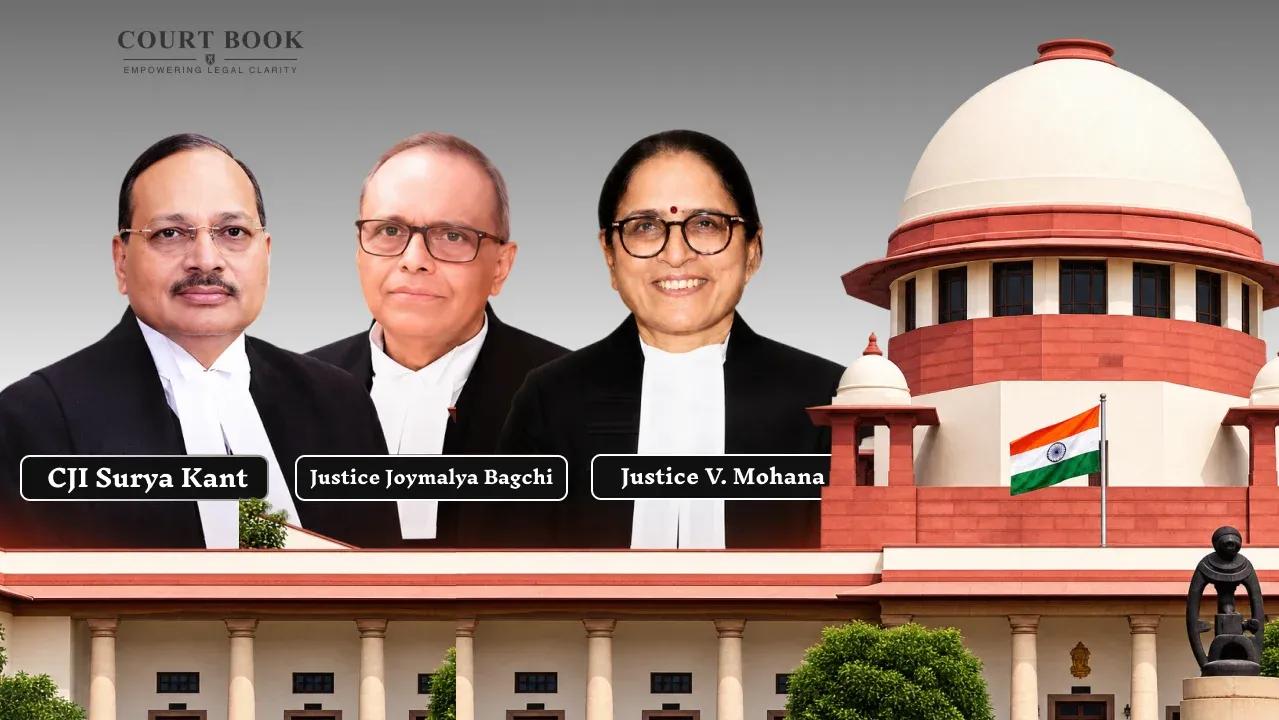
The Supreme Court on November 23 strongly criticised a Bihar Sessions Judge for holding a police officer guilty of contempt over alleged non-compliance with a direction to register an FIR. The Bench questioned the judge's understanding of the law and warned him against acting beyond his jurisdiction, telling him not to behave like a “Bahubali.”
A Bench comprising Chief Justice of India Surya Kant and Justices Joymalya Bagchi and V Mohana was hearing a plea filed by Sessions Judge Anil Kumar challenging observations made by the Patna High Court concerning his actions.
Background
Anil Kumar, while serving as the Additional Sessions Judge-IV at Rohtas, Sasaram, had directed the Superintendent of Police to register a criminal case against a person allegedly involved in giving false evidence in a case decided in 2023.
Following alleged non-compliance with the direction, the judge initiated contempt proceedings against the police officer. On September 29, 2026, he held the SP guilty and imposed a symbolic fine of ₹1. He also made observations concerning the functioning and training of IAS and IPS officers.


The Patna High Court subsequently questioned the proceedings, particularly because the original judgment and its directions were already under challenge before it. The High Court sought records of the contempt proceedings and made critical observations regarding the judicial officer's actions.
During the hearing, Justice Joymalya Bagchi questioned whether failure to comply with a direction to register an FIR could be treated as an offence committed in the presence of the court.
The Bench explained that such offences could include acts like assaulting someone in court, abusing the court or refusing to leave the courtroom when directed. However, administrative non-compliance with a judicial direction did not automatically fall within that category.
Justice Bagchi remarked:
“We are really surprised at your understanding of law. You must first understand the scope and ambit of Section 384 BNSS and Section 345 CrPC. If someone slaps someone or abuses the Court, or refuses to leave the courtroom when directed, that is an offence committed in the face of the Court. But if we direct someone to register an FIR and they do not, it does not amount to a crime committed in the face of the Court.”
The Court also questioned the judge's decision to summon the Superintendent of Police and convict him on the same day, observing that the matter could have been left to the High Court.
Justice Bagchi further remarked:
“Your understanding of law is also very appalling. Such an aggressive stance you are taking, asking the Superintendent to come and on the same day, you have convicted him, fined him. It would have been better if you had left it to the High Court.”
The Bench emphasised that judges must remain conscious of procedural constraints and their legal authority. It also advised the judicial officer to undergo training at the National Judicial Academy.
“Enough of adventure. Go to the National Judicial Academy and have training. Now, to become the Bahubali? As a judge, you must know your jurisdiction.”
The Supreme Court disposed of the plea and permitted the Sessions Judge to approach the Patna High Court. It requested the High Court to consider his explanation-cum-apology sympathetically while dealing with the proceedings.



