

The Supreme Court has set aside the absorption of four officers from Haryana’s Development and Panchayat Department into the Public Works Department (Building and Roads), holding that their appointment by transfer was contrary to the applicable service rules.
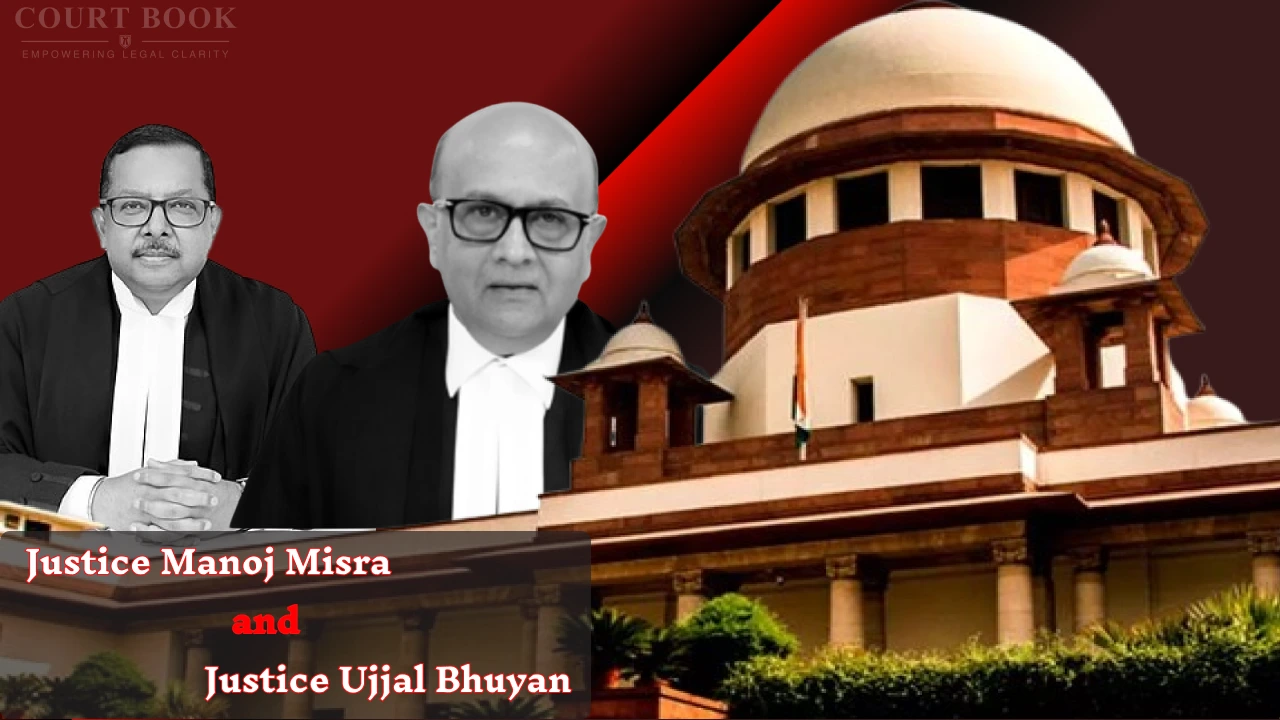
A Bench of Justice Manoj Misra and Justice Ujjal Bhuyan delivered the judgment on August 18, 2026, in a batch of connected civil appeals arising from disputes over deputation, absorption and seniority in the cadre of Assistant Engineer (Civil)/Sub-Divisional Engineer (Civil).
The Court held that the four officers could not continue in the PW(B&R) Department merely because they had remained there for many years. It directed their repatriation to the Development and Panchayat Department.
Background of the Case
The dispute concerned four officers - Pradeep Atri, Praveen Chaudhary, Pankaj Gaur and Arun Bhatia - who were originally serving in the Development and Panchayat Department of Haryana.
They were sent to the PW(B&R) Department on deputation and were subsequently absorbed there as Assistant Engineers/Sub-Divisional Engineers. Their absorption was challenged by direct recruits who argued that the officers had been placed in the department through a route that was not permitted under the Punjab Service of Engineers, Class II, P.W.D. (Buildings and Roads Branch) Rules, 1965.
The Punjab and Haryana High Court had earlier held that their deputation and absorption were bad in law. However, considering that the officers had remained in service since around 2005 and no longer had a lien in their parent department, the High Court allowed them to continue while restricting their seniority.
The Supreme Court examined whether that approach could legally be sustained.
Supreme Court's Observations
The Court focused particularly on Rule 10 of the 1965 Rules, which permits appointment by transfer in "special circumstances".
The Bench explained that the expression cannot be used for ordinary administrative situations. According to the Court, "special circumstances" must mean something beyond what is normal or routine. A shortage of officers or the existence of vacancies, by itself, does not satisfy that requirement.
In Pradeep Atri's case, the Court noted that he had participated in the direct recruitment process for the same post but had not qualified. His subsequent absorption into the department was therefore found to have enabled him to obtain indirectly what he had not obtained through the regular recruitment process. The Court held that there were no special circumstances supporting his absorption.
The Court reached a similar conclusion regarding Praveen Chaudhary. It noted that his deputation had been initiated soon after his appointment in the parent department and that the process for his absorption followed shortly after he joined the PW(B&R) Department. The Bench also referred to political involvement in the process.
As regards Pankaj Gaur and Arun Bhatia, the Court found that their qualifications, satisfactory work and the possibility that they would become junior-most in their parent department could not amount to "special circumstances" under Rule 10.
The Bench further observed that political influence and favouritism could not be treated as a lawful basis for appointment by transfer.
Long Service Could Not Cure the Illegality
The Supreme Court disagreed with the High Court's decision to allow the four officers to remain in the PW(B&R) Department because of the length of their service.
The Bench observed that an appointment made contrary to statutory rules is illegal from the beginning.
"Illegality cannot be cured and made legal and valid by lapse of time," the Court said, relying on the principles laid down by the Constitution Bench in Uma Devi.
The Court also clarified that termination of their absorption would not leave them without a substantive position. Since the deputation and absorption were being set aside, their lien in the parent department would revive.
Decision
The Supreme Court held that the deputation of Pradeep Atri and Praveen Chaudhary was illegal, while the deputation of Pankaj Gaur and Arun Bhatia was irregular.
More importantly, the Court declared the absorption of all four officers in the PW(B&R) Department "illegal, non est and void". Their absorption orders were set aside and quashed.
The four officers were directed to be repatriated to the Development and Panchayat Department, where their cadre and seniority would be determined by the competent authority in accordance with the Court's directions.
The Supreme Court consequently set aside the portion of the Punjab and Haryana High Court's judgment that had allowed the four officers to continue in the PW(B&R) Department. All the civil appeals were disposed of accordingly.
Case Details:
Case Title: Hemant Kumar & Ors. v. State of Haryana & connected matters
Case Number: Civil Appeal Nos. of 2026, arising from SLP (C) Nos. 12017-12018 of 2023 and connected matters
Judges: Justice Manoj Misra and Justice Ujjwal Bhuyan
Decision Date: August 18, 2026


