

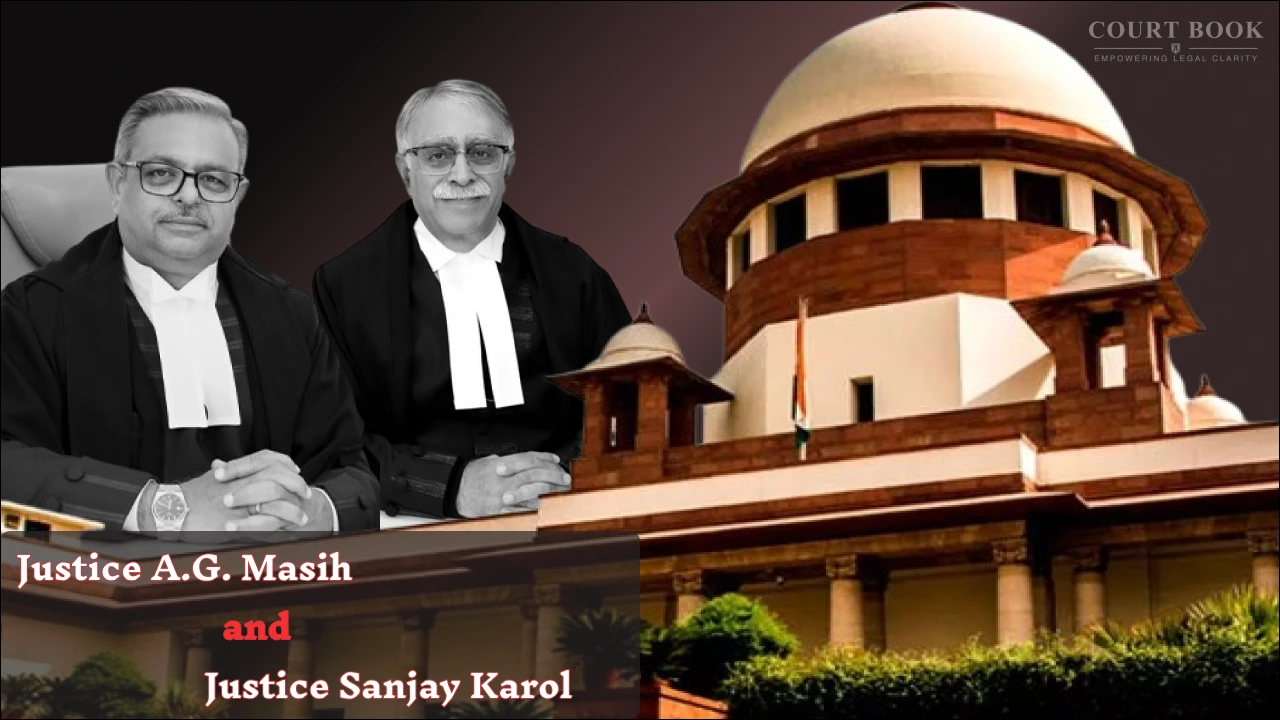
The Supreme Court on August 17, 2026, cancelled the bail granted to a foreign national accused in a case involving about five kilograms of heroin and issued a detailed set of directions to strengthen bail and surety verification in NDPS cases involving foreign nationals.
A Bench of Justices Sanjay Karol and Augustine George Masih held that the case had gone beyond an ordinary challenge to a bail order after the accused could not be traced following his release and the sureties produced on his behalf were found to be non-existent. The Court described what had emerged during the proceedings as “deeply unsettling.”
Background of the Case
The proceedings arose from Crime No. 37 of 2023 registered by the Directorate of Revenue Intelligence under several provisions of the Narcotic Drugs and Psychotropic Substances Act, 1985.
The accused, Chidiebere Kingsley Nawchara, was arrested on March 16, 2023, after 4,935 grams of heroin were recovered from another person at Mumbai airport. The prosecution case relied, among other things, on statements and WhatsApp communications said to connect the accused with the movement of the alleged drug consignment.
The Special NDPS Court at Greater Mumbai had rejected his bail application in September 2024. However, the Bombay High Court subsequently granted regular bail in May 2025, citing the material relied upon by the prosecution and the accused’s prolonged custody.
The Supreme Court later stayed the bail order and directed authorities to arrest the accused. Despite a Look Out Notice and other steps, he could not be traced. The Court recorded that he had effectively “jumped the bail.”
Supreme Court’s Observation on Bail
The Bench noted that the High Court had not recorded the satisfaction required under Section 37 of the NDPS Act for granting bail in a case involving commercial quantity.
The Court particularly considered the previous NDPS conviction recorded against the accused. It noted that the quantity involved in the present case was around five kilograms of heroin and that Section 31A of the NDPS Act was attracted at the threshold of one kilogram in the circumstances discussed by the Court.
The Supreme Court also observed that prolonged custody could not, by itself, overcome the statutory requirements governing bail under the NDPS Act.
Fake Sureties Raise Serious Concern
The case took a wider turn when authorities examined the sureties furnished for the accused.
The address provided by one surety was found to be non-existent. The employer named by the surety also stated that the person had never worked there, while the bank details supplied in the surety bond could not be verified.
The Supreme Court said that where sureties themselves turn out to be fake, the mechanism intended to secure an accused’s presence becomes ineffective. It therefore invoked its power under Article 142 of the Constitution to address the lack of uniformity in surety verification.
Directions for Foreign Nationals in Commercial-Quantity NDPS Cases
The Court directed that foreign nationals accused in NDPS cases involving commercial quantity must deposit their passports with the jurisdictional court and register with the Foreigners Regional Registration Office within one week of release.
They must ordinarily provide two sureties of like amount. Courts may relax the requirement only where securing two sureties is shown to be genuinely difficult or impossible, and reasons must be recorded in writing.
The Court further directed that sureties must be verified within three days and that the accused’s Indian residential address must also be physically re-verified before release. A centralised database of accused persons and sureties is to be created, while High Courts have been directed to develop digital systems for faster verification of property and financial documents.
The Court also directed departmental inquiries where sureties later found to be fake had been officially verified. A lien or charge equal to the surety amount is to be created on property furnished by a surety, subject to the terms laid down by the Court.
Decision
The Supreme Court held that the accused’s bail conditions had been violated after he became untraceable. It therefore cancelled the bail granted by the Bombay High Court and issued the above directions concerning foreign nationals facing NDPS cases involving commercial quantities.
The appeal was ultimately disposed of in these terms.
Case Details:
Case Title: Union of India v. Chidiebere Kingsley Nawchara & Ors.
Case Number: Criminal Appeal No. of 2026 @ SLP (Crl.) No. 14185 of 2025
Judge: Justice Sanjay Karol and Justice Augustine George Masih
Decision Date: August 17, 2026


