

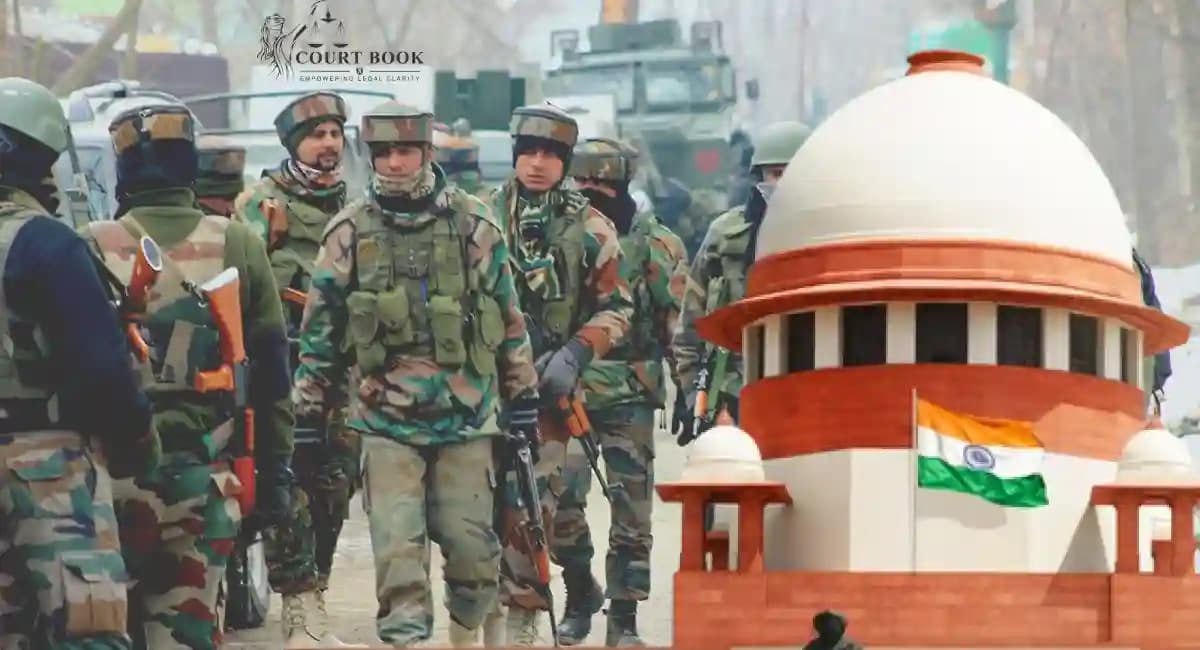
The Supreme Court has ruled that an accidental gunshot injury sustained from a soldier’s own service weapon while on duty in an active counter-insurgency operation qualifies as a "Battle Casualty" for enhanced war injury pension. A bench of Justice Satish Chandra Sharma and Nongmeikapam Kotiswar Singh allowed the appeal filed by retired Subedar Major and Honorary Lieutenant Devi Singh. The Court set aside an earlier order of the Armed Forces Tribunal (AFT) in Lucknow, holding that genuine surviving field records cannot be discarded simply because original files were destroyed in floods or missed during later digitisation.
Background
Devi Singh joined the Indian Army in June 1985 and retired in March 2019 after 33 years of service. On 7 August 2002, while deployed with the 31 Sub Area Signal Company in Jammu and Kashmir during Operation Rakshak and Operation Parakram, his loaded weapon accidentally discharged on duty. The bullet pierced his left thigh and damaged his femoral vein, leaving him with a 40% permanent disability. While the government granted him an ordinary disability pension, it denied him the higher War Injury Element because the Adjutant General’s Branch (MP-5) had not issued a final Battle Casualty Certificate and his name was missing from a later digital database. The original Court of Inquiry files had been destroyed while in official custody during the 2014 floods.
Examining Regulation 103 and Category ‘E’ of Regulation 82 of the Pension Regulations for the Army, the bench clarified that an accidental discharge is legally distinct from an intentional, self-inflicted wound. The Court noted that contemporaneous unit orders, medical board proceedings, and a 2015 certificate from Signals Records consistently recorded the incident as a battle casualty linked to Operation Rakshak.
"Weapon ownership and intention are distinct facts, the former cannot, without evidence of intention, prove the latter."


The bench further observed that the Army’s own records had explicitly described the 2002 incident as an accident, and no medical or command authority had ever suggested deliberate self-harm. Addressing the missing digital entry and destroyed files, the judges emphasised that field commanders are best placed to certify operational realities.
"The absence of the appellant's name from a subsequently created digital database is merely the absence of further corroboration, but it is not affirmative evidence capable of disproving the contemporaneous and signed official records that have survived. The appellant, therefore cannot be made to suffer for no fault on his part."
The Supreme Court allowed the appeal and set aside the Lucknow Tribunal’s orders from May and July 2023. The bench directed the Union of India to sanction and pay the War Injury Element of pension to Devi Singh effective from his retirement date, adjusting the ordinary disability pension already paid.
The authorities have been ordered to issue the revised Pension Payment Order and clear all net arrears within three months.



