

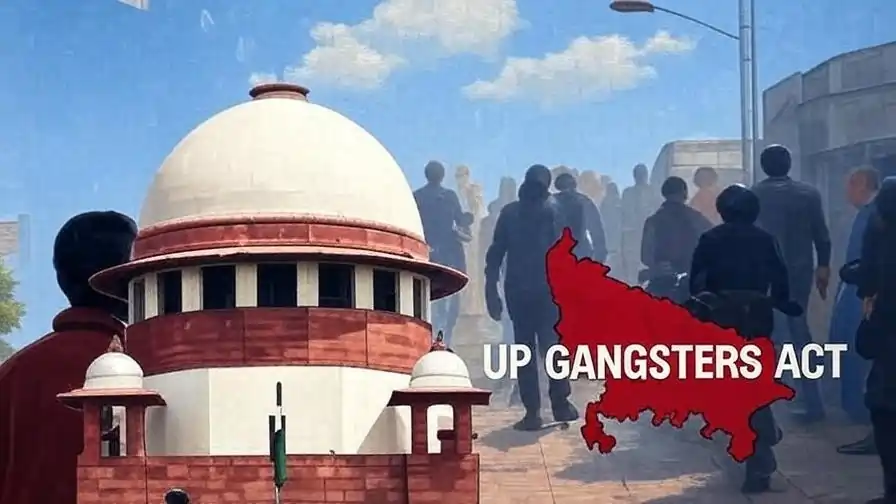
The Supreme Court has held that the Uttar Pradesh Gangsters and Anti-Social Activities (Prevention) Act, 1986, in its present form, is “stillborn” as it does not create an independent criminal offence. The Court consequently quashed proceedings initiated under the Gangsters Act against two advocates, while making it clear that criminal cases under other penal laws would not be affected by its ruling.
A Bench of Justice J.B. Pardiwala and Justice K. Vinod Chandran delivered the judgment on August 20, 2026, in two criminal appeals challenging proceedings under Sections 2 and 3 of the U.P. Gangsters Act. The Court held that a Gang Chart prepared under the 2021 Rules cannot itself create criminal liability when the parent legislation does not create a distinct offence.
Background of the Cases
The first appeal concerned an advocate who became involved in a dispute relating to elections of the Bar Association at Fatehgarh, Farrukhabad. After disciplinary proceedings before the Bar Council of Uttar Pradesh and a subsequent FIR, the police registered another FIR under the U.P. Gangsters Act in February 2024, accompanied by a Gang Chart.
The allegations in that FIR broadly described the accused as members of a criminal gang involved in various anti-social activities. The advocate challenged the proceedings, but the High Court declined to grant the relief sought.
The second appeal arose from proceedings against another advocate and members of his family. An FIR under Sections 2 and 3 of the U.P. Act was registered at Loni Border, Ghaziabad Rural. The Supreme Court noted that the Gang Chart relied upon in that case had not been produced with the record.
Supreme Court Examines the U.P. Gangsters Act
The central question before the Court was not whether the allegations in the underlying criminal cases were true. The Court specifically clarified that offences registered under other penal laws would continue to be dealt with under those laws.
The issue was narrower: whether the U.P. Gangsters Act itself created an offence for which a person could be prosecuted and punished.
The Bench examined Section 2, which defines a “gang” and “gangster”, and Section 3, which prescribes punishment. It found that the activities listed in Section 2(b) were already punishable under other laws. According to the Court, the U.P. Act did not independently create a separate offence corresponding to those activities.
The Court explained:
“There can be no punishment without an offence in law.”
It held that the principle is reflected in Article 20(1) of the Constitution, which prevents punishment for conduct unless there is a law creating the offence and prescribing the applicable punishment.
Gang Chart Cannot Create a Criminal Offence
The Bench also examined the role of the 2021 Rules, particularly the mechanism for preparing and approving a Gang Chart.
The Court held that the Rules could not create an offence when the parent statute itself had not created one. In its view, determining a person's status as a “gangster” through the Gang Chart and then imposing punishment under Section 3 went beyond the authority given to the State Government to frame rules.
The judgment further observed that the statutory scheme could result in a person facing prolonged pre-trial incarceration and punishment based on the same Gang Chart, even though the underlying acts were separately punishable under other criminal laws.
Court’s Decision
The Supreme Court ultimately held that the U.P. Gangsters Act, as presently framed, was “stillborn” because it did not create a criminal offence.
The Court clarified that it was not deciding the constitutional validity of the Act as a whole and was not affecting criminal charges arising under other penal statutes. Those proceedings, the Court said, would continue according to the applicable laws.
The Bench allowed both appeals and quashed the impugned proceedings, including the charge sheet arising from FIR No. 41 of 2024 in the first case and the Sessions Case arising from FIR No. 740 of 2022 in the second case.
It directed that the appellants be released forthwith if they were not required in any other case.
Case Details
Case Title: Shiv Pratap Singh Alias Chinu v. State of U.P. & Ors. with Himanshu Srivastava v. State of U.P. & Ors.
Case Number: Criminal Appeal No. 3979 of 2026 and Criminal Appeal No. 3980 of 2026
Judge: Justice J.B. Pardiwala and Justice K. Vinod Chandran
Decision Date: August 20, 202


