

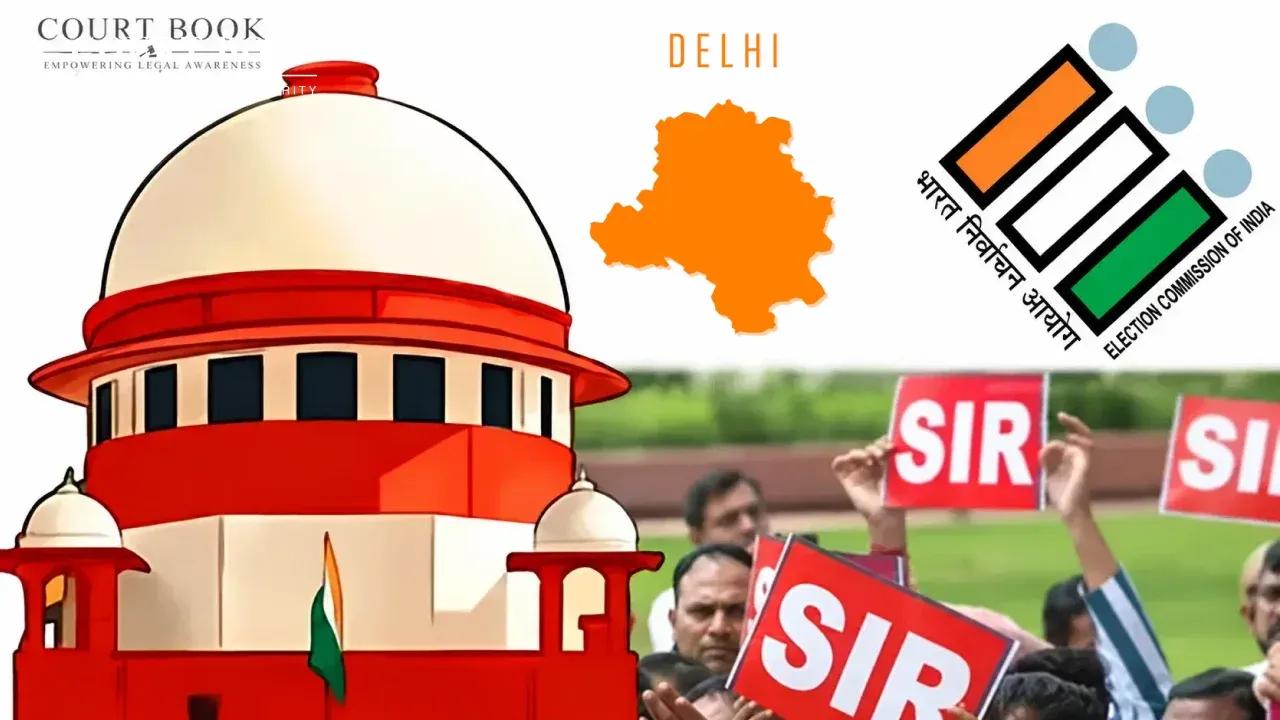
The Supreme Court has questioned the Election Commission of India (ECI) over requiring previously registered voters excluded from Delhi’s draft electoral rolls during the Special Intensive Revision (SIR) to submit Form 6, which is intended for first-time voter registration. The Court suggested allowing such voters to submit their pending enumeration forms and use Form 8 where applicable.
A Bench comprising Chief Justice of India Surya Kant, Justice Joymalya Bagchi and Justice V. Mohana was hearing a writ petition filed by Anjali Bharadwaj and Amrita Johri concerning the Delhi SIR exercise. The petitioners raised concerns about transparency and the process followed for voters whose names were missing from the draft electoral rolls.
Advocate Prashant Bhushan, appearing for the petitioners, submitted that around 43 lakh voters had been categorised as shifted or absent. He argued that many had not received enumeration forms despite being included in earlier electoral rolls. Requiring them to submit Form 6, he contended, could force previously registered voters to make an inappropriate declaration that they were seeking enrolment for the first time.
The Bench questioned why voters already enrolled in the previous electoral roll should be required to submit a fresh registration form instead of being allowed to explain their circumstances and provide the necessary documents.


Justice Bagchi observed:
"Right to vote is a vital right. Your job has been done with due diligence. Let's say the voter was at lapse. He did not respond - will that be a ground to forfeit the right forever? Tell me the answer. A voter, for various reasons, was not able to respond. Voter comes and says please put in these papers. You say put in Form 6. How does he file Form 6? There is this structural incongruity, which has to be addressed."
The Court also questioned the classification of voters as shifted, absent, dead or duplicated, noting that some might not have received enumeration forms or could have been temporarily away from Delhi. It suggested creating a residual category for such cases, allowing affected individuals to explain their non-response and submit supporting documents.
The Bench further asked why the ECI could not accept delayed enumeration forms until publication of the final electoral roll.
Senior Advocate Dama Seshadri Naidu, appearing for the ECI, described the SIR as an evolving exercise and assured the Court that the concerns raised would be examined. He maintained that the process was not intended to permanently exclude eligible voters.
Naidu stated:
"There is no question of permanent exclusion. Even after publication of the final roll, an elector can approach the authorities and seek inclusion. Applications can be made until the relevant nomination deadline."
The Bench also urged the Commission to publicise the list of excluded voters in simple language and inform them how to approach the nearest electoral authority to seek corrective action.
The ECI agreed to consider the Court's suggestions, including extending the deadline if necessary.
The Supreme Court directed that the matter be taken up again after two weeks, with the focus on addressing the concerns of voters missing from the draft electoral rolls.



