

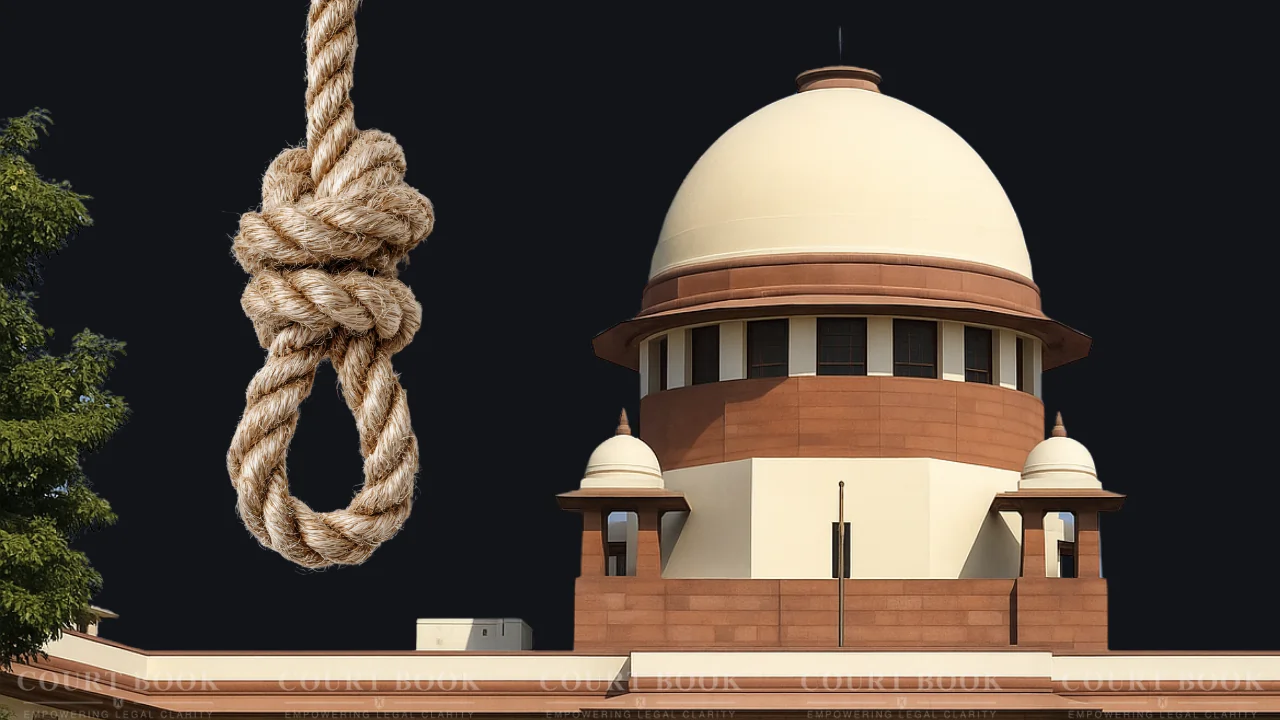
The Supreme Court on Tuesday, August 18, 2026, has dismissed a long-pending challenge to hanging as the method of executing a death sentence, holding that there was no sufficient ground to reconsider the constitutional validity of the existing provision.
A Bench of Justices Vikram Nath and Sandeep Mehta delivered the decision in Rishi Malhotra v. Union of India, concerning the constitutional validity of the provision requiring a death sentence to be carried out by hanging. Supreme Court records confirm that the matter was registered as W.P.(Crl.) No. 145/2017 and was heard by the same Bench.
Background of the Case
The petition was filed by Senior Advocate Rishi Malhotra in 2017. It challenged Section 354(5) of the Code of Criminal Procedure, now corresponding to Section 393(5) of the Bharatiya Nagarik Suraksha Sanhita (BNSS).
The provision directs that where a person is sentenced to death, the sentence shall direct that the prisoner “be hanged by the neck till he is dead.”
The petitioner argued that hanging could involve unnecessary pain and suffering and sought consideration of alternative methods of execution, including lethal injection and other methods.
During the proceedings, the Union Government informed the Court that the issue was being examined at the highest level. The Court had also considered whether an expert body could examine the medical and scientific aspects of different execution methods. The matter was eventually reserved for judgment in January 2026.
Supreme Court’s Observation
The Bench declined to reopen the constitutional question settled earlier in Deena v. Union of India. The Court said it was “not persuaded” that a case had been made out for referring the earlier three-judge Bench decision to a larger Bench for reconsideration.
At the same time, the Supreme Court made clear that its ruling does not permanently close the constitutional question.
It observed that future scrutiny could take place if “compelling scientific, medical, or empirical evidence” establishes that the factual and scientific basis of the earlier decision has materially changed.
The Court also emphasised that constitutional interpretation must remain responsive to developments in constitutional law as well as advances in scientific knowledge.
Decision
The Supreme Court dismissed the writ petition. However, it clarified that the Union Government remains free to conduct a comprehensive scientific review of the existing execution method through an expert body comprising specialists in areas including law, forensic medicine, neuroscience and criminology.
The purpose of such a review, the Court said, could be to examine whether an alternative method would better meet the constitutional objective of reducing unnecessary pain while preserving the dignity of condemned prisoners.
The writ petition was accordingly dismissed with these observations.
Case Details
Case Title: Rishi Malhotra v. Union of India
Case Number: W.P.(Crl.) No. 145/2017
Judge: Justice Vikram Nath and Justice Sandeep Mehta
Decision Date: 18 August 2026


