

The Supreme Court has clarified that the constitutional 24-hour limit for producing an arrested person before a magistrate begins when the person is actually taken into custody, not when the police formally record the arrest. The Court held that investigating agencies cannot delay recording an arrest to create additional time for interrogation without judicial supervision.
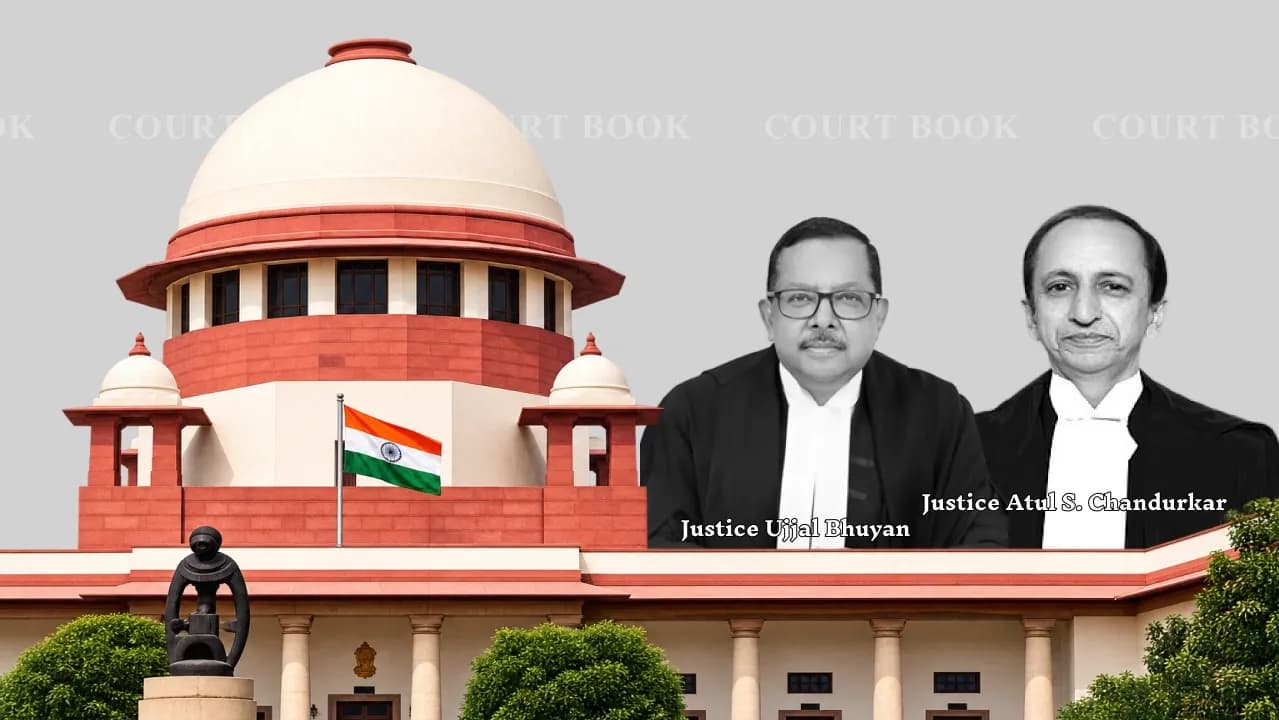
A Bench of Justice Ujjal Bhuyan and Justice Atul S. Chandurkar delivered the ruling while hearing appeals filed by four persons in an NDPS case involving the alleged seizure of 11.03 kg of methamphetamine tablets, commonly known as yaba.
Background
The dispute arose from a search and seizure operation conducted on September 29, 2025. The four appellants were taken into custody at approximately 2 PM that day. However, their formal arrests were recorded only on September 30, 2025.
The appellants challenged the Tripura High Court's decision refusing them bail. They argued that the investigating agency had violated Article 22(2) of the Constitution by failing to produce them before a magistrate within 24 hours of their actual detention.


The investigating agency maintained that the constitutional deadline should be calculated from the time the formal arrest was recorded. The Supreme Court disagreed with this interpretation.
The Bench explained that Article 22(2) protects individuals from being kept in custody without timely judicial supervision. These protections cannot be avoided simply by describing a person's custody as part of an investigation rather than an arrest.
"The Court made it clear that the protection under Clause (2) of Article 22 cannot be bypassed by keeping a person in custody for investigation without formally recording the arrest. It held that creating such a distinction would leave an unconstitutional gap in the safeguards guaranteed under the provision."
It further clarified that the expressions 'arrested' and 'detained' in Article 22(2) cannot be interpreted in a way that weakens the constitutional protection available to a person whose freedom has already been taken away.
The Bench stated:
"The Bench emphasised that detention and arrest cannot be treated as separate stages to weaken an individual's constitutional rights. It said that Article 22(2) must be interpreted in a manner that strengthens the protection of personal liberty rather than allowing procedural distinctions to undermine it."
The Court also referred to the problem of custodial violence and observed that judicial oversight is particularly important during the investigation stage, when individuals may be vulnerable to misuse of authority.
The Supreme Court laid down the following conclusions regarding Article 22(2) and detention:
1. 24-hour period begins from actual detention: The constitutional deadline starts when a person's liberty is effectively curtailed, not when the formal arrest is recorded.
2. Immediate release after breach: If detention continues beyond 24 hours without production before a magistrate, the person must be released forthwith.
3. Only travel time can be excluded: The time reasonably required to travel from the place of arrest to the magistrate's court is the only permissible exclusion.
4. Earlier High Court decisions disapproved: The decisions in Aryaman Pattnaik, Kannan and Arun K Thomas were held not to lay down the correct interpretation of Article 22(2).
5. Detention must remain reasonable: Investigating authorities must also comply with Section 58 of the BNSS, which does not permit unreasonable detention even within the 24-hour limit.
6. Magistrates must verify detention time: Magistrates must record the actual date and time when the person's liberty was first curtailed and examine compliance with the constitutional deadline.
7. Remand can be refused for unreasonable detention: Even if production takes place within 24 hours, a magistrate can decline remand if the period of detention is unreasonable in the circumstances.
Applying these principles, the Supreme Court found that the appellants had been taken into custody at 2 PM on September 29, 2025. They should therefore have been produced before the magistrate by 2 PM on September 30.
However, they were produced at 4:45 PM on September 30, exceeding the constitutional deadline.
The Bench also found that there was an unexplained gap of approximately 18 hours between the completion of the search and seizure proceedings and the formal arrest. It held that this period could not be considered reasonable under Section 58 of the BNSS.
The Court further clarified that the restrictions on granting bail under Section 37 of the NDPS Act cannot override fundamental rights guaranteed under the Constitution.
Holding that the appellants' continued detention violated Article 22(2) of the Constitution, the Supreme Court set aside the Tripura High Court's order dated April 29, 2026.
The Bench directed that all four appellants be released from custody forthwith, finding that their detention beyond the constitutionally permitted period was illegal.
Case Title: Sujit Das v Union of India
Case Number: SLP(Crl) No. 12451-12453/2026



