

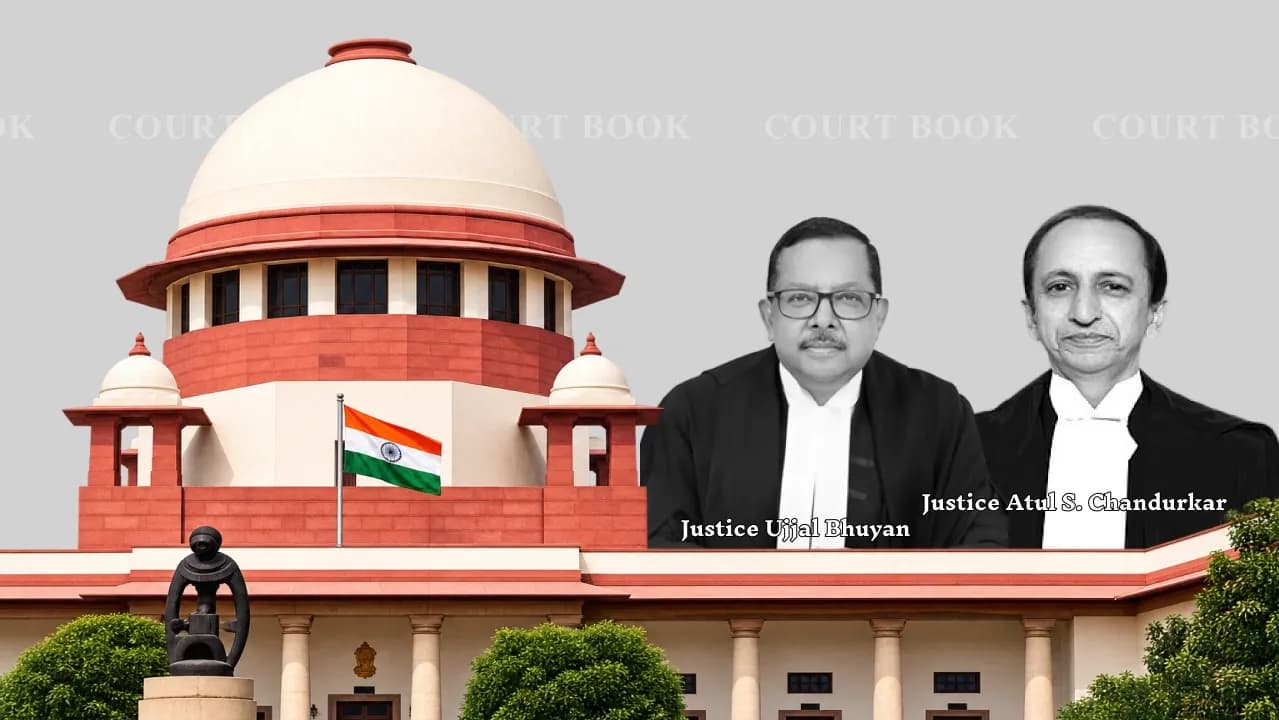
The Supreme Court has acquitted a woman convicted of murdering her daughter-in-law, holding that an accused charged with murder under Section 302 read with Section 34 of the Indian Penal Code (IPC) cannot be individually convicted under Section 302 when the other co-accused have been acquitted, unless a separate charge of murder was framed against her.
A bench of Justice Ujjal Bhuyan and Justice Atul S. Chandurkar set aside the Bombay High Court's Aurangabad Bench judgment, finding that the appellant's conviction was legally unsustainable. The Court also questioned the reliance placed on one dying declaration when the victim had made other inconsistent statements and the prosecution had failed to provide independent corroboration.
Background
The case arose from an incident in 2005 in which a married woman, Sunitabai, suffered fatal burn injuries after allegedly being set on fire. The prosecution alleged that her husband, father-in-law, mother-in-law and brother-in-law had subjected her to harassment over the absence of a child and dowry-related demands.
All four accused were charged under Sections 498A, 342, 406 and 302 read with Section 34 IPC. However, the Sessions Court acquitted them, citing inconsistencies in three dying declarations and the prosecution's failure to examine an important witness who had taken the victim to the hospital.


The Bombay High Court upheld the acquittal of the husband, father-in-law and brother-in-law but reversed the acquittal of the mother-in-law, convicting her individually under Section 302 IPC.
The woman challenged this decision before the Supreme Court.
The Supreme Court first examined whether the appellant could legally be convicted individually when the original murder charge was based on the alleged common intention of all four accused.
The bench noted that no separate charge under Section 302 IPC had been framed against the appellant. The Court observed:
"It is required to be stated that the defence raised by the accused was in response to the charge framed against all of them. The charge was that A1 to A4 in furtherance of their common intention, at the same date, time and place had caused the death of the victim by pouring kerosene on her person and setting her on fire, thus, committing an offence punishable under Section 302 read with Section 34 of the Penal Code. There was no independent charge framed under Section 302 of the Penal Code against any of the accused."
The Court further explained that convicting the appellant alone without an independent charge would prejudice her defence and effectively introduce a new accusation at the stage of appeal.
The bench relied on Krishna Govind Patil v. State of Maharashtra, reiterating that when three of four accused charged under Section 302 read with Section 34 are acquitted, the remaining accused cannot automatically be convicted on the same charge.
The bench also considered the inconsistencies between the victim's three dying declarations. While the High Court had rejected two declarations, Exhibits 44 and 48, it relied on Exhibit 56 to convict the appellant. The Supreme Court found that this approach required greater scrutiny, particularly because the prosecution had not produced corroborating evidence.
The Court also highlighted the failure to examine the person who had first reached the house, rescued the victim and taken her to the hospital. He was present when Exhibit 56 was recorded and could have provided important evidence about the incident, including the alleged use of a piece of rope to tie the victim.
Another important issue concerned Section 106 of the Indian Evidence Act, which deals with facts especially within a person's knowledge. The bench clarified that this provision cannot be used to fill gaps in the prosecution's case.
It observed:
"Section 106 of the Indian Evidence Act, 1872 would come into play only after the prosecution discharges its initial burden pointing to the involvement of the concerned accused."
The Court further noted that the appellant was around 60 years old, while the deceased was approximately 30. This age difference was also relevant when examining the High Court's decision to reverse the acquittal.
The Supreme Court held that the Sessions Court had rightly extended the benefit of doubt to the appellant. It emphasised that an acquittal strengthens the presumption of innocence and that the High Court had not established sufficient grounds to overturn the trial court's findings.
The bench concluded:
"The Sessions Court was correct in holding that in view of inconsistency in the three dying declarations, the appellant was entitled to the benefit of doubt. The High Court, while considering an appeal against acquittal, ought to have given due consideration to this aspect before proceeding to reverse the judgment of the Sessions Court."
Accordingly, the Supreme Court quashed the Bombay High Court's judgment, allowed the appeal and acquitted Sau Kamalbai Waman Patil.
It directed that she be set free forthwith, if not required in any other case.
Case Details
Case Title: Sau Kamalbai Waman Patil v. The State of Maharashtra
Case Number: Criminal Appeal No. 118 of 2018
Judges: Justice Ujjal Bhuyan and Justice Atul S. Chandurkar
Decision Date: November 5, 2026



