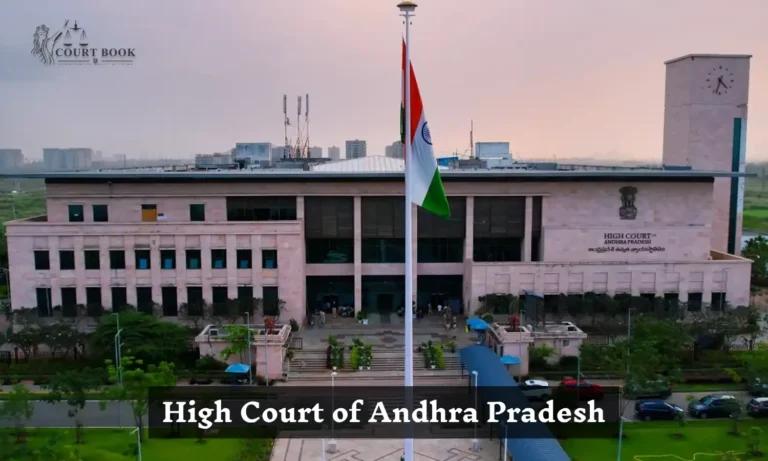
The Andhra Pradesh High Court has set aside the attachment of personal bank accounts belonging to former directors of a private company in liquidation, holding that tax authorities failed to follow the mandatory legal safeguards under the Andhra Pradesh Value Added Tax (APVAT) Act.
A Division Bench ruled that directors cannot be made personally liable for company tax dues unless the law’s strict conditions are clearly met and explained to them.
Background of the Case
The case arose from three writ petitions filed by former directors of M/s. Kusalava Batteries Private Limited, a company that went into liquidation under the Insolvency and Bankruptcy Code, 2016.
During the liquidation process, commercial tax authorities attempted to recover over ₹23.37 lakh in alleged VAT dues. Their claim was rejected by the liquidator as it was not filed within the prescribed time or format. The company was later formally dissolved by the National Company Law Tribunal.
Years later, in September 2025, the Deputy Commercial Tax Officer issued notices under Section 29 of the APVAT Act, directing banks to attach the personal accounts of the former directors to recover the tax amount.
Read also:- Delhi High Court Refuses to Reopen Rent Dispute, Clears Way for Eviction Over Landlord’s Business Need
Challenging this move, the directors approached the High Court, arguing that personal recovery was illegal and violated the principles of natural justice.
Counsel for the petitioners submitted that:
- Tax authorities failed to recover dues during liquidation despite having the opportunity.
- Directors of a private company cannot be automatically held liable for tax arrears.
- Section 24(5) of the APVAT Act allows recovery from directors only if non-payment occurred due to gross negligence, misfeasance, or breach of duty.
- No notice explaining such alleged misconduct was ever issued before attaching their bank accounts.
“The State cannot take advantage of its own delay and shift the burden onto former directors,” the petitioners argued before the Bench.
The State contended that once company dues become unrecoverable, the law permits recovery from directors. According to the department, the burden lies on the directors to prove they were not responsible for the default.
Read also:- Supreme Court Defers Unitech Homebuyers' Pleas, Sets Fresh Hearing Amid Crowd of Pending Applications
Court’s Observations
After examining the law and facts, the Bench made it clear that director liability is not automatic.
“The provision does not permit a shortcut to recovery,” the court observed, noting that two conditions must be satisfied before invoking Section 24(5):
- The tax dues must be genuinely unrecoverable from the company.
- Authorities must first indicate how non-payment resulted from gross negligence, misfeasance, or breach of duty by the directors.
The judges emphasized that directors must be given a fair opportunity to respond once such allegations are clearly spelled out.
“The initial burden lies on the tax department to disclose the basis for invoking personal liability,” the Bench remarked.
The court also pointed out that the earlier notice issued in 2021 failed to mention any specific misconduct by the directors, making the later bank attachment legally unsustainable.
Read also:- Allahabad High Court Quashes Criminal Case After Parties Reach Settlement in Gonda Dispute
The Decision
Allowing all three writ petitions, the High Court quashed the attachment of the directors’ bank accounts, holding it to be contrary to Section 24(5) of the APVAT Act.
However, the court clarified that the tax department is not barred from fresh recovery proceedings, provided it strictly follows the law and gives the directors a proper opportunity to defend themselves.
“There shall be no order as to costs,” the Bench concluded, bringing the matter to a close.
Case Title: Chukkapalli Ramakrishna Prasad & Ors. vs Deputy Commercial Tax Officer & Ors.
Case Numbers: W.P. Nos. 26352, 26371 & 26377 of 2025
Case Type: Writ Petitions (Tax Recovery)
Decision Date: 08 December 2025