

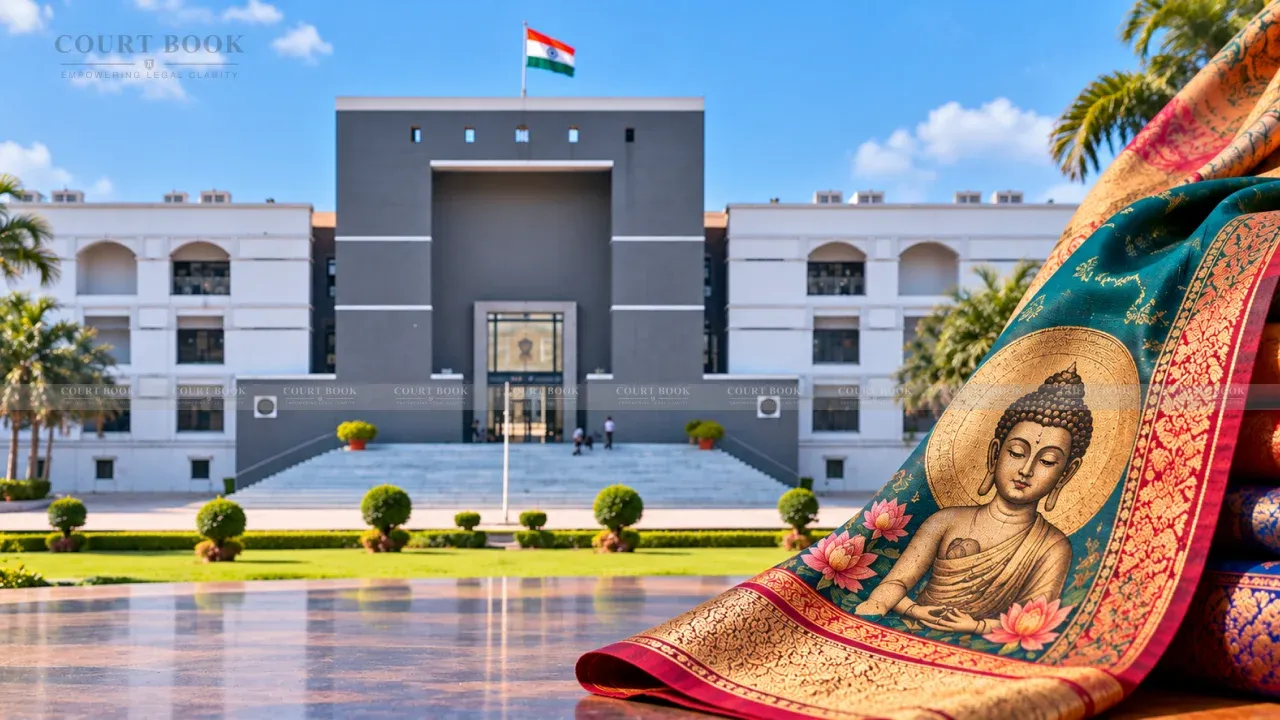
The Gujarat High Court has quashed a criminal case against a Surat textile trader over sarees and other dress materials carrying images of Lord Gautam Buddha on their lower portion or pallu. Justice P. M. Raval held that merely printing or selling textile material featuring a deity or revered religious figure cannot automatically be treated as an act intended to outrage religious feelings.
Background
The case arose from an FIR registered at Salabatpura Police Station, Surat, on December 21, 2017, under Section 295A read with Section 114 of the Indian Penal Code (IPC).
According to the complaint, members of the Ambedkar community had informed the President of the Samast Yuva Ambedkar Samaj that sarees and textile materials bearing printed images of Lord Gautam Buddha were being sold at textile markets and shops in Surat.
The complainant alleged that the images appeared towards the lower portion of the garments, including the feet, border or pallu area. It was alleged that placing the images in that position amounted to degrading the revered figure and intentionally hurting the religious sentiments of the community.
The applicant, however, denied having any intention to hurt religious feelings. He submitted that he was engaged in the ordinary business of selling sarees and dress materials and procured products according to prevailing designs and market requirements.
The High Court examined whether the allegations in the FIR, even if accepted at face value, disclosed the essential ingredients of Section 295A IPC.
The provision deals with deliberate and malicious acts intended to outrage the religious feelings of a class by insulting its religion or religious beliefs. The Court noted that the law does not cover every act which may be perceived as an insult to religion.
The Court observed:
“Section 295A IPC does not contemplate each and every act to be penalised and every act of insult to or attempt to insult the religion or the religious beliefs of a class of citizens but it penalises only those acts of insults to or those varieties of attempts to insult the religion or the religious beliefs of a class of citizens, which are perpetrated with the deliberate and malicious intention of outraging the religious feelings of that class.”
The Court also relied upon the principles laid down in earlier decisions, including Ramji Lal Modi v. State of U.P. and Mahendra Singh Dhoni v. Yerraguntla Shyamsundar, concerning the requirement of deliberate and malicious intention under Section 295A.
After examining the photographs placed on record and the police report, the High Court found no material suggesting that the applicant had deliberately and maliciously intended to insult a religion or outrage the religious feelings of any particular class.
The Court noted that similar textile material was also being sold by other persons in Surat. It further considered the applicant's business activity in the context of ordinary commercial trade.
The Court held:
“Mere printing or selling of textile materials containing artistic depictions of a deity or revered icon, even if appearing on portions of a garment near the lower border or Pallu, cannot automatically be presumed to be an act driven by deliberate malice or calculated to disrupt public order.”
The Court further clarified that commercial activity involving religious motifs, in the absence of an overt act, inflammatory conduct or demonstrable intention to denigrate a religious belief, would not by itself cross the threshold of a criminal offence under Section 295A IPC.
Justice P. M. Raval concluded that the foundational requirement of Section 295A - namely, a deliberate and malicious intention to outrage religious feelings - was absent from the material placed before the Court.
The High Court held that the allegations, even when taken at face value, failed to establish a prima facie case against the applicant. Continuing the criminal proceedings would therefore amount to an abuse of the process of law.
The Court accordingly allowed the application and quashed the FIR registered against Bharatbhai Hirjibhai Shankar, along with all consequential criminal proceedings arising from it.
Case Details
Case Title: Bharatbhai Hirjibhai Shankar v. State of Gujarat & Anr.
Case Number: R/Criminal Misc. Application No. 854 of 2018
Judge: Justice P. M. Raval
Decision Date: October 7, 2026


