

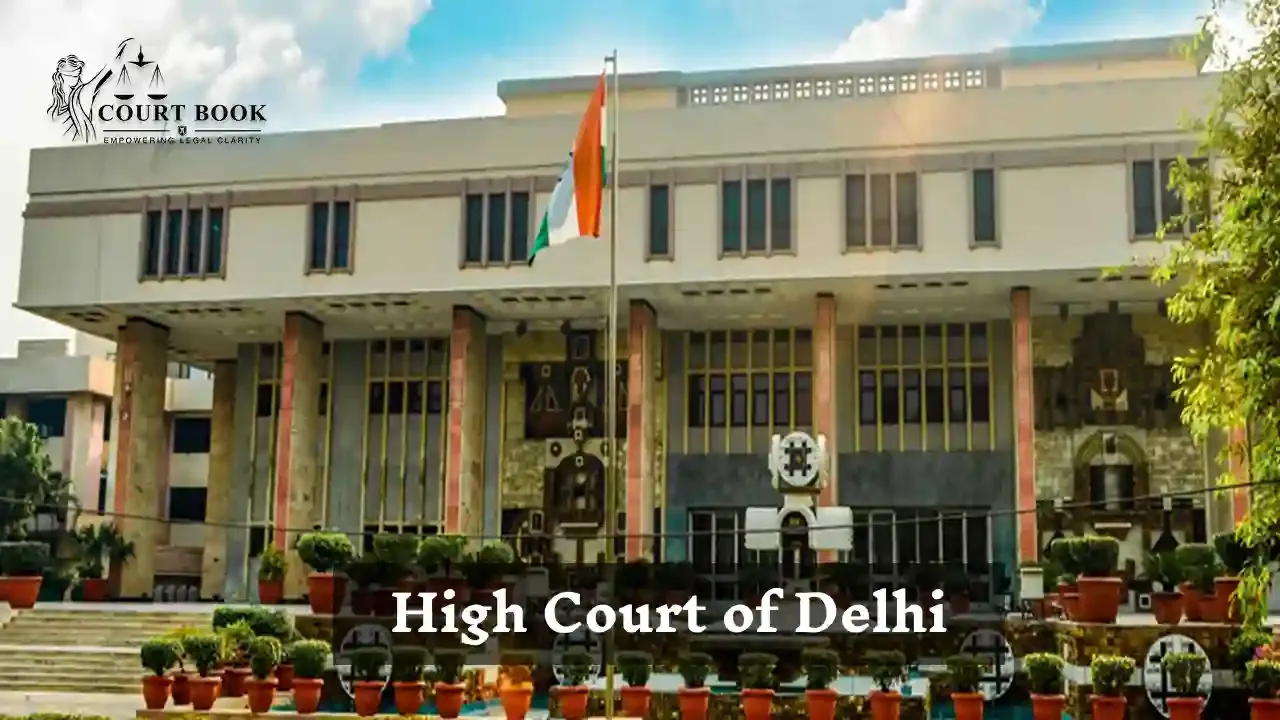
In a significant ruling on the rights of employees in private schools, the Delhi High Court has set aside the dismissal of teacher Rekha Sabharwal from Saai Memorial Girls School, holding that her removal was carried out without the mandatory approval of the Directorate of Education (DoE). The Court ordered her reinstatement with continuity of service and 50% back wages, while directing that the disciplinary proceedings against her be conducted afresh.
Background of the Case
Rekha Sabharwal, an assistant teacher at Saai Memorial Girls School, was served with a charge sheet in October 2006. The school accused her of poor teaching performance, alleged misconduct with colleagues and school authorities, and refusal to attend a parent-teacher meeting.
An inquiry was conducted and the Inquiry Officer found most of the charges proved. Based on the inquiry report, the school removed Sabharwal from service in March 2007. Her challenge before the Delhi School Tribunal failed in 2009, and a Single Judge of the High Court also dismissed her writ petition in 2017.
Sabharwal then approached a Division Bench of the High Court through the present appeal.
Court Examines Approval Requirement
During the hearing, Sabharwal argued that her removal was illegal because the school had not obtained prior approval from the Directorate of Education, as required under Section 8(2) of the Delhi School Education Act.
The school relied on an earlier Delhi High Court judgment which had held that such approval was not necessary for private unaided schools.
The Division Bench disagreed. Referring to the Supreme Court's ruling in Raj Kumar v. Director of Education, the Court noted that the requirement of prior approval applies even to private unaided schools.
The bench observed that Supreme Court decisions operate retrospectively unless specifically stated otherwise. As a result, the school's dismissal order could not survive legal scrutiny.
“The order... having been issued without the prior approval of the DOE, violates Section 8(2) of the DSE Act and is, therefore, liable to be set aside”,
the Court held.
The Court also examined the composition of the disciplinary authority.
Sabharwal argued that the school Principal and Vice-Principal were both complainants and witnesses against her, yet also participated in the disciplinary committee that took decisions in the matter.
Accepting the contention, the bench said the arrangement violated the fundamental principle that no person should act as a judge in their own cause.
“The DA could not have included the Principal and Ms. Jasvir Kaur as members,”
the Court observed, adding that their participation created a legitimate apprehension of bias.
The Bench also found certain aspects of the case troubling.
Sabharwal was originally appointed as a Hindi teacher and had taught the subject for more than three years. According to the record, there were no complaints regarding her performance during that period.
The Court noted that complaints about her teaching surfaced only after she was suddenly assigned to teach English and Environmental Science in August 2006, despite not holding a degree in English.
The judges said the school had offered no convincing explanation for this change.
Observing that Sabharwal had also alleged harassment by the school, the Court directed that all aspects of the dispute should be re-examined in a fresh inquiry.
Court Finds Punishment Order Defective
The Bench further held that the disciplinary authority's order removing Sabharwal from service was not a reasoned order.
According to the Court, once Sabharwal replied to the show-cause notice, the disciplinary authority was required to consider her defence and provide reasons for rejecting it.
“The least that justice required was coverage... of the points raised by the appellant, and a dispassionate consideration thereof,” the Court said.
Decision
Allowing the appeal, the Delhi High Court quashed the inquiry report, the disciplinary authority's order, the Delhi School Tribunal's decision, and the 2017 judgment of the Single Judge.
Case Details:
Case Title: Rekha Sabharwal v. Management of Saai Memorial Girls School & Ors.
Case Number: LPA 266/2017
Judge: Justice C. Hari Shankar and Justice Om Prakash Shukla
Decision Date: 29 May 2026


