

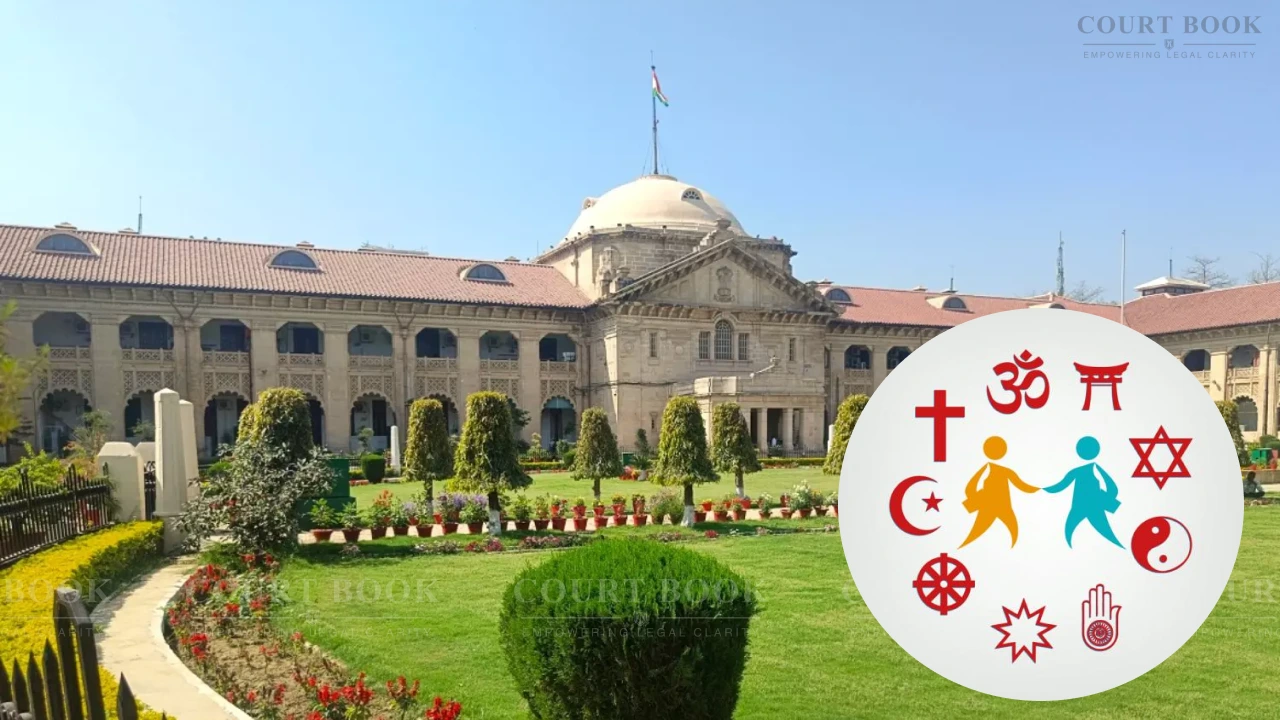
The Allahabad High Court has allowed a habeas corpus petition filed on behalf of two adult women who said they were confined by their father after voluntarily embracing Islam. Justice Sandeep Jain held that the detention was illegal and directed the father and the State of Uttar Pradesh to jointly pay Rs 25 lakh as compensation.
The judgment was delivered on August 6, 2026, in Habeas Corpus Writ Petition No. 1079 of 2026. The Court had earlier directed the State to produce both women before it, following which they appeared before the Court.
Background of the Case
During their interaction with the Court, both women stated that they had embraced Islam voluntarily and without force, fraud, coercion, undue influence or inducement. The first woman stated that she had converted in 2020, while the second said she had embraced Islam in 2021.
They alleged that their father subsequently confined them in the parental home because of their religious choices and restricted their freedom of movement. They also stated that their passports, educational certificates, identity documents, bank-related papers and other belongings remained with him.
The State opposed the petition, referring to an ongoing criminal investigation concerning alleged unlawful religious conversion. It argued that the conversion formed part of a larger alleged organised activity and that releasing the women could affect the investigation.
Court's Observation
Justice Sandeep Jain examined the limited purpose of habeas corpus proceedings, which are meant to protect a person from unlawful detention. Referring to Supreme Court decisions, the Court noted that such a writ can also be used where a person is allegedly kept in private detention.
The Court found that both women were majors and had clearly expressed their independent choices. It observed that Article 25 protects freedom of conscience and that an adult's decision to adopt, renounce or change faith forms part of individual autonomy and personal liberty under Articles 21 and 25.
“The legality of the conversion and the legality of their detention constitute two distinct and independent issues,” the Court observed, making it clear that any dispute concerning compliance with the Uttar Pradesh Prohibition of Unlawful Conversion of Religion Act, 2021, could be examined by the competent authority separately.
The Court also rejected the State's submission that the women's religious choice, by itself, demonstrated a threat to national security. It held that mere apprehensions could not replace legally admissible material when fundamental rights were being considered.
Decision
The High Court concluded that the women had been unlawfully confined and that their detention had no sanction of law. It held that their liberty could not be curtailed merely because their religious choices were opposed by their father.
The writ petition was accordingly allowed. The Court declared both women free to live at any place and with any person of their choice. The father and the State were held jointly and severally liable and directed to pay Rs 25 lakh compensation, to be equally divided between them, within eight weeks.
The father was further directed not to interfere with their liberty, movement, residence, profession or religious choices. He was also ordered to return their passports, educational certificates, identity documents, bank documents and other personal belongings within seven days.
The State authorities were directed to ensure that the women faced no interference and, if required, provide protection in accordance with law.
Case Details
Case Title: Kunwar Sultan Ali And 2 Others v. State of U.P. and 3 Others
Case Number: Habeas Corpus Writ Petition No. 1079 of 2026
Court: High Court of Judicature at Allahabad
Judge: Hon'ble Justice Sandeep Jain
Decision Date: August 6, 2026


