

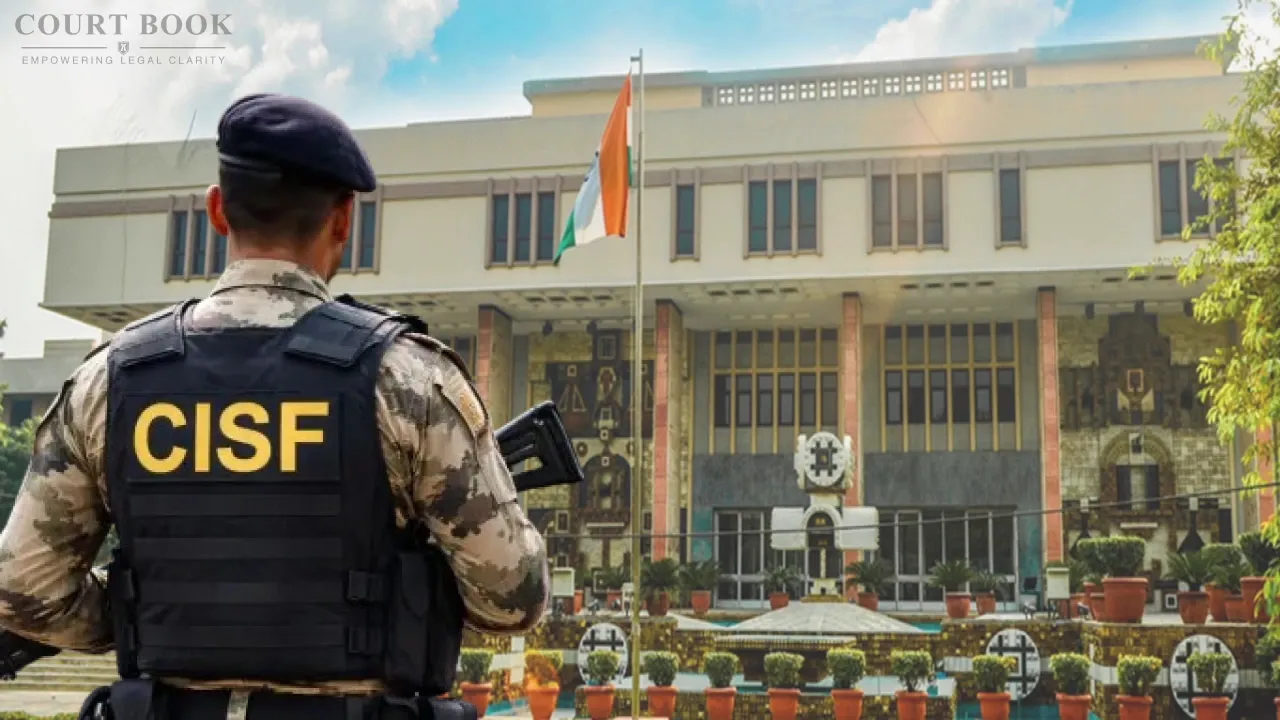
The Delhi High Court has refused to interfere with the dismissal of a CISF Sub-Inspector who challenged her removal from service on the ground that the departmental inquiry against her was conducted ex parte. The Court held that the officer had been given sufficient opportunities to participate in the proceedings but failed to do so.
The judgment was delivered on May 29, 2026, by a Division Bench comprising Justice Anil Kshetrapal and Justice Amit Mahajan in Ms. Mamta Chaudhary v. Union of India & Ors., W.P.(C) 7917/2026.
Background of the Case
Mamta Chaudhary, a Sub-Inspector posted with the CISF at Chennai Airport, was subjected to disciplinary proceedings under the CISF Rules, 2001. Three charges were framed against her.
The first related to allegations that she entered into a marriage with a man whose earlier marriage was still subsisting. The second charge concerned her absence from duty and leaving her unit without authorization from July 2023 onward. The third alleged that she falsely claimed to have submitted an application seeking three years of extraordinary leave.
Following a departmental inquiry, all charges were held proved, and she was removed from service on August 8, 2024. Her appeal and revision petition were subsequently rejected by the departmental authorities.
Before the High Court, the petitioner argued that the disciplinary proceedings violated principles of natural justice because the punishment order was passed ex parte. She also contended that the Inquiry Officer belonged to the same CISF unit where she was posted, raising concerns about impartiality.
It was further argued that certain important witnesses were not examined during the inquiry.
The Bench noted that the High Court, while exercising jurisdiction under Article 226 of the Constitution, does not sit as an appellate authority over departmental findings and is primarily concerned with the decision-making process rather than re-evaluating evidence.
Rejecting the allegation of bias, the Court observed that the CISF Rules do not prohibit the appointment of an Inquiry Officer from the same unit. The Bench found that the petitioner had not produced any material, apart from the officer's posting in the same unit, to establish actual bias.
The Court recorded that as many as 16 prosecution witnesses were examined during the inquiry. Evidence relating to the first charge included testimony from the complainant, her relatives, the children of the concerned individual, photographs, and various documents.
“The standard of proof in departmental enquiry is that of preponderance of probability, and the said threshold has rightly been found to be satisfied in the facts of the present case,” the Bench observed.
The Court also noted that despite repeated opportunities, the petitioner neither participated in the proceedings nor cross-examined witnesses or presented her defence.
Holding that the disciplinary authority's findings were based on adequate material and had already been affirmed by the appellate and revisional authorities, the Delhi High Court found no reason to exercise its writ jurisdiction.
“The present petition is accordingly dismissed,” the Bench ordered, thereby upholding the removal of the CISF officer from service.
Case Details:
Case Title: Ms. Mamta Chaudhary v. Union of India & Ors.
Case Number: W.P.(C) 7917/2026
Judges: Justice Amit Mahajan and Justice Anil Kshetrapal
Decision Date: 29 May 2026


