

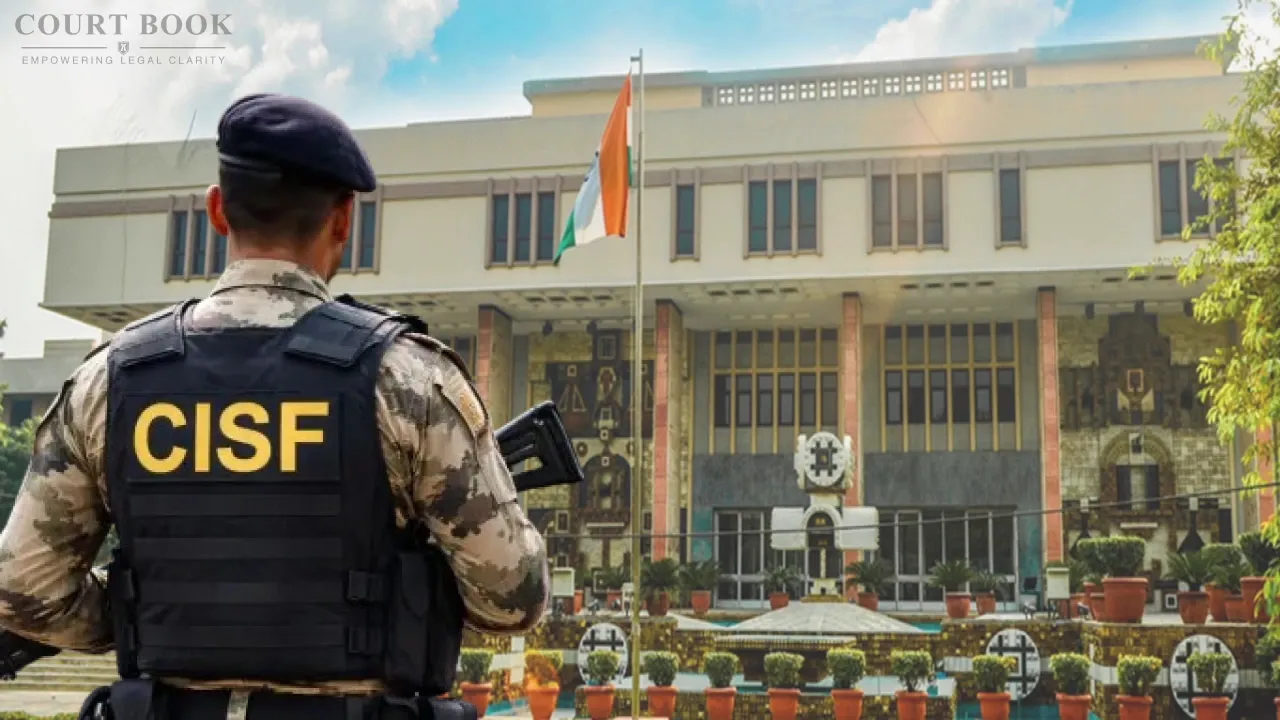
The Delhi High Court has declined to interfere with disciplinary proceedings initiated against a senior CISF officer and upheld the validity of his suspension, observing that departmental action can proceed independently of developments in a criminal case.
A Division Bench of Justice V. Kameswar Rao and Justice Manmeet Pritam Singh Arora disposed of two writ petitions filed by CISF officer Ranjan Pratap Singh, who had challenged both the departmental charge-sheet issued against him and orders relating to his suspension.
Background of the Case
The petitions arose from disciplinary proceedings initiated under the Central Civil Services (Classification, Control and Appeal) Rules, 1965.
The officer challenged a charge-sheet issued in September 2020 and sought a direction that departmental proceedings should remain on hold until the conclusion of criminal proceedings arising from the same set of allegations.
He also questioned the legality of his suspension and subsequent extensions, arguing that the relevant orders had not been issued by the competent authority.
Court Examines Challenge to Charge-Sheet
Before the High Court, the petitioner primarily argued that one of the charges framed against him was based merely on the fact of his arrest and that an arrest, by itself, could not amount to misconduct.
The Bench, however, found that the charge relating to the arrest could not be viewed in isolation.
“The petitioner having been arrested because of Article-I, has resulted in tarnishing the good image of the Force,” the Court observed.
The judges noted that if the conduct of an employee adversely affects the reputation of a disciplined force, it can legitimately become the subject of departmental proceedings.
Accordingly, the Court held that the challenged article of charge was maintainable and declined to interfere with the charge-sheet.
Suspension Orders Found Valid
In the second petition, the officer challenged the original suspension order, its extensions, and related administrative decisions.
The Court examined records produced in a sealed cover and found that the suspension and review orders had in fact been approved by the competent authority within the prescribed period.
After inspecting the records, the Bench recorded that even the petitioner’s counsel was satisfied that the relevant approvals existed.
The Court therefore rejected the challenge to the suspension orders.
Court on Continuation of Suspension
The petitioner also requested the Court to direct authorities to revoke the suspension, pointing out that he had remained under suspension for several years.
The Bench refused to issue such a direction.
“The decision to continue with the suspension is primarily on the competent authority,” the Court observed, adding that the nature of the charges did not justify judicial intervention on that issue.
The Court further rejected the challenge to the decision fixing the officer’s suspension headquarters at Behror, Rajasthan, holding that the competent authority was empowered under applicable rules to do so.
Effect of Criminal Court’s Discharge Order
During the proceedings, the petitioner informed the Court that a trial court had discharged him in the criminal case.
However, the High Court clarified that such a development would not automatically bring departmental proceedings to an end.
The Bench observed that it is a settled principle of law that departmental enquiries may continue even where an employee has been acquitted or discharged in criminal proceedings. The Court left it to the disciplinary authority to assess the effect of the trial court’s order and proceed according to law.
Decision
Disposing of both petitions, the Delhi High Court upheld the validity of the departmental charge-sheet and suspension-related orders. The Court left it open to the petitioner to make representations before the disciplinary authority, which would be free to consider the impact of the criminal court’s findings and take an appropriate decision in accordance with law.
Case Details
Case Title: Ranjan Pratap Singh v. Union of India & Others
Case Numbers: W.P.(C) 4096/2021 and W.P.(C) 11716/2021
Bench: Justice V. Kameswar Rao and Justice Manmeet Pritam Singh Arora
Decision Date: June 19, 2026


