

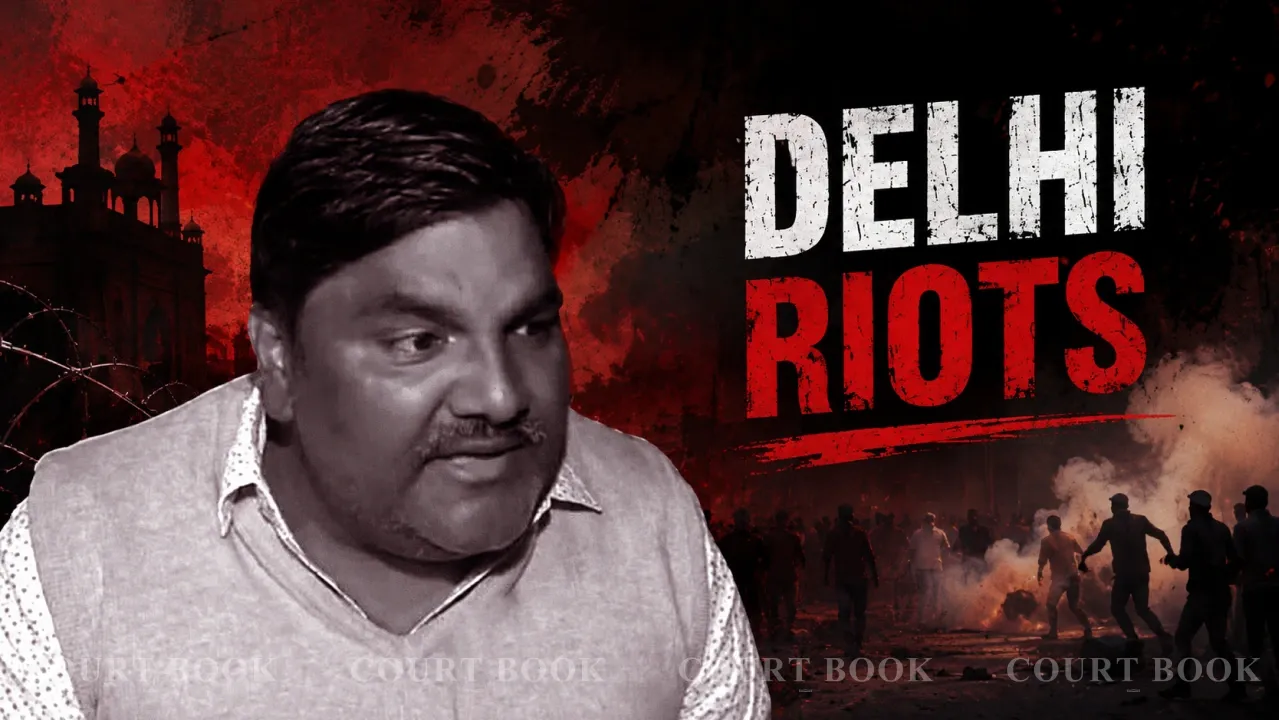
A Delhi court has sentenced former Aam Aadmi Party councillor Mohd. Tahir Hussain and four other convicts to life imprisonment in the murder case of Intelligence Bureau (IB) staffer Ankit Sharma, holding that the crime was grave but did not meet the legal standard required for awarding the death penalty. The sentencing order was delivered by Additional Sessions Judge Parveen Singh of the Karkardooma Courts on 31 July 2026, following the conviction of the accused earlier this month.
Background of the Case
The case arose from FIR No. 65/2020 registered at Police Station Dayalpur in connection with the violence that took place during the February 2020 North-East Delhi riots. On 13 July 2026, the trial court had convicted Mohd. Tahir Hussain, Nazim, Kasim, Anas and Javed for offences including unlawful assembly, promoting enmity, kidnapping and murder with the aid of Section 149 of the Indian Penal Code.
During the sentencing hearing, the prosecution sought the death penalty, arguing that the killing was exceptionally brutal and fell within the category of the "rarest of rare" cases. The defence, however, urged the court to impose life imprisonment, relying on mitigating factors such as the convicts' family circumstances, conduct during custody and the possibility of reform.
Court's Observations
The court acknowledged the seriousness of the offence and described the killing as one committed during communal violence in a manner that reflected extreme brutality.
As the court observed,
"The manner in which it was committed was of the utmost brutality."
It further noted that the offence constituted a significant aggravating circumstance while considering the appropriate sentence.
However, the judge emphasised that the law requires courts to examine not only the crime but also the possibility of the offender's reformation before imposing capital punishment.
Rejecting the prosecution's request for the death sentence, the court observed, "Death is the penalty of the last resort," and held that the prosecution had failed to establish that the convicts were beyond the possibility of reform or rehabilitation.
The court also noted that no specific individual act causing the fatal injuries had been proved against any of the convicts during the trial, even though they had been held guilty by applying the principle of unlawful assembly under Section 149 IPC. It considered this an important mitigating factor while deciding the sentence.
Court's Decision
Declining to impose capital punishment, the court sentenced Mohd. Tahir Hussain, Nazim, Kasim, Anas and Javed to rigorous imprisonment for life for the offence punishable under Section 302 read with Section 149 IPC. Separate sentences and fines were also imposed for the remaining offences, with all sentences directed to run concurrently.
The court further ordered that ₹5 lakh from the fine amount be paid as compensation to the victim's family.


