

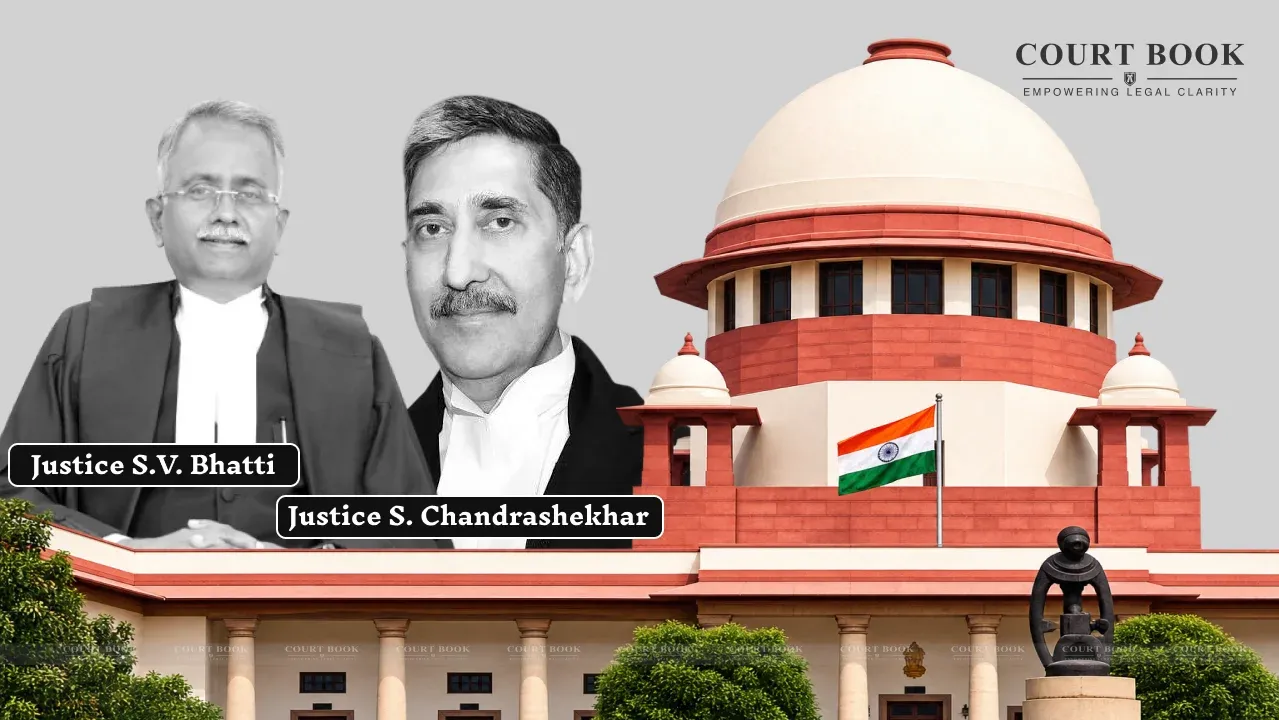
The Supreme Court of India has ruled that employees recruited through the prescribed selection process must rank above employees appointed on compassionate grounds or through temporary arrangements when determining seniority in the disputed Tamil Nadu government service cadre. The Court clarified that earlier temporary service cannot, by itself, give such employees seniority over direct recruits appointed through regular selection.
In a judgment delivered on October 9, 2026, a Bench of Justice S.V. Bhatti and Justice Shree Chandrashekhar modified the Madras High Court’s decision concerning the seniority of direct recruits, special appointees and compassionate appointees working in ministerial posts.
Background
The dispute arose from appointments made between 1981 and 1984 to posts including Junior Assistant, Typist and Steno-typist in Tamil Nadu. During this period, the State made temporary appointments under Rule 10(a)(i) of the Tamil Nadu State and Subordinate Services Rules, 1955. Meanwhile, candidates selected through a Tamil Nadu Public Service Commission examination conducted in November 1983 joined service between 1985 and 1987.
The State subsequently regularised the services of certain temporary employees under the Special Absorption Rules, 1987. A separate government order dated September 14, 1984, addressed the seniority of employees appointed on compassionate grounds.
The competing claims eventually reached the Supreme Court through Civil Appeal Nos. 8755, 8756 and 8757 of 2013, along with three transferred cases challenging the applicable seniority rules.
The Court examined whether compassionate and special appointees could claim seniority over candidates selected through the regular recruitment process merely because they had entered service earlier on a temporary basis or under compassionate appointment schemes.
The Bench upheld Clause 10 of the Special Absorption Rules, which placed special appointees below candidates selected through the November 1983 competitive examination, irrespective of the direct recruits' actual joining dates. It observed that the delay in appointing the selected candidates was attributable to temporary employees occupying the posts, rather than any fault on the recruits' part.
The Court explained the governing principle in these words:
" A Government employee appointed to a post following the due procedure and in accordance with the rules must rank senior to the appointees who entered in service as a temporary or stopgap measure or were appointed owing to some emergency."
The Bench also rejected the claim that compassionate appointees S. Prem Kumar and T.A. Kannappa could be placed above the direct recruits of the 1983 batch. It held that compassionate appointment is an exceptional mode of appointment and that the initial appointment date could not automatically confer superior seniority over regularly selected candidates.
Regarding the relative seniority of compassionate and special appointees, the Court held that their positions must be determined by their respective dates of regularisation, unless the applicable recruitment rules prescribe another method.
The Supreme Court dismissed Transferred Case (Civil) Nos. 50, 51 and 52 of 2013. Civil Appeal Nos. 8756 and 8757 of 2013 were disposed of with directions concerning the seniority of special and compassionate appointees, while Civil Appeal No. 8755 of 2013 was allowed to the extent that S. Prem Kumar and T.A. Kannappa could not rank above the 1983 direct recruits.
The Madras High Court's judgment was modified accordingly, with no order as to costs.


