

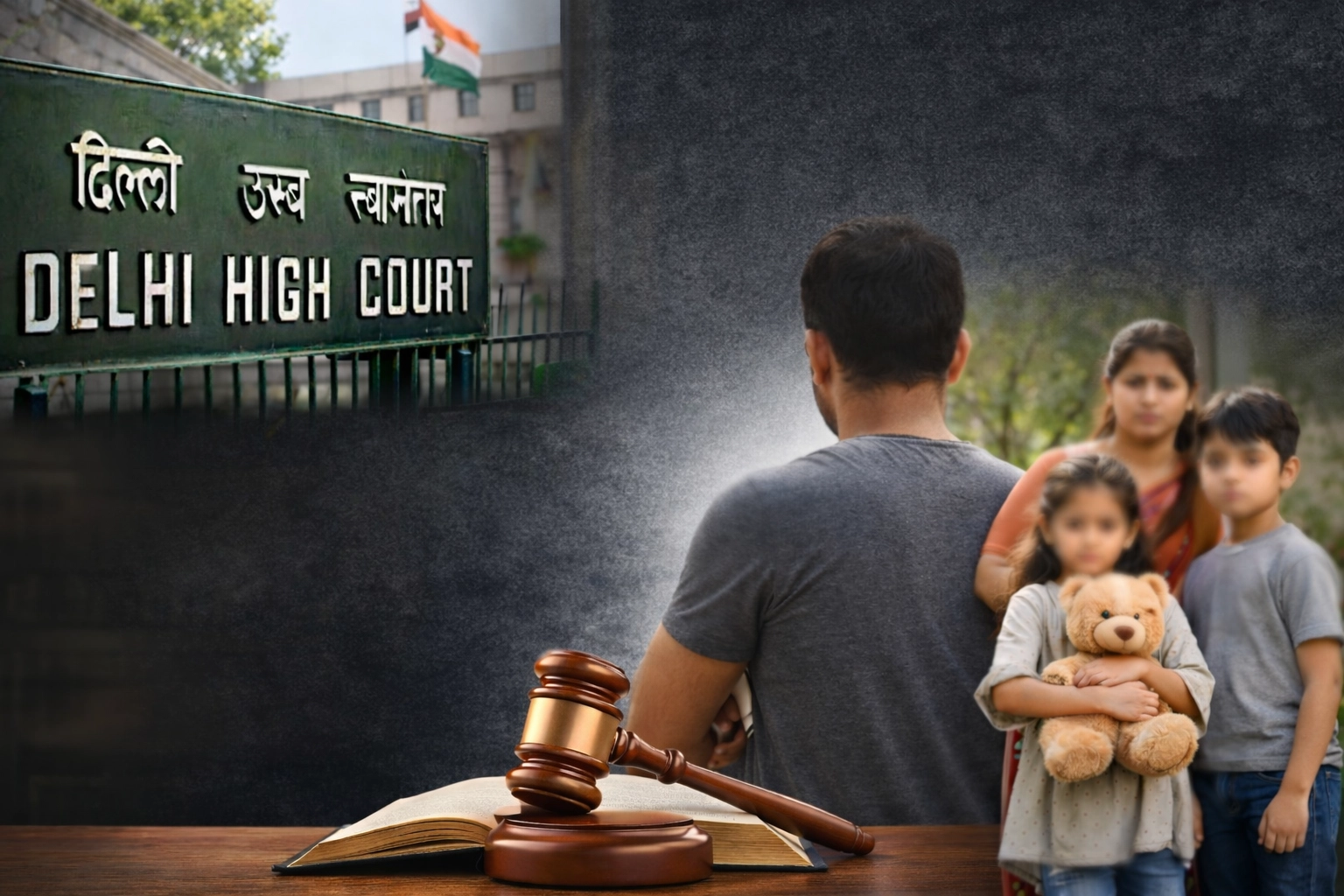
The Delhi High Court has upheld a Family Court order directing a DNA test in a long-running maintenance dispute, holding that the rights of children to establish their biological identity cannot be pushed aside merely because an alleged father fears damage to his reputation.
Delivering a detailed judgment, Justice Swarana Kanta Sharma observed that when paternity is directly in dispute and there is sufficient prima facie material on record, scientific evidence may become necessary to determine the truth.
Background of the Case
The case arose from maintenance proceedings filed under Section 125 of the Code of Criminal Procedure by Geeta Devi and her three children. They claimed that Ravi Kumar had lived with Geeta Devi in a relationship similar to marriage and that the three children were born from that relationship.
Ravi Kumar denied every allegation. He maintained that he had been legally married to another woman since 1986, never married Geeta Devi, never lived with her, and was not the biological father of the children. He also opposed the Family Court's direction for DNA testing, arguing that such an order would harm his reputation and that of his legally wedded wife.
The Family Court nevertheless directed DNA testing after noting photographs, public records, school documents and witness testimony that prima facie reflected Ravi Kumar as the children's father. Ravi Kumar challenged that order before the Delhi High Court.
Court Examines Whether DNA Test Was Justified
The High Court clarified that it was not deciding whether Ravi Kumar and Geeta Devi had a valid marriage. Instead, the central question was whether the children were biologically related to the petitioner, since that issue directly affected their maintenance claim.
The Court noted that the children themselves had sought the DNA test to establish their parentage. It also referred to documents placed before the Family Court, including photographs allegedly showing the petitioner with the family, school records naming him as the father, voter and ration card entries, and testimony from the family's former landlady regarding their cohabitation.
According to the Court, this material was sufficient to justify scientific examination at this stage, without expressing any final opinion on its evidentiary value.
Court Observations
Referring to recent Supreme Court rulings on DNA testing, the High Court observed that such tests cannot be ordered routinely but may be directed where paternity itself is the core issue and other evidence is insufficient.
The bench observed,
"The right of a child to know his or her biological origins and parentage is also intrinsically connected with the child's identity and dignity."
Addressing the petitioner's concern regarding reputational harm, the Court made it clear that such apprehension could not outweigh the interests of children seeking to establish their biological parentage.
In another significant observation, the Court said,
"The law respects freedom of choice, but it equally insists upon accountability where those choices affect the rights of others, particularly innocent children."
The judgment further stated that courts are not concerned with policing the personal choices of consenting adults but cannot ignore the legal consequences of those choices when innocent children are affected.
Decision
After examining the record, the High Court concluded that the question of paternity was central to the pending maintenance proceedings and could not be treated as a collateral issue. It found that the respondents had produced prima facie material indicating a relationship between the parties and that there was no equally effective alternative to determine the disputed issue of biological parentage.
Holding that the Family Court had exercised its jurisdiction properly, the High Court refused to interfere with the order directing DNA testing.
The petition challenging the Family Court's order was accordingly dismissed, with the Court clarifying that its observations should not be treated as findings on the ultimate merits of the maintenance case.
Case Details
Case Title: Ravi Kumar v. Geeta Devi & Ors.
Case Number: CRL.M.C. 3855/2024 & CRL.M.A. 14726/2024
Judge: Hon'ble Dr. Justice Swarana Kanta Sharma
Decision Date: 03 July 2026


