

The Supreme Court has set aside a series of Karnataka High Court orders that had quashed multiple FIRs registered against two police officers, holding that the High Court exceeded the limits of its jurisdiction by assessing evidence at the investigation stage. The Court reiterated that while considering a plea to quash an FIR, courts must only examine whether the allegations disclose a prima facie cognizable offence and should not weigh the strength of the prosecution's evidence.
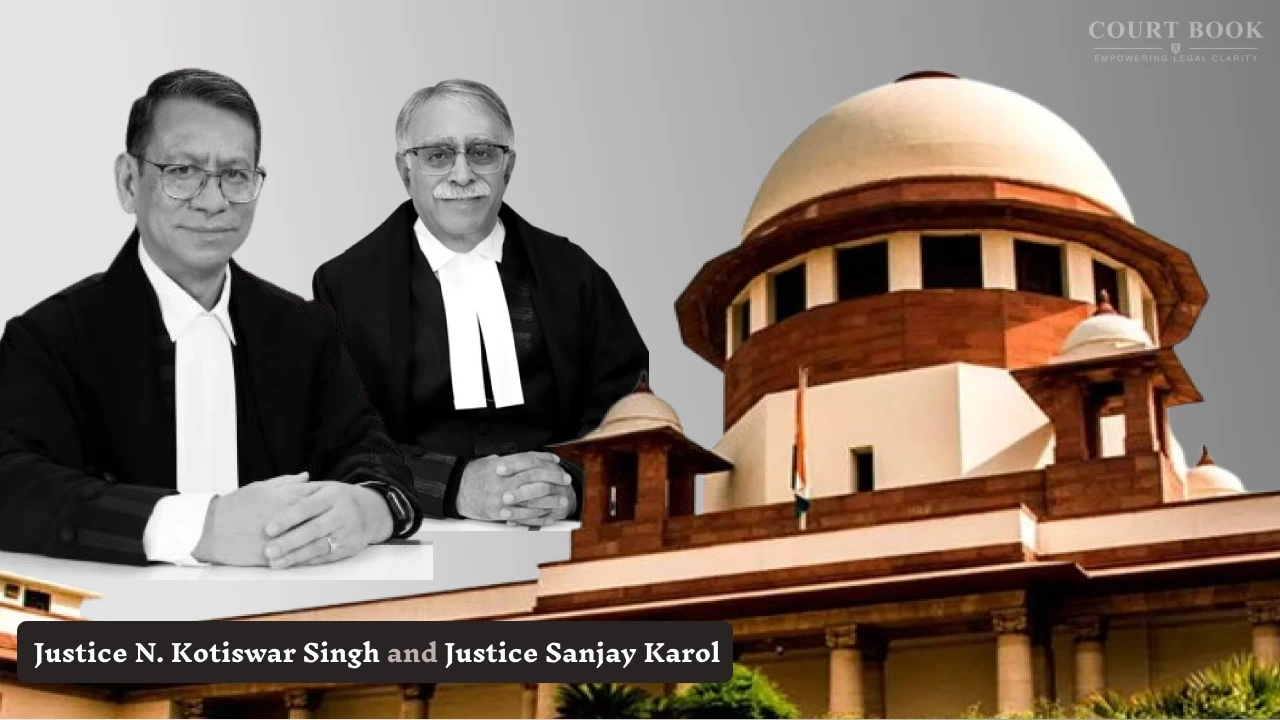
The judgment was delivered by a Bench comprising Justice Sanjay Karol and Justice Nongmeikapam Kotiswar Singh on July 30, 2026.
Background of the Case
The appeals arose from seven matters filed by the State of Karnataka challenging a common judgment of the Karnataka High Court dated September 8, 2021. The High Court had quashed six FIRs registered against Prabhu Shankar and Niranjan Kumar C., both police officers serving with the Central Crime Branch, Bengaluru. The FIRs related to allegations investigated under provisions of the Prevention of Corruption Act and the Indian Penal Code.
The High Court had primarily relied on factors such as alleged delay in lodging the FIRs, lack of prima facie material, absence of demand or recovery of money, and what it viewed as mala fide action arising from departmental infighting.
Aggrieved by those findings, the State approached the Supreme Court.
Court's Observations
The Supreme Court observed that the power to quash an FIR is an extraordinary one and must be exercised with great caution. It emphasized that, at the stage of considering a petition for quashing, courts are not expected to assess the credibility of evidence or determine whether the prosecution will ultimately succeed.
The Bench observed:
“At this initial stage, a ‘mini-trial’ cannot be conducted by the High Court.”
According to the Court, issues such as delay in lodging the FIR, proof of demand, recovery of money, or contradictions in evidence are matters that can be examined during trial or while considering discharge, but they cannot justify quashing an FIR at the threshold.
The Bench further noted that the High Court had travelled beyond the permissible scope of its jurisdiction by evaluating investigative material instead of confining itself to whether the FIRs disclosed cognizable offences.
No Direct Recovery Not a Ground to Quash FIR
The Supreme Court also rejected the High Court's reasoning that the absence of direct payment or recovery from the first respondent weakened the case at the FIR stage.
Referring to its recent precedent, the Court observed that even an attempt to obtain an undue advantage for another person may attract the provisions of the Prevention of Corruption Act and that actual receipt of illegal gratification is not always necessary for an investigation to proceed.
The Bench noted that these questions must be examined after evidence is led during the trial and not while deciding whether the FIR itself should survive.
Delay in FIR Cannot End Investigation
Addressing the High Court's reliance on delay in registration of the FIRs, the Supreme Court held that delay alone cannot be a valid reason to terminate a criminal investigation.
The Bench observed:
“The mere delay... cannot by itself be a ground to quash the FIR.”
It explained that whether the delay has been satisfactorily explained is an issue that the trial court can examine after evidence is recorded.
Court's Decision
Allowing all the appeals filed by the State of Karnataka, the Supreme Court set aside the Karnataka High Court's common judgment that had quashed the FIRs. The Court restored the criminal proceedings, while clarifying that the respondents remain free to pursue any remedies available to them under law.
It also directed that such remedies be decided independently and without being influenced by the observations made in its judgment.
Case Details
Case Title: State of Karnataka & Anr. v. Prabhu Shankar & Anr. (with connected matters)
Case Number: Criminal Appeal(s) of 2026 arising out of SLP (Crl.) No. 1522 of 2022 and connected matters
Judge: Justice Sanjay Karol and Justice Nongmeikapam Kotiswar Singh
Decision Date: July 30, 2026


